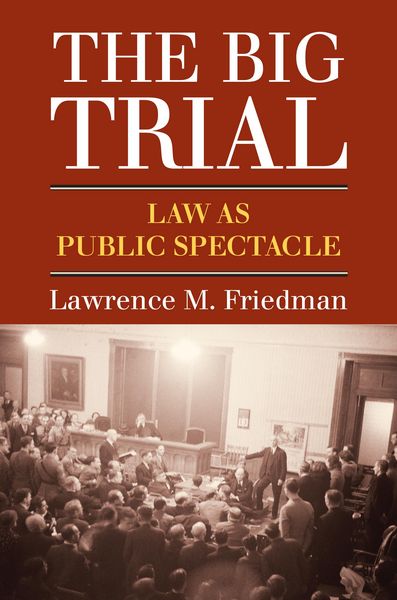
The Big Trial Law as Public Spectacle
-
- Einzelkauf Download ausgewählt
-
Sprache:Englisch
32,49 €
inkl. gesetzl. MwSt.Beschreibung
Produktdetails
Format
ePUB
Kopierschutz
Nein
Family Sharing
Nein
Text-to-Speech
Ja
Erscheinungsdatum
04.05.2015
Verlag
University Press of KansasSeitenzahl
224 (Printausgabe)
Dateigröße
1347 KB
Sprache
Englisch
EAN
9780700620784
Winner: Scribes Book Award
The trial of O. J. Simpson was a sensation, avidly followed by millions of people, but it was also, in a sense, nothing new. One hundred years earlier the Lizzie Borden trial had held the nation in thrall. The names (and the crimes) may change, but the appeal is enduringand why this is, how it works, and what it means are what Lawrence Friedman investigates in The Big Trial.
What is it about these cases that captures the public imagination? Are the headline trials of our period different from those of a century or two ago? And what do we learn from them, about the nature of our society, past and present? To get a clearer picture, Friedman first identifies what certain headline trials have in common, then considers particular cases within each grouping. The political trial, for instance, embraces treason and spying, dissenters and radicals, and, to varying degrees, corruption and fraud. Celebrity trials involve the famouswhether victims, as in the case of Charles Manson, or defendants as disparate as Fatty Arbuckle and William Kennedy Smithbut certain high-profile cases, such as those Friedman categorizes as tabloid trials, can also create celebrities. The fascination of whodunit trials can be found in the mystery surrounding the case: Are we sure about O. J. Simpson? What about Claus von Bulowtried, in another sensational case, for sending his wife into a coma? An especially interesting type of case Friedman groups under the rubric worm in the bud. These are cases, such as that of Lizzie Borden, that seem to put society itself on trial; they raise fundamental social questions and often suggest hidden and secret pathologies. And finally, a small but important group of cases proceed from moral panic, the Salem witchcraft trials being the classic instance, though Friedman also considers recent examples.
Though they might differ in significant ways, these types of trials also have important similarities. Most notably, they invariably raise questions about identity (Who is this defendant? A villain? An innocent unfairly accused?). And in this respect, The Big Trial shows us, the headline trial reflects a critical aspect of modern society. Reaching across the nineteenth and twentieth centuries to the latest outrage, from congressional hearings to lynching and vigilante justice to public punishment, from Dr. Sam Sheppard (the fugitive) to Jeffrey Dahmer (the cannibal), The Rosenbergs to Timothy McVeigh, the book presents a complex picture of headline trials as displays of powermoments of didactic theater that demonstrate in one way or another whether a society is fair, whom it protects, and whose interest it serves.
Noch keine Bewertungen vorhanden
Verfassen Sie die erste Bewertung zu diesem Artikel
Helfen Sie anderen Kundinnen und Kunden durch Ihre Meinung.
Kurze Frage zu unserer Seite
Vielen Dank für dein Feedback
Wir nutzen dein Feedback, um unsere Produktseiten zu verbessern. Bitte habe Verständnis, dass wir dir keine Rückmeldung geben können. Falls du Kontakt mit uns aufnehmen möchtest, kannst du dich aber gerne an unseren Kund*innenservice wenden.
zum Kundenservice