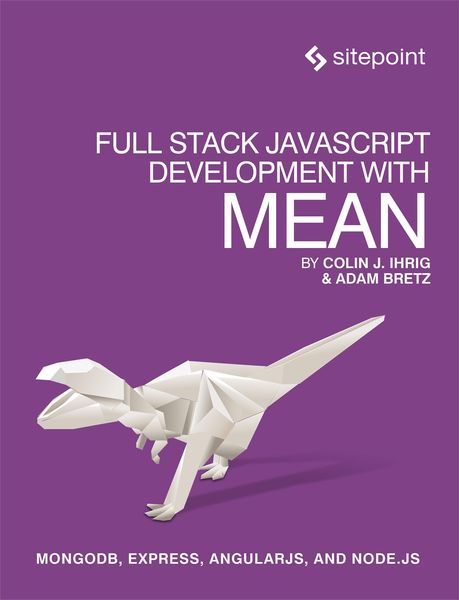
Full Stack JavaScript Development With MEAN MongoDB, Express, AngularJS, and Node.JS
-
- Taschenbuch
- eBook ausgewählt
-
Form:Einzelkauf Download
-
Sprache:Englisch
-
eBook Format:ePUB
- PDF 30,49 €
- ePUB 25,49 € ausgewählt
25,49 €
inkl. gesetzl. MwSt.Beschreibung
Produktdetails
Format
ePUB
Kopierschutz
Ja
Family Sharing
Ja
Text-to-Speech
Ja
Erscheinungsdatum
24.12.2014
Verlag
SitePointSeitenzahl
300 (Printausgabe)
Dateigröße
1458 KB
Sprache
Englisch
EAN
9781457192340
With modern tools. it is possible to create a production grade, full-stack application using HTML, CSS, and JavaScript alone. The combination of MongoDB, Express, AngularJS, and Node.js has become so popular that it has earned the title MEAN stack -- the subject of this book.
This book explores the MEAN stack in detail. We will begin by covering Node.js, as it will lay the groundwork for all of our server-side work. You will learn how to get Node running on your local machine as well as download modules using npm. The key aspects of the Node.js programming model will also be covered.
From there, we will move on to MongoDB, where you'll learn how to interact with Mongo from a Node application. You will also learn how to create, retrieve, update, and delete data from a Mongo store.
After you have a solid grasp on Node and Mongo, the book will move on to the Express web server. We'll cover the basics of Express applications via topics like routes and middleware. Building on previous chapters, we will cover the integration of Node, Mongo, and Express.
Our coverage of the MEAN stack will wrap up with several chapters on AngularJS. These chapters will cover Angular fundamentals like data binding, directives, controllers, routing, and services. In an effort to explore competing technologies, a slight introduction to Ember.js will also be provided.
Full stack JavaScript is not fully encompassed by the MEAN stack. There is an entire ecosystem of JavaScript tools to learn about, and this book will introduce a few of them. We will cover task runners Gulp.js and Grunt.js which are extremely useful for automating mundane, repetitive tasks. We'll also cover JSHint, a linting tool used to improve code quality. Linting tools analyze source code and report potentials issues - a feature that is especially useful in non-compiled languages like JavaScript.
Noch keine Bewertungen vorhanden
Verfassen Sie die erste Bewertung zu diesem Artikel
Helfen Sie anderen Kundinnen und Kunden durch Ihre Meinung.
Kurze Frage zu unserer Seite
Vielen Dank für dein Feedback
Wir nutzen dein Feedback, um unsere Produktseiten zu verbessern. Bitte habe Verständnis, dass wir dir keine Rückmeldung geben können. Falls du Kontakt mit uns aufnehmen möchtest, kannst du dich aber gerne an unseren Kund*innenservice wenden.
zum Kundenservice