Gutscheinbedingungen

**Gültig bis 10.06.2026 / Gültig für gebrauchte Bücher / Mindestbestellwert 20,00 € / Einzelne Artikel können ausgeschlossen sein / Online auf www.bücher.de.de / Nicht kombinierbar mit anderen Gutscheinen oder Preisaktionen / Nur einmal pro Einkauf einlösbar / Gutschein wird auf max. 500€ Bestellwert angerechnet / Keine Barauszahlung / Nicht gültig für Versandkosten und Services

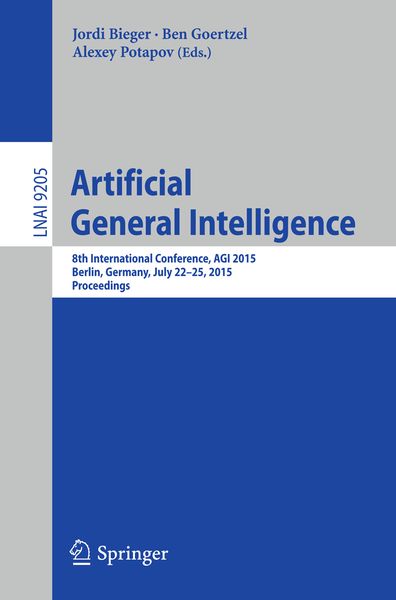
  • Produktbild: Artificial General Intelligence
  • Produktbild: Artificial General Intelligence
Band 9205

Artificial General Intelligence 8th International Conference, AGI 2015, AGI 2015, Berlin, Germany, July 22-25, 2015, Proceedings

49,99 €

inkl. gesetzl. MwSt., Versandkostenfrei

Lieferung nach Hause

Beschreibung

Produktdetails

Einband

Taschenbuch

Erscheinungsdatum

09.07.2015

Abbildungen

XII, 92 illus., schwarz-weiss Illustrationen

Herausgeber

Jordi Bieger + weitere

Verlag

Springer

Seitenzahl

416

Maße (L/B/H)

23,5/15,5/2,4 cm

Gewicht

645 g

Auflage

2015

Sprache

Englisch

ISBN

978-3-319-21364-4

Beschreibung

Produktdetails

Einband

Taschenbuch

Erscheinungsdatum

09.07.2015

Abbildungen

XII, 92 illus., schwarz-weiss Illustrationen

Herausgeber

Verlag

Springer

Seitenzahl

416

Maße (L/B/H)

23,5/15,5/2,4 cm

Gewicht

645 g

Auflage

2015

Sprache

Englisch

ISBN

978-3-319-21364-4

Herstelleradresse

Springer-Verlag KG
Sachsenplatz 4-6
1201 Wien
AT

Email: ProductSafety@springernature.com

Kundinnen und Kunden meinen

0 Bewertungen

Informationen zu Bewertungen

Zur Abgabe einer Bewertung ist eine Anmeldung im Konto notwendig. Die Authentizität der Bewertungen wird von uns nicht überprüft. Wir behalten uns vor, Bewertungstexte, die unseren Richtlinien widersprechen, entsprechend zu kürzen oder zu löschen.

Die Bewertungen sind nach Format, Anzahl Sterne und Datum sortiert.

Verfassen Sie die erste Bewertung zu diesem Artikel

Helfen Sie anderen Kund*innen durch Ihre Meinung

Kundinnen und Kunden meinen

0 Bewertungen filtern

  • Produktbild: Artificial General Intelligence
  • Produktbild: Artificial General Intelligence
  • Modeling Motivation in MicroPsi 2.- Genetic Programming on Program Traces as an Inference Engine for Probabilistic Languages.- Scene Based Reasoning.- Anchoring Knowledge in Interaction: Towards a harmonic subsymbolic/symbolic framework and architecture of computational cognition.- Safe Baby AGI.- Observation, Communication and Intelligence in Agent-Based Systems.- Reffective Variants of Solomono Induction and AIXI.- Are there Deep Reasons Underlying the Pathologies of Today's Deep Learning Algorithms?.- Speculative Scientific Inference via Synergetic Combination of Probabilistic Logic and Evolutionary Pattern Recognition.- Stochastic Tasks: Difficulty and Levin Search.- Instrumental Properties of Social Testbeds.- Towards Human-Level Inductive Functional Programming.- Anytime Bounded Rationality.- Ultimate Intelligence Part I: Physical Completeness and Objectivity of Induction.- Towards Emotion in Sigma: From Appraisal to Attention.- Inferring human values for safe AGI design.- Two Attempts to Formalize Counter possible Reasoning in Deterministic Settings.- Bounded Cognitive Resources and Arbitrary Domains.- Using Localization and Factorization to Reduce the Complexity of Reinforcement Learning.- Towards Flexible Task Environments for Comprehensive Evaluation of Artificial Intelligent Systems & Automatic Learners.- Assumptions of Decision-Making Models in AGI.- Issues in Temporal and Causal Inference.- The Space of Possible Mind Designs.-A Definition of Happiness for Reinforcement Learning Agents.- Expression Graphs: Unifying Factor Graphs and Sum-Product Neworks.- Toward tractable universal induction through recursive program learning.- How can Cognitive Modeling Benefit from Ontologies? Evidence from the HCI Domain.- C-tests revisited: back and forth with complexity.- A New View on Grid Cells Beyond the Cognitive Map Hypothesis.- Programming languages and artificial general intelligence.- From Specialized Syntax to General Logic: The Case of Comparatives.- Decision-Making During Language Understanding by Intelligent Agents.- Plan Recovery in Reactive HTNs Using Symbolic Planning.- Optimization Framework with Minimum Description Length Principle for Probabilistic Programming.- Can Machines Learn Logics?.- Comparing Computer Models Solving Number Series Problems.- Emotional Concept Development.- The Cyber-Physical System Approach towards Artificial General Intelligence: The Problem of Verification.- Analysis of Types of Self-Improving Software.- On the Limits of Recursively Self-Improving AGI.- Godel Agents in a Scalable Synchronous Agent Framework.