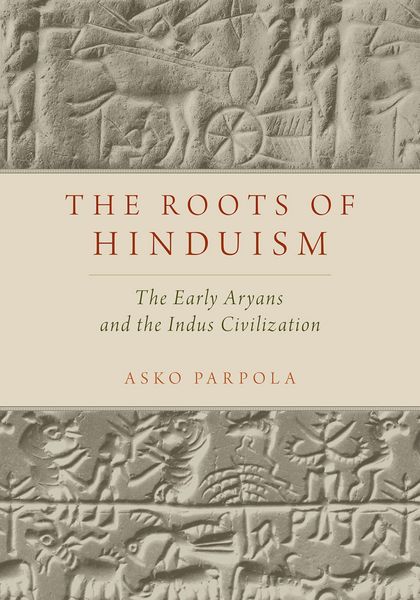
The Roots of Hinduism The Early Aryans and the Indus Civilization
-
- Englisch ausgewählt
95,99 €
inkl. gesetzl. MwSt.,
Beschreibung
Produktdetails
Einband
Taschenbuch
Erscheinungsdatum
12.08.2015
Abbildungen
190 illus.
Verlag
KNV BesorgungSeitenzahl
384
Maße (L/B/H)
25,4/17,7/2,2 cm
Gewicht
717 g
Sprache
Englisch
ISBN
978-0-19-022692-3
Hinduism has two major roots. The more familiar is the religion brought to South Asia in the second millennium BCE by speakers of Aryan or Indo-Iranian languages, a branch of the Indo-European language family. Another, more enigmatic, root is the Indus civilization of the third millennium BCE, which left behind thousands of short inscriptions in a forgotten pictographic script. Discovered in the valley of the Indus River in the early 1920s, the Indus civilization had a population estimated at one million people, in more than 1000 settlements, several of which were cities of some 50,000 inhabitants. With an area of nearly a million square kilometers, the Indus civilization was more extensive than the other key urban cultures of the time, in Mesopotamia and Egypt. Yet, after almost a century of excavation and research the Indus civilization remains little understood. What language did the Indus people speak? How might we decipher the exquisitely carved Indus inscriptions? What deities did they worship? Are the roots of contemporary Hinduism to be found in the religion of the Indus civilization as well as in the Vedic religion? Since the rise of Hindu nationalist politics in the 1980s, these questions have been debated with increasing animosity, colored by the history of modern colonialism in India. This is especially true of the enigmatic Indus script, which is at the hub of the debates, and a particular focus of this book. Asko Parpola has spent fifty years researching the roots of Hinduism to answer these fundamental questions. In this pioneering book, he traces the Indo-Iranian speakers from the Aryan homeland north of the Black Sea through the Eurasian steppes to Central, West, and South Asia. Among many other things, he discusses the profound impact of the invention of the horse-drawn chariot on Indo-Aryan religion, and presents new ideas on the origin and formation of the Vedic literature and rites, and the great Hindu epics.
Noch keine Bewertungen vorhanden
Verfassen Sie die erste Bewertung zu diesem Artikel
Helfen Sie anderen Kundinnen und Kunden durch Ihre Meinung.
Kurze Frage zu unserer Seite
Vielen Dank für dein Feedback
Wir nutzen dein Feedback, um unsere Produktseiten zu verbessern. Bitte habe Verständnis, dass wir dir keine Rückmeldung geben können. Falls du Kontakt mit uns aufnehmen möchtest, kannst du dich aber gerne an unseren Kund*innenservice wenden.
zum Kundenservice