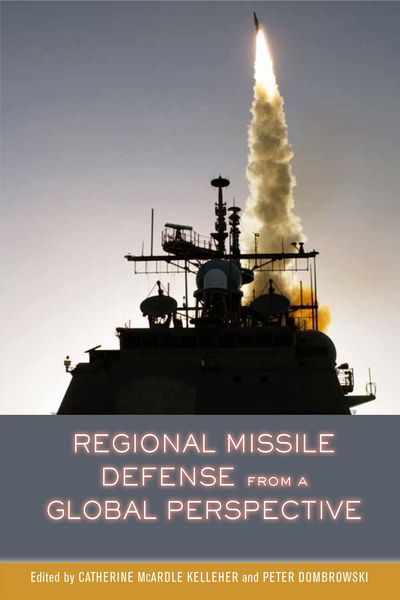
Produktbild: Regional Missile Defense from a Global Perspective

Regional Missile Defense from a Global Perspective

131,99 €

inkl. gesetzl. MwSt., Versandkostenfrei


Beschreibung

Produktdetails

Einband

Gebundene Ausgabe

Erscheinungsdatum

23.09.2015

Herausgeber

Catherine McArdle Kelleher + weitere

Verlag

Stanford University Press

Seitenzahl

328

Maße (L/B/H)

23,3/15,9/2,5 cm

Gewicht

574 g

Sprache

Englisch

ISBN

978-0-8047-9064-2

Beschreibung

Rezension

"Kelleher and Dombrowski have produced a serious and significant accounting of the debate, drawing on top-flight experts from around the world and across the political spectrum. They effectively highlight the unique role of regional missile defense in tackling missile proliferation."-Rose Gottemoeller, Undersecretary of State for Arms Control and International Security "Regional missile defense is a critical element of strategic stability in an increasingly fragmented global order. During this time of heightened risk of conflict, the United States must continue to pursue regional missile defense for its own security. This book is a must-read for policy makers wishing to understand the role of missile defense in a new strategic age."-Stephen J. Hadley, National Security Advisor to President George W. Bush, 2005-2009 "Regional Missile Defense from a Global Perspective is a must-read for legislators, foreign policy experts, and academics interested in missile defense public policy. Top experts provide analysis of the different levels of international ally and adversary military investment and integration, address the challenges posed by missile defense technical sophistication, and explain the geopolitical dynamics of nuclear and non-nuclear powers using missile defense to blur the lines between defensive and offensive systems."-Hon. Ellen Tauscher, Chairman, Strategic Forces Subcommittee of HASC, and former Under Secretary of State for Arms Control and International Security "Regional ballistic missile defenses have spread to Europe, the Middle East, and Asia in response to the proliferation of theater-range ballistic missiles. This timely and thoughtful volume probes the political, strategic, and financial dimensions of regional missile defense and highlights the unique circumstances and implications of their deployment in different regions of the globe. It should be of great interest to academics and policy makers interested in regional strategic dynamics."-Dean Wilkening, Lawrence Livermore National Laboratory, Livermore, CA "The book provides an excellent review of missile defense that should be required reading for policymakers grappling with nuclear deterrence, proliferation, and missile defense. A policymaker should take the analysis in the book to shape policy countering regional threats, while also keeping capabilities below a threshold that does not drastically reduce nuclear deterrence."-Jeremiah Burgess, H-War

Produktdetails

Einband

Gebundene Ausgabe

Erscheinungsdatum

23.09.2015

Herausgeber

Verlag

Stanford University Press

Seitenzahl

328

Maße (L/B/H)

23,3/15,9/2,5 cm

Gewicht

574 g

Sprache

Englisch

ISBN

978-0-8047-9064-2

Herstelleradresse

Libri GmbH
Europaallee 1
36244 Bad Hersfeld
DE

Email: gpsr@libri.de

Noch keine Bewertungen vorhanden

Verfassen Sie die erste Bewertung zu diesem Artikel

Helfen Sie anderen Kundinnen und Kunden durch Ihre Meinung.

Kundinnen und Kunden meinen

Bewertungen (0)

Die Leseprobe wird geladen.
  • Produktbild: Regional Missile Defense from a Global Perspective
  • Contents and AbstractsIntroduction chapter abstract

    Missile defense, and particularly regional missile defense, has returned to the spotlight after nearly a decade of relative obscurity. It has returned to the global policy agenda both because President Obama made regional missile defense a centerpiece of his national security strategy and because Russia's aggressive foreign policy toward Ukraine and elsewhere has soured its relations with Europe and the United States. The new hallmark of Obama's regional missile defense system, the European Phased Adaptive Approach (EPAA) scheduled to be operational in 2020, has become a pawn in the larger game of resetting the West's relations with Russia. Current uncertainties about missile defense in the European context have global implications, however, because regional missile defense has been a centerpiece of U.S. strategic diplomacy since the middle of the George W. Bush administration.

    1Addressing the Missile Threat: 1980-2008 chapter abstract

    This chapter discusses U.S. ballistic missile defense policies and programs through four administrations, from President Reagan through the second President Bush. That history has been one of major change-in basic strategy, military aims, threat definition, technological focus, funding, and U.S. and international political salience. National missile defense (NMD) efforts, aimed at countering strategic ballistic missiles, were particularly subject to dramatic fluctuations over the period. Programs grew or contracted, and were emphasized or terminated, depending on several different factors. Changes in the political environment surrounding NMD were undoubtedly due in large part to the scaled-down ambitions of U.S. NMD efforts.

    2U.S. National Missile Defense Policy chapter abstract

    Since the collapse of the Soviet Union, every U.S. administration has articulated similar missile defense objectives: (1) The United States will defend its homeland from limited ballistic missile attacks, and (2) it will defend U.S. deployed forces from regional missile threats while also protecting our allies and partners. This continuity may seem unremarkable. But it stands in stark contrast to the Cold War, which saw the United States adopt almost every conceivable policy on ballistic missile defense (BMD), ranging from no policy to outright opposition to complete support to the qualified endorsement of limited defenses. It represents an equilibrium between three forces: external threats, domestic politics, and technological and financial realities. The first two forces have tended to put "upward pressure" on BMD programs. The scale of U.S. ambitions has, however, been kept in check by the cost and technical complexity of developing and deploying defenses.

    3Theater Ballistic Missile Defense Concepts chapter abstract

    The Obama administration has adopted the Phased Adaptive Approach (PAA) to guide its deployment of defenses against theater-range ballistic missiles. Under this approach, the United States will deploy missile defense architectures tailored to the needs of specific regions and support the integration of U.S assets with allied resources. It will deploy these capabilities over time, t