KI-Beratung Beta

Gutscheinbedingungen

**Gültig vom 23.11. bis 30.11.2026 | Gültig für nicht preisgebundene fremdsprachige Bücher | Einzelne Artikel können ausgeschlossen sein | Online auf www.bücher.de einlösbar | Click & Collect nur mit Online-Zahlung (Paypal/Kreditkarte) vorab | Nicht kombinierbar mit anderen Gutscheinen oder Preisaktionen | Nur einmal pro Einkauf einlösbar | Gutschein wird auf max. 500€ Bestellwert angerechnet | Keine Barauszahlung | Nicht gültig für Versandkosten und Services

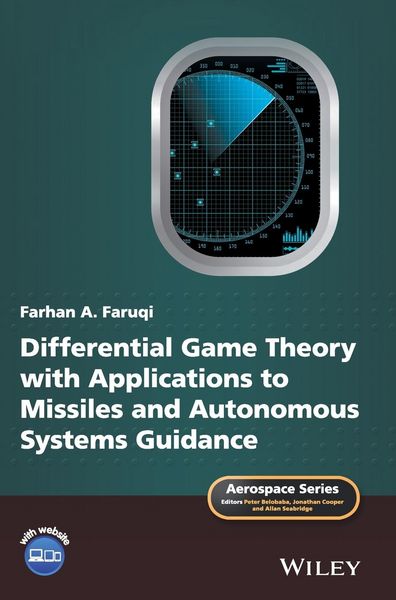
  • Produktbild: Differential Game Theory with Applications to Missiles and Autonomous Systems Guidance
  • Produktbild: Differential Game Theory with Applications to Missiles and Autonomous Systems Guidance

Differential Game Theory with Applications to Missiles and Autonomous Systems Guidance

Aus der Reihe Aerospace Series (PEP)

179,99 €

inkl. gesetzl. MwSt., Versandkostenfrei


Beschreibung

Differential Game Theory with Applications to Missiles and Autonomous Systems explains the use of differential game theory in autonomous guidance and control systems.   The book begins with an introduction to the basic principles before considering optimum control and game theory. Two-party and multi-party...

Beschreibung

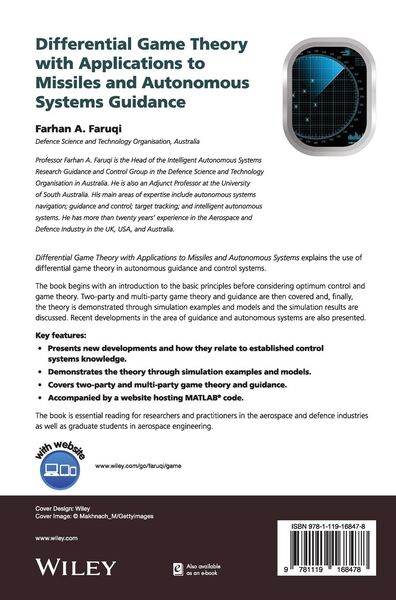
Differential Game Theory with Applications to Missiles and Autonomous Systems explains the use of differential game theory in autonomous guidance and control systems.
 
The book begins with an introduction to the basic principles before considering optimum control and game theory. Two-party and multi-party game theory and guidance are then covered and, finally, the theory is demonstrated through simulation examples and models and the simulation results are discussed. Recent developments in the area of guidance and autonomous systems are also presented.
 
Key features:
* Presents new developments and how they relate to established control systems knowledge.
* Demonstrates the theory through simulation examples and models.
* Covers two-party and multi-party game theory and guidance.
* Accompanied by a website hosting MATLAB(r) code.
 
The book is essential reading for researchers and practitioners in the aerospace and defence industries as well as graduate students in aerospace engineering.

Produktdetails

Einband

Gebundene Ausgabe

Erscheinungsdatum

30.05.2017

Verlag John Wiley & Sons Inc
Seitenzahl

224

Produktdetails

Einband

Gebundene Ausgabe

Erscheinungsdatum

30.05.2017

Verlag John Wiley & Sons Inc
Seitenzahl

224

Maße (L/B/H)

25/17,5/1,6 cm

Gewicht

552 g

Auflage

1. Auflage

Sprache

Englisch

ISBN

978-1-119-16847-8

Herstelleradresse

Libri GmbH
Europaallee 1
36244 Bad Hersfeld
DE

Email: gpsr@libri.de

Noch keine Bewertungen vorhanden

Verfassen Sie die erste Bewertung zu diesem Artikel

Helfen Sie anderen Kundinnen und Kunden durch Ihre Meinung.

Kundinnen und Kunden meinen

Bewertungen (0)

Die Leseprobe wird geladen.
  • Produktbild: Differential Game Theory with Applications to Missiles and Autonomous Systems Guidance
  • Produktbild: Differential Game Theory with Applications to Missiles and Autonomous Systems Guidance
  • Preface xi
     
    Acknowledgments xiii
     
    About the Companion Website xv
     
    1. Differential Game Theory and Applications to Missile Guidance 1
     
    Nomenclature 1
     
    Abbreviations 2
     
    1.1 Introduction 2
     
    1.2 Game Theoretic Concepts and Definitions 3
     
    1.3 Game Theory Problem Examples 4
     
    1.4 Game Theory Concepts Generalized 8
     
    1.5 Differential Game Theory Application to Missile Guidance 10
     
    1.6 Two-Party and Three-Party Pursuit-Evasion Game 11
     
    1.7 Book Chapter Summaries 11
     
    References 14
     
    2. Optimum Control and Differential Game Theory 16
     
    Nomenclature 16
     
    Abbreviations 17
     
    2.1 Introduction 17
     
    2.2 Calculus of Optima (Minimum or Maximum) for a Function 18
     
    2.3 Dynamic Optimum Control Problem 23
     
    2.4 Optimal Control for a Linear Dynamical System 38
     
    2.5 Optimal Control Applications in Differential Game Theory 40
     
    2.6 Extension of the Differential Game Theory to Multi-Party Engagement 50
     
    2.7 Summary and Conclusions 50
     
    References 51
     
    Appendix 53
     
    3. Differential Game Theory Applied to Two-Party Missile Guidance Problem 63
     
    Nomenclature 63
     
    Abbreviations 64
     
    3.1 Introduction 64
     
    3.2 Development of the Engagement Kinematics Model 67
     
    3.3 Optimum Interceptor/Target Guidance for a Two-Party Game 70
     
    3.4 Solution of the Riccati Differential Equations 75
     
    3.5 Extension of the Game Theory to Optimum Guidance 79
     
    3.6 Relationship with the Proportional Navigation (PN) and the Augmented PN Guidance 81
     
    3.7 Conclusions 82
     
    References 82
     
    Appendix 84
     
    4. Three-Party Differential Game Theory Applied to Missile Guidance Problem 102
     
    Nomenclature 102
     
    Abbreviations 103
     
    4.1 Introduction 103
     
    4.2 Engagement Kinematics Model 104
     
    4.3 Three-Party Differential Game Problem and Solution 107
     
    4.4 Solution of the Riccati Differential Equations 111
     
    4.5 Discussion and Conclusions 116
     
    References 117
     
    Appendix 118
     
    5. Four Degrees-of-Freedom (DOF) Simulation Model for Missile Guidance and Control Systems 125
     
    Nomenclature 125
     
    Abbreviations 126
     
    5.1 Introduction 126
     
    5.2 Development of the Engagement Kinematics Model 126
     
    5.3 Vehicle Navigation Model 130
     
    5.4 Vehicle Body Angles and Flight Path Angles 133
     
    5.5 Vehicle Autopilot Dynamics 135
     
    5.6 Aerodynamic Considerations 135
     
    5.7 Conventional Guidance Laws 136
     
    5.8 Overall State Space Model 138
     
    5.9 Conclusions 138
     
    References 139
     
    Appendix 140
     
    6. Three-Party Differential Game Missile Guidance Simulation Study 150
     
    Nomenclature 150
     
    Abbreviations 150
     
    6.1 Introduction 151
     
    6.2 Engagement Kinematics Model 151
     
    6.3 Game Theory Problem and the Solution 154
     
    6.4 Discussion of the Simulation Results 157
     
    6.5 Conclusions 162
     
    References 163
     
    Appendix 164
     
    Addendum 165
     
    Index 189