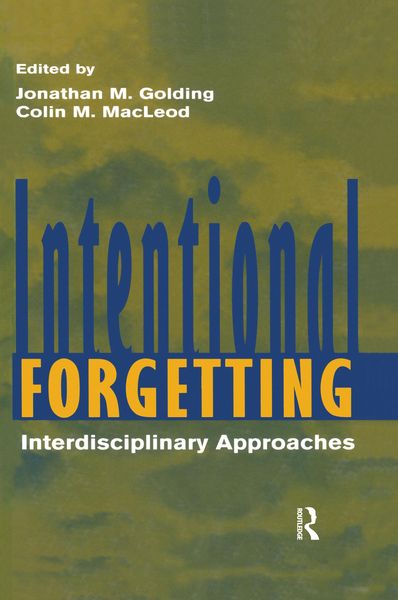
Intentional Forgetting Interdisciplinary Approaches
-
Form:Einzelkauf Download
-
Sprache:Englisch
-
eBook Format:ePUB 3
- ePUB 3 78,99 € ausgewählt
- PDF 78,99 €
78,99 €
inkl. gesetzl. MwSt.Beschreibung
Produktdetails
Format
ePUB 3
Kopierschutz
Ja
Family Sharing
Nein
Text-to-Speech
Ja
Erscheinungsdatum
17.06.2013
Herausgeber
Jonathan M. Golding + weitereVerlag
Taylor & Francis eBooksSeitenzahl
512 (Printausgabe)
Dateigröße
23270 KB
Sprache
Englisch
EAN
9781134800735
Research on intentional forgetting has been conducted in various forms and under various names for at least 30 years, but until now no effort has been made to present these different perspectives in one place. Comprising both review chapters and new empirical studies, this book brings together the many research paradigms investigating intentional forgetting, thereby highlighting the commonalities that link these seemingly disparate areas of research. It serves as a "case study" of one phenomenon in memory--the intention to forget or to modify memory.
Why is research on intentional forgetting important? It helps to increase the understanding of how memory functions, especially with regard to its updating. In William James' "booming, buzzing confusion," we frequently are unable to adequately process all of the information that we experience; on-line forgetting of some information is necessary. Moreover, we must often replace existing information with new information, as when someone we know relocates and acquires a new address and telephone number. Investigating this updating ability has been the main thrust of research on intentional forgetting, specifically those studies on the directed forgetting phenomenon. Cognitive experiments on directed forgetting have shown that we are able to deal more effectively with large amounts of information by following instructions to treat some of the information as "to be forgotten." In this way, interference is reduced and we are able to devote all of our resources to the remaining to-be-remembered information. The mechanisms that lead to this reduction continue to promote new experiments, but over a quarter century of research maintains that the directed forgetting effect is robust.
Kundinnen und Kunden meinen
Verfassen Sie die erste Bewertung zu diesem Artikel
Helfen Sie anderen Kund*innen durch Ihre Meinung
Kurze Frage zu unserer Seite
Vielen Dank für dein Feedback
Wir nutzen dein Feedback, um unsere Produktseiten zu verbessern. Bitte habe Verständnis, dass wir dir keine Rückmeldung geben können. Falls du Kontakt mit uns aufnehmen möchtest, kannst du dich aber gerne an unseren Kund*innenservice wenden.
zum Kundenservice