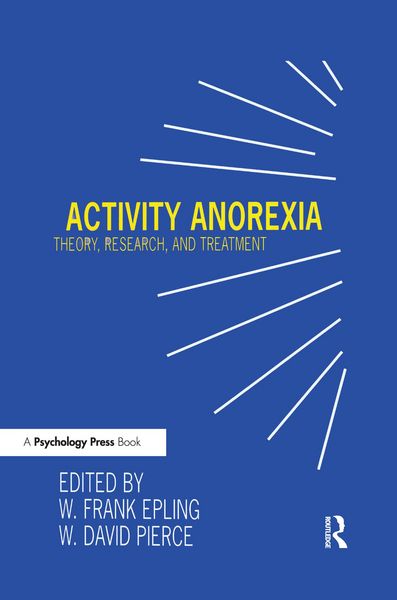
Activity Anorexia Theory, Research, and Treatment
-
- Hardcover
- Taschenbuch
- eBook ausgewählt
-
Form:Einzelkauf Download
-
Sprache:Englisch
-
eBook Format:ePUB
- PDF 72,99 €
- ePUB 72,99 € ausgewählt
72,99 €
inkl. gesetzl. MwSt.Beschreibung
Produktdetails
Format
ePUB
Kopierschutz
Ja
Family Sharing
Nein
Text-to-Speech
Ja
Erscheinungsdatum
17.06.2013
Herausgeber
W. Frank Epling + weitereVerlag
Taylor & Francis eBooksSeitenzahl
252 (Printausgabe)
Dateigröße
5528 KB
Sprache
Englisch
EAN
9781134794577
This volume provides researchers and clinicians with an insight into recent developments in activity anorexia. Much of the basic information on the topic has come from animal literature; the theory of activity anorexia is built on an animal model of self-starvation (rats placed on a single daily feeding run more and more, over days stop eating, and die of starvation). Additionally, experiments that for ethical or practical reasons could not be done with humans may be conducted with other animals. The animal research is extending the understanding of biologically-based reward mechanisms that regulate eating and exercise, environment-behavior interactions that affect anorexia, and the biochemical changes that accompany physical activity and starvation.
Increasingly, however, the impact of physical activity on human anorexia is being directly investigated--eight out of fourteen research chapters in this volume are based on human research. Some researchers are interested in the impact of hyperactivity and caloric restriction on human reproductive function. Other authors are investigating physically active subgroups of people considered to be at risk for anorexia. Finally, several clinician/researchers suggest how physical activity and extreme dieting interact for anorexia nervosa patients.
Chapter authors were asked to present their views independent of the editors' argument that, when it is present, physical activity is central to anorexia. Many of the contributors disagree with the editors about the details of activity anorexia. A few suggest that excessive physical activity is either incidental to, or an epiphenomenon of, anorexia. Most authors are, however, in accord with the view that physical activity reduces food consumption which further drives up activity that results in even less caloric intake. No matter what their perspective, all contributors agree that hyperactivity frequently accompanies self-starvation in humans and other animals. The end result is a lively book that provides a source of ideas for both researchers and practitioners.
Noch keine Bewertungen vorhanden
Verfassen Sie die erste Bewertung zu diesem Artikel
Helfen Sie anderen Kundinnen und Kunden durch Ihre Meinung.
Kurze Frage zu unserer Seite
Vielen Dank für dein Feedback
Wir nutzen dein Feedback, um unsere Produktseiten zu verbessern. Bitte habe Verständnis, dass wir dir keine Rückmeldung geben können. Falls du Kontakt mit uns aufnehmen möchtest, kannst du dich aber gerne an unseren Kund*innenservice wenden.
zum Kundenservice