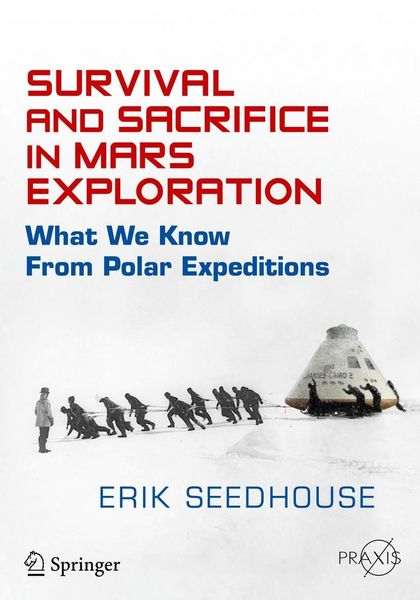
Survival and Sacrifice in Mars Exploration What We Know from Polar Expeditions
-
- Taschenbuch
- eBook ausgewählt
-
Form:Einzelkauf Download
-
Sprache:Englisch
35,30 €
inkl. gesetzl. MwSt.Beschreibung
Produktdetails
Format
Kopierschutz
Nein
Family Sharing
Nein
Text-to-Speech
Nein
Erscheinungsdatum
26.03.2015
Verlag
Springer Nature SwitzerlandSeitenzahl
163 (Printausgabe)
Dateigröße
15912 KB
Sprache
Englisch
EAN
9783319124483
With current technology, a voyage to Mars and back will take three
years. That's a lot of time for things to go wrong. But sooner or later
a commercial enterprise will commit itself to sending humans to Mars.
How will the astronauts survive? Some things to consider are:
ith current technology, a voyage to Mars and back will take threeyears. That's a lot of time for things to go wrong. But sooner or later
a commercial enterprise will commit itself to sending humans to Mars.
How will the astronauts survive? Some things to consider are:
. Who decides what medical resources are used for whom?
Who decides what medical resources are used for whom?. What is the relative weight of mission success and the health of the
crew?
What is the relative weight of mission success and the health of thecrew?
. Do we allow crewmembers to sacrifi ce their lives for the good of themission?
Do we allow crewmembers to sacrifi ce their lives for the good of themission?
. And what if a crewmember does perish? Do we store the body for
return to Earth or give the member a burial in space?
Questions like these, and hundreds of others, have been explored by
science fi ction, but scant attention has been paid by those designing
missions. Fortunately, the experience gained in polar exploration more
than 100 years ago provides crews and mission planners with a framework
to deal with contingencies and it is this that forms the core of this book.
Why the parallels between polar and space exploration? Because polar
exploration offers a better analogy for a Mars mission today than those
invoked by the space community. Although astronauts are routinely
compared to Lewis and Clark, Mars-bound astronauts will be closer in their
roles to polar explorers. And, as much as space has been described as a
New Frontier, Mars bears greater similarity to the polar regions, which is
why so much can be learned from those who ventured there.
And what if a crewmember does perish? Do we store the body forreturn to Earth or givethe member a burial in space?Questions like these, and hundreds of others, have been explored by
science fi ction, but scant attention has been paid by those designing
missions. Fortunately, the experience gained in polar exploration more
than 100 years ago provides crews and mission planners with a framework
to deal with contingencies and it is this that forms the core of this book.
Why the parallels between polar and space exploration? Because polar
exploration offers a better analogy for a Mars mission today than those
invoked by the space community. Although astronauts are routinely
compared to Lewis and Clark, Mars-bound astronauts will be closer in their
roles to polar explorers. And, as much as space has been described as a
New Frontier, Mars bears greater similarity to the polar regions, which is
why so much can be learned from those who ventured there.
Noch keine Bewertungen vorhanden
Verfassen Sie die erste Bewertung zu diesem Artikel
Helfen Sie anderen Kundinnen und Kunden durch Ihre Meinung.
Kurze Frage zu unserer Seite
Vielen Dank für dein Feedback
Wir nutzen dein Feedback, um unsere Produktseiten zu verbessern. Bitte habe Verständnis, dass wir dir keine Rückmeldung geben können. Falls du Kontakt mit uns aufnehmen möchtest, kannst du dich aber gerne an unseren Kund*innenservice wenden.
zum Kundenservice