KI-Beratung Beta

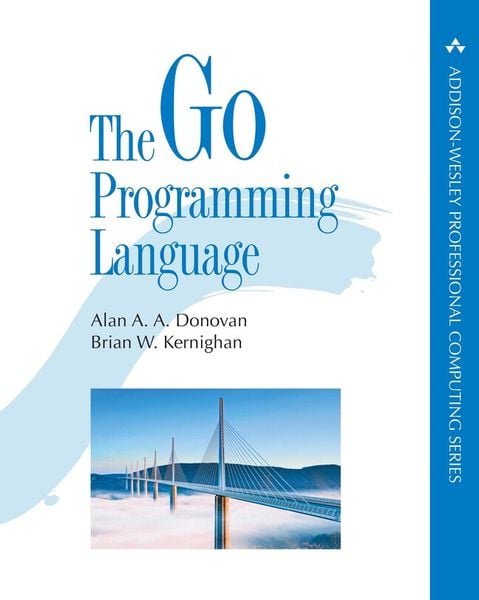
Produktbild: Go Programming Language, The

Go Programming Language, The

1

38,99 €

inkl. gesetzl. MwSt., Versandkostenfrei


Beschreibung

The authoritative resource to writing clear and idiomatic Go to solve real-world problems

Google’s Go team member Alan A. A. Donovan and Brian Kernighan, co-author of The C Programming Language, provide hundreds of interesting and practical examples of well-written Go code to help programmers learn this...

Beschreibung

The authoritative resource to writing clear and idiomatic Go to solve real-world problems

Google’s Go team member Alan A. A. Donovan and Brian Kernighan, co-author of The C Programming Language, provide hundreds of interesting and practical examples of well-written Go code to help programmers learn this flexible, and fast, language. It is designed to get you started programming with Go right away and then to progress on to more advanced topics.

  • Basic components : an opening tutorial provides information and examples to get you off the ground and doing useful things as quickly as possible. This includes:
    • command-line arguments
    • gifs
    • URLs
    • web servers
  • Program structure : simple examples cover the basic structural elements of a Go program without getting sidetracked by complicated algorithms or data structures.
  • Data types: Go offers a variety of ways to organize data, with a spectrum of data types that at one end match the features of the hardware and at the other end provide what programmers need to conveniently represent complicated data structures.
  • Composite types :
    • arrays
    • slices
    • maps
    • structs
    • JSON
    • test and HTML templates
  • Functions : break a big job into smaller pieces that might well be written by different people separated by both time and space.
  • Methods :
    • declarations
    • with a pointer receiver
    • struct embedding
    • values and expressions
  • Interfaces : write functions that are more flexible and adaptable because they are not tied to the details of one particular implementation.
  • Concurrent programming : Goroutines, channels, and with shared variables.
  • Packages : use existing packages and create new ones.
  • Automated testing : write small programs that check the code.
  • Reflection features : update variables and inspect their values at run time.
  • Low-level programming : step outside the usual rules to achieve the highest possible performance, interoperate with libraries written in other languages, or implement a function that cannot be expressed in pure Go.

Each chapter has exercises to test your understanding and explore extensions and alternatives. Source code is freely available for download and may be conveniently fetched, built, and installed using the go get command.

Produktdetails

Einband

Taschenbuch

Erscheinungsdatum

26.10.2015

Verlag Pearson Education Limited
Seitenzahl

400

Produktdetails

Einband

Taschenbuch

Erscheinungsdatum

26.10.2015

Verlag Pearson Education Limited
Seitenzahl

400

Maße (L/B/H)

23,5/19,5/2,2 cm

Gewicht

655 g

Farbe

Hellblau / Weiß

Auflage

1

Sprache

Englisch

ISBN

978-0-13-419044-0

Herstelleradresse

Addison Wesley
St.-Martin-Straße 82
81541 München
DE

Email: salesde@pearson.com

Kundinnen und Kunden meinen

Informationen zu Bewertungen

Zur Abgabe einer Bewertung ist eine Anmeldung im Konto notwendig. Die Authentizität der Bewertungen wird von uns nicht überprüft. Wir behalten uns vor, Bewertungstexte, die unseren Richtlinien widersprechen, entsprechend zu kürzen oder zu löschen.

Die Bewertungen sind nach Format, Anzahl Sterne und Datum sortiert.

  • Bewertung

    1/5

    04.05.2022

    eBook (ePUB)

    Kein EPUB sondern ACSM File

    Liebe Orell Füssli, nun habe ich zum wiederholten Male ein Buch nicht im gängigen EPUB Format, sondern im proprietären ACSM Format bekommen. Diese Format kann ich nicht nutzen und deshalb habe ich wieder Geld (insgesamt CHF 60,-) direkt in den Mülleimer überwiesen. Damit ist für mich der EBook Markt endgültig gestorben. Viele Dank ein erboster (Nicht-)Leser

Kundinnen und Kunden meinen

5

0

4

0

3

0

2

0

1

1

Bewertungen (1)

Die Leseprobe wird geladen.
  • Produktbild: Go Programming Language, The
  • Preface xi

    Chapter 1: Tutorial 1

    1.1 Hello, World 1

    1.2 Command-Line Arguments 4

    1.3 Finding Duplicate Lines 8

    1.4 Animated GIFs 13

    1.5 Fetching a URL 15

    1.6 Fetching URLs Concurrently 17

    1.7 A Web Server 19

    1.8 Loose Ends 23

    Chapter 2: Program Structure 27

    2.1 Names 27

    2.2 Declarations 28

    2.3 Variables 30

    2.4 Assignments 36

    2.5 Type Declarations 39

    2.6 Packages and Files 41

    2.7 Scope 45

    Chapter 3: Basic Data Types 51

    3.1 Integers 51

    3.2 Floating-Point Numbers 56

    3.3 Complex Numbers 61

    3.4 Booleans 63

    3.5 Strings 64

    3.6 Constants 75

    Chapter 4: Composite Types 81

    4.1 Arrays 81

    4.2 Slices 84

    4.3 Maps 93

    4.4 Structs 99

    4.5 JSON 107

    4.6 Text and HTML Templates 113

    Chapter 5: Functions 119

    5.1 Function Declarations 119

    5.2 Recursion 121

    5.3 Multiple Return Values 124

    5.4 Errors 127

    5.5 Function Values 132

    5.6 Anonymous Functions 135

    5.7 Variadic Functions 142

    5.8 Deferred Function Calls 143

    5.9 Panic 148

    5.10 Recover 151

    Chapter 6:. Methods 155

    6.1 Method Declarations 155

    6.2 Methods with a Pointer Receiver 158

    6.3 Composing Types by Struct Embedding 161

    6.4 Method Values and Expressions 164

    6.5 Example: Bit Vector Type 165

    6.6 Encapsulation 168

    Chapter 7: Interfaces 171

    7.1 Interfaces as Contracts 171

    7.2 Interface Types 174

    7.3 Interface Satisfaction 175

    7.4 Parsing Flags with flag.Value 179

    7.5 Interface Values 181

    7.6 Sorting with sort.Interface 186

    7.7 The http.Handler Interface 191

    7.8 The error Interface 196

    7.9 Example: Expression Evaluator 197

    7.10 Type Assertions 205

    7.11 Discriminating Errors with Type Assertions 206

    7.12 Querying Behaviors with Interface Type Assertions 208

    7.13 Type Switches 210

    7.14 Example: Token-Based XML Decoding 213

    7.15 A Few Words of Advice 216

    Chapter 8: Goroutines and Channels 217

    8.1 Goroutines 217

    8.2 Example: Concurrent Clock Server 219

    8.3 Example: Concu rent Echo Server 222

    8.4 Channels 225

    8.5 Looping in Parallel 234

    8.6 Example: Concurrent Web Crawler 239

    8.7 Multiplexing with select 244

    8.8 Example: Concurrent Directory Traversal 247

    8.9 Cancellation 251

    8.10 Example: Chat Server 253

    Chapter 9: Concurrency with Shared Variables 257

    9.1 Race Conditions 257

    9.2 Mutual Exclusion: sync.Mutex 262

    9.3 Read/Write Mutexes: sync.RWMutex 266

    9.4 Memory Synchronization 267

    9.5 Lazy Initialization: sync.Once 268

    9.6 The Race Detector 271

    9.7 Example: Concurrent Non-Blocking Cache 272

    9.8 Goroutines and Threads 280

    Chapter 10: Packages and the Go Tool 283

    10.1 Introduction 283

    10.2 Import Paths 284

    10.3 The Package Declaration 285

    10.4 Import Declarations 285

    10.5 Blank Imports 286

    10.6 Packages and Naming 289

    10.7 The Go Tool 290

    Chapter 11: Testing 301

    11.1 The go test Tool 302

    11.2 Test Functions 302

    11.3 Coverage 318

    11.4 Benchmark Functions 321

    11.5 Profiling 323

    11.6 Example Functions 326

    Chapter 12: Reflection 329

    12.1 Why Reflection? 329

    12.2 reflect.Type and reflect.Value 330

    12.3 Display, a Recursive Value Printer 333

    12.4 Example: Encoding S-Expressions 338

    12.5 Setting Variables with reflect.Value 341

    12.6 Example: Decoding S-Expressions 344

    12.7 Accessing Struct Field Tags 348

    12.8 Displaying the Methods of a Type 351

    12.9 A Word of Caution 352

    Chapter 13: Low-Level Programming 353

    13.1 unsafe.Sizeof, Alignof, and Offsetof 354

    13.2 unsafe.Pointer 356

    13.3 Example: Deep Equivalence 358

    13.4 Calling C Code with cgo 361

    13.5 Another Word of Caution 366

    Index 367