Gutscheinbedingungen

**Gültig vom 20.07.2026 bis 22.07.2026 | Gültig für nicht preisgebundene fremdsprachige Bücher | Einzelne Artikel können ausgeschlossen sein | Nicht kombinierbar mit anderen Gutscheinen oder Preisaktionen | Nur einmal pro Einkauf einlösbar | Gutschein wird auf max. 500€ Bestellwert angerechnet | Keine Barauszahlung | Nicht gültig für Versandkosten und Services

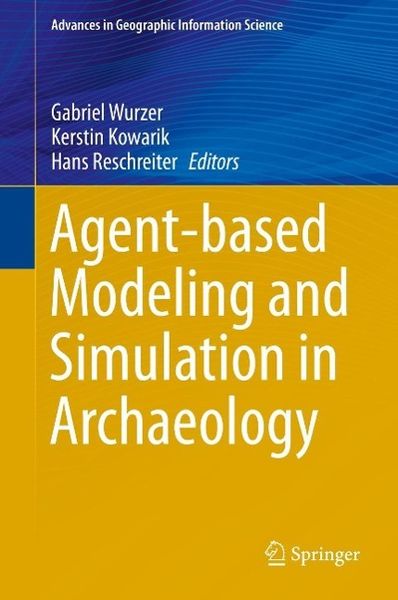
Produktbild: Agent-based Modeling and Simulation in Archaeology

Agent-based Modeling and Simulation in Archaeology

96,29 €

inkl. gesetzl. MwSt.

Beschreibung

Produktdetails

Format

PDF

Kopierschutz

Nein

Family Sharing

Nein

Text-to-Speech

Nein

Erscheinungsdatum

08.11.2014

Herausgeber

Gabriel Wurzer + weitere

Verlag

Springer

Seitenzahl

269 (Printausgabe)

Dateigröße

6743 KB

Sprache

Englisch

EAN

9783319000084

Beschreibung

Rezension

From the book reviews:

“Agent-based Modeling and Simulation in Archaeology provides a much-needed update, in one solid volume, on the methods and practice of using agent-based modeling to understand the past. … The most useful portion of this book to those new to agent-based modeling is probably the Methods section. … this book will be a worthwhile addition to our bookshelves, and I can already imagine incorporating it into courses in agent-based modeling.” (simulatingcomplexity, simulatingcomplexity.wordpress.com, February, 2015)

Portrait

Gabriel Wurzer is a computer scientist working on Agent-Based Simulation at Vienna University of Technology, in which field he is publishing, organizing workshops and holding lectures. Through cooperation with the Natural History Museum Vienna, he developed multiple models on prehistoric salt mining in the prehistoric mines of Hallstatt. Apart from Archaeology, he is also active in the field of Architectural planning, especially Hospital Simulation in the context of early design. Kerstin Kowarik is an archaeologist working at the Natural History Museum Vienna specializing in the European Bronze Age and Early Iron Age. She is currently engaged with several research projects on the prehistoric salt mines of Hallstatt. Her research focuses on provisioning structures, organization of trade and human - environment interaction. She has a special interest in exploring the potential of computer based simulations for archaeological research, economic archaeology and environmental archaeology. Hans Reschreiter is an archaeologist working at the Natural History Museum Vienna specializing in prehistoric crafts and technology as well as prehistoric mining. He is head of the archaeological excavations in the prehistoric salt mines of Hallstatt (Austria). His research focuses on working processes and mining technology. He has a special interest in prehistoric wood working, experimental archaeology and ethnoarchaeology.

Produktdetails

Format

PDF

eBooks im PDF-Format haben eine festgelegte Seitengröße und eignen sich daher nur bedingt zum Lesen auf einem tolino eReader oder Smartphone. Für den vollen Lesegenuss empfehlen wir Ihnen bei PDF-eBooks die Verwendung eines Tablets oder Computers.

Kopierschutz

Nein

Dieses eBook können Sie uneingeschränkt auf allen Geräten der tolino Familie, allen sonstigen eReadern und am PC lesen. Das eBook ist nicht kopiergeschützt und kann ein personalisiertes Wasserzeichen enthalten. Weitere Hinweise zum Lesen von eBooks mit einem personalisierten Wasserzeichen finden Sie unter Hilfe/Downloads.

Family Sharing

Nein

Mit Family Sharing können Sie eBooks innerhalb Ihrer Familie (max. sechs Mitglieder im gleichen Haushalt) teilen. Sie entscheiden selbst, welches Buch Sie mit welchem Familienmitglied teilen möchten. Auch das parallele Lesen durch verschiedene Familienmitglieder ist durch Family Sharing möglich. Um eBooks zu teilen oder geteilt zu bekommen, muss jedes Familienmitglied ein Konto bei Thalia oder einem anderen tolino-Buchhändler haben. Weitere Informationen finden Sie unter Hilfe/Family-Sharing.

Text-to-Speech

Nein

Bedeutet Ihnen Stimme mehr als Text? Mit der Funktion Text-to-Speech können Sie sich im tolino webReader und in der aktuellen Thalia – Lesen & Hören App das eBook vorlesen lassen. Weitere Informationen finden Sie unter Hilfe/Text-to-Speech.

Barrierefreiheit

  • keine Information zur Barrierefreiheit bekannt

Erscheinungsdatum

08.11.2014

Herausgeber

Verlag

Springer

Seitenzahl

269 (Printausgabe)

Dateigröße

6743 KB

Sprache

Englisch

EAN

9783319000084

Noch keine Bewertungen vorhanden

Verfassen Sie die erste Bewertung zu diesem Artikel

Helfen Sie anderen Kundinnen und Kunden durch Ihre Meinung.

Kundinnen und Kunden meinen

Bewertungen (0)

Weitere Artikel findest du in

  • Produktbild: Agent-based Modeling and Simulation in Archaeology
  • Introduction.- Explaining the past with ABM: On modeling philosophy.- Agent-based modeling in archaeology.- Why agent-based modeling?.- Ontological considerations: Emergence and rationality.- Epistemic considerations: how to learn by agent-based Modeling.- Summary.- References.- Modeling Archaeology: Origins of the Artificial Anasazi Project and Beyond.- Introduction.- Structure of the Artificial Anasazi (AA) model.- Selected socio-ecological models similar to Artificial Anasazi.- Current efforts - The ALHV model.- Discussion and conclusions.- References.- Methods.- Agent-Based Simulation in Archaeology: A Characterization.- Motivation and Classification of Computer Models.- Introduction to Agent-Based Modeling.- General Advantages and Disadvantages of Agent-Based Models.- References.- Reproducibility.- Introduction.- Outline.- Lifecycle of a Modeling and Simulation Study.- Parameter and Output Definition.- Documentation.- Verification and Validation.- Verification and Validation specifically targeted at Agent-Based Models.- Conclusion.- References.- Geosimulation: Modeling Spatial Processes.- Introduction.- Society and Space: Dealing with Intangible Assets and Infrastructures.- Scale and Process: Taking Relations and Interdependencies into Consideration.- ABM and GIS: Coupling techniques of different methodological domains.- Conclusion.- References.- Large simulations and small societies: High performance computing for archaeological simulations.- Introduction.- Background.- Developing HPC-based simulations.- Computational solutions of methodological problems.- Concluding remarks.- References.- Applications.- Mining with Agents: Modeling prehistoric mining and prehistoric economy.- Introduction.- The Prehistoric Salt Mine of Hallstatt/Upper Austria.- Agent-Based Simulation of Mining.- Implementation.- Experimentation.- Discussion.- Extensions: Towards Prehistoric Economy.- Conclusions and Future Work.- References.- Modeling settlement rank-size fluctuations.- Introduction.- Background.- Model Design.- Results.- Conclusions.- References.- Understanding the Iron Age Economy: Sustainability of Agricultural Practices under Stable Population Growth.- Introduction.- Methodological approach.- Data resources and modeling inputs.- Models.- Discussion.- Conclusion.- References.- Simulating Patagonian Territoriality in Prehistory: Space, Frontiers and Networks among hunter-gatherers.- Introduction.- From Ethnicity to Territoriality.- Beginning of Times at the End of the World: Patagonia.- An Agent-based Simulation Model for Understanding the Emergence of Patagonian Ethnicity and Territoriality.- Running the Model: Preliminary Results.- Conclusions.- Acknowledgements.- References.- Summary and Outlook.- How did sugarscape become a whole society model?.- Introduction.- The realist-generalist ancestral form.- The realist-particularist approach.- The realist-abstract border.- The abstract-generalist approach.- Conclusion.- References.