KI-Beratung Beta

  • Produktbild: Computational Linguistics and Talking Robots
  • Produktbild: Computational Linguistics and Talking Robots
- 26%

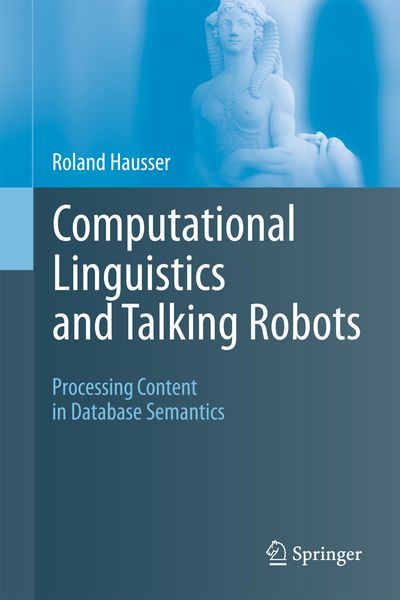
Computational Linguistics and Talking Robots Processing Content in Database Semantics

26% sparen

86,99 € UVP 117,69 €

inkl. gesetzl. MwSt., Versandkostenfrei


Beschreibung

The practical task of building a talking robot requires a theory of how natural language communication works. Conversely, the best way to computationally verify a theory of natural language communication is to demonstrate its functioning concretely in the form of a talking robot, the epitome of human–machine...

Beschreibung

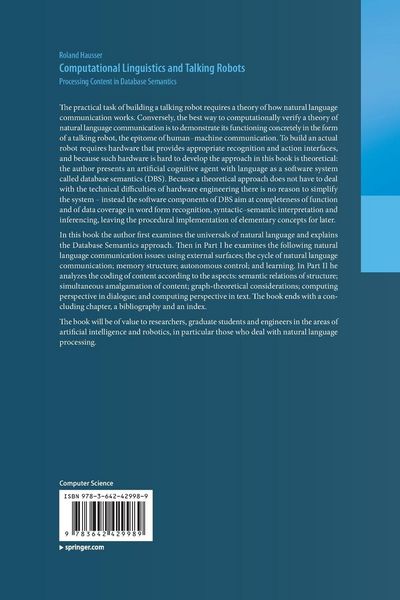
The practical task of building a talking robot requires a theory of how natural language communication works. Conversely, the best way to computationally verify a theory of natural language communication is to demonstrate its functioning concretely in the form of a talking robot, the epitome of human–machine communication. To build an actual robot requires hardware that provides appropriate recognition and action interfaces, and because such hardware is hard to develop the approach in this book is theoretical: the author presents an artificial cognitive agent with language as a software system called database semantics (DBS). Because a theoretical approach does not have to deal with the technical difficulties of hardware engineering there is no reason to simplify the system – instead the software components of DBS aim at completeness of function and of data coverage in word form recognition, syntactic–semantic interpretation and inferencing, leaving the procedural implementation of elementary concepts for later.

In this book the author first examines the universals of natural language and explains the Database Semantics approach. Then in Part I he examines the following natural language communication issues: using external surfaces; the cycle of natural language communication; memory structure; autonomous control; and learning. In Part II he analyzes the coding of content according to the aspects: semantic relations of structure; simultaneous amalgamation of content; graph-theoretical considerations; computing perspective in dialogue; and computing perspective in text. The book ends with a concluding chapter, a bibliography and an index.

The book will be of value to researchers, graduate students and engineers in the areas of artificial intelligence and robotics, in particular those who deal with natural language processing.

Produktdetails

Einband

Taschenbuch

Erscheinungsdatum

11.10.2014

Abbildungen

XII, 286 p.

Verlag Springer Berlin

Produktdetails

Einband

Taschenbuch

Erscheinungsdatum

11.10.2014

Abbildungen

XII, 286 p.

Verlag Springer Berlin
Seitenzahl

286

Maße (L/B/H)

23,5/15,5/1,7 cm

Gewicht

458 g

Auflage

2011

Sprache

Englisch

ISBN

978-3-642-42998-9

Herstelleradresse

Springer-Verlag KG
Sachsenplatz 4-6
1201 Wien
AT

Email: ProductSafety@springernature.com

Noch keine Bewertungen vorhanden

Verfassen Sie die erste Bewertung zu diesem Artikel

Helfen Sie anderen Kundinnen und Kunden durch Ihre Meinung.

Kundinnen und Kunden meinen

Bewertungen (0)

  • Produktbild: Computational Linguistics and Talking Robots
  • Produktbild: Computational Linguistics and Talking Robots

  • Chap. 1.- Introduction: How to Build a Talking Robot.- Part I.- Five Mysteries of Natural Language Communication.- Chap. 2.-  Mystery Number One: Using External Surfaces.-  Chap. 3.- Mystery Number Two: Cycle of Natural Language Communication.- Chap. 4.- Mystery Number Three: Memory Structure.- Chap. 5.- Mystery Number Four: Autonomous Control.- Chap. 6.- Mystery Number Five: Learning.- Part II.- The Coding of Content.- Chap. 7.- Semantic Relations of Structure.- Chap. 8.- Simultaneous Amalgamation of Content.- Chap. 9.- Graph-Theoretical Considerations.- Chap. 10.- Computing Perspective in Dialogue.- Chap. 11.- Computing Perspective in Text.- Chap. 12.- Conclusion.- Bibliography.