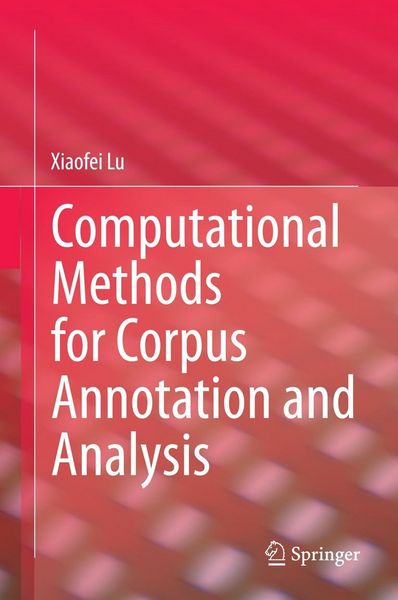
Computational Methods for Corpus Annotation and Analysis
-
- Hardcover
- Taschenbuch
- eBook ausgewählt
-
Form:Einzelkauf Download
-
Sprache:Englisch
106,99 €
inkl. gesetzl. MwSt.Beschreibung
Produktdetails
Format
Kopierschutz
Nein
Family Sharing
Nein
Text-to-Speech
Nein
Erscheinungsdatum
08.07.2014
Verlag
Springer NetherlandsSeitenzahl
186 (Printausgabe)
Dateigröße
3374 KB
Sprache
Englisch
EAN
9789401786454
In the past few decades the use of increasingly large text corpora has grown rapidly in language and linguistics research. This was enabled by remarkable strides in natural language processing (NLP) technology, technology that enables computers to automatically and efficiently process, annotate and analyze large amounts of spoken and written text in linguistically and/or pragmatically meaningful ways. It has become more desirable than ever before for language and linguistics researchers who use corpora in their research to gain an adequate understanding of the relevant NLP technology to take full advantage of its capabilities.
This volume provides language and linguistics researchers with an accessible introduction to the state-of-the-art NLP technology that facilitates automatic annotation and analysis of large text corpora at both shallow and deep linguistic levels. The book covers a wide range of computational tools for lexical, syntactic, semantic, pragmatic and discourse analysis, together with detailed instructions on how to obtain, install and use each tool in different operating systems and platforms. The book illustrates how NLP technology has been applied in recent corpus-based language studies and suggests effective ways to better integrate such technology in future corpus linguistics research.
This book provides language and linguistics researchers with a valuable reference for corpus annotation and analysis.
This volume provides language and linguistics researchers with an accessible introduction to the state-of-the-art NLP technology that facilitates automatic annotation and analysis of large text corpora at both shallow and deep linguistic levels. The book covers a wide range of computational tools for lexical, syntactic, semantic, pragmatic and discourse analysis, together with detailed instructions on how to obtain, install and use each tool in different operating systems and platforms. The book illustrates how NLP technology has been applied in recent corpus-based language studies and suggests effective ways to better integrate such technology in future corpus linguistics research.
This book provides language and linguistics researchers with a valuable reference for corpus annotation and analysis.
Noch keine Bewertungen vorhanden
Verfassen Sie die erste Bewertung zu diesem Artikel
Helfen Sie anderen Kundinnen und Kunden durch Ihre Meinung.
Kurze Frage zu unserer Seite
Vielen Dank für dein Feedback
Wir nutzen dein Feedback, um unsere Produktseiten zu verbessern. Bitte habe Verständnis, dass wir dir keine Rückmeldung geben können. Falls du Kontakt mit uns aufnehmen möchtest, kannst du dich aber gerne an unseren Kund*innenservice wenden.
zum Kundenservice