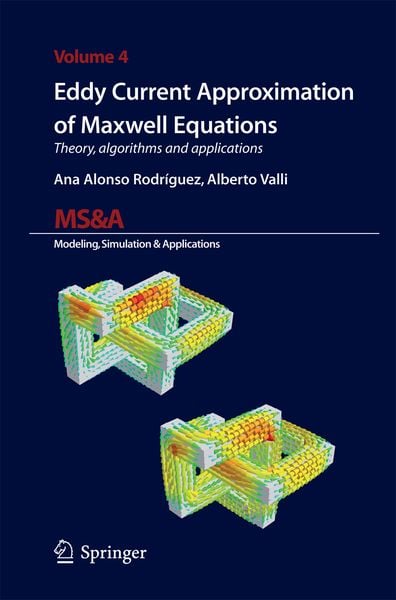

Eddy Current Approximation of Maxwell Equations Theory, Algorithms and Applications
-
- Hardcover
- Taschenbuch ausgewählt
-
Sprache:Englisch
104,99 €
UVP
117,69 €
inkl. gesetzl. MwSt.,
Beschreibung
Produktdetails
Einband
Taschenbuch
Erscheinungsdatum
11.11.2014
Abbildungen
XIII, 347 p.
Verlag
Springer ItaliaSeitenzahl
347
Maße (L/B/H)
23,5/15,5/2 cm
Gewicht
552 g
Auflage
2010
Sprache
Englisch
ISBN
978-88--4705584-1
This book deals with the mathematical analysis and the numerical approximation of time-harmonic eddy current problems. It is self-contained and suitable for mathematicians and engineers working in the field, and also accessible for beginners. Depending on the choice of the physical unknowns, these problems are formulated in different variational ways, with specific attention to the topology of the computational domain. Finite elements of nodal or edge type are used for numerical approximation, and a complete analysis of convergence is performed. A specific feature of the book is the emphasis given to saddle-point formulations in terms of the magnetic and electric fields. New results for voltage or current intensity excitation problems are also presented.
Noch keine Bewertungen vorhanden
Verfassen Sie die erste Bewertung zu diesem Artikel
Helfen Sie anderen Kundinnen und Kunden durch Ihre Meinung.
Kurze Frage zu unserer Seite
Vielen Dank für dein Feedback
Wir nutzen dein Feedback, um unsere Produktseiten zu verbessern. Bitte habe Verständnis, dass wir dir keine Rückmeldung geben können. Falls du Kontakt mit uns aufnehmen möchtest, kannst du dich aber gerne an unseren Kund*innenservice wenden.
zum Kundenservice