• Produktbild: Environmental Sociology
  • Produktbild: Environmental Sociology
- 12%

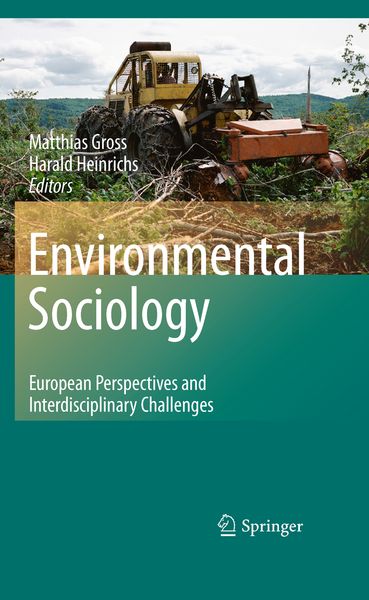
Environmental Sociology European Perspectives and Interdisciplinary Challenges

12% sparen

159,99 € UVP 181,89 €

inkl. gesetzl. MwSt., Versandkostenfrei

Lieferung nach Hause

Beschreibung

Produktdetails

Einband

Taschenbuch

Erscheinungsdatum

06.11.2014

Herausgeber

Matthias Gross + weitere

Verlag

Springer Netherland

Seitenzahl

361

Maße (L/B/H)

23,5/15,5/2,1 cm

Gewicht

575 g

Auflage

2010

Sprache

Englisch

ISBN

978-94-007-9940-0

Beschreibung

Portrait

Dr. Harald Heinrichs ist Juniorprofessor für Sustainable Development and Participation am Institut für Umweltkommunikation der Universität Lüneburg.
Dr. rer. soc. Matthias Groß arbeitet am Department für Stadt- und Umweltsoziologie im Helmholtz-Zentrum für Umweltforschung (UFZ) in Leipzig. Zu seinen aktuellen Forschungsschwerpunkten gehören neben der Umweltsoziologie experimentelle Landschaftsgestaltungen sowie Wissenschafts- und Technikforschung.

Produktdetails

Einband

Taschenbuch

Erscheinungsdatum

06.11.2014

Herausgeber

Verlag

Springer Netherland

Seitenzahl

361

Maße (L/B/H)

23,5/15,5/2,1 cm

Gewicht

575 g

Auflage

2010

Sprache

Englisch

ISBN

978-94-007-9940-0

Herstelleradresse

Springer-Verlag KG
Sachsenplatz 4-6
1201 Wien
AT

Email: GPSR Kontakt

Noch keine Bewertungen vorhanden

Verfassen Sie die erste Bewertung zu diesem Artikel

Helfen Sie anderen Kundinnen und Kunden durch Ihre Meinung.

Kundinnen und Kunden meinen

Bewertungen (0)

  • Produktbild: Environmental Sociology
  • Produktbild: Environmental Sociology
  • 1. Introduction: New Trends and Interdisciplinarity Challenges in Environmental Sociology.- PART 1: Natural Flows and Global Environmental Discourse.- 2. Social Theories of Environmental Reform: Towards a Third Generation.- 3. The New Climate Change Discourse: A Challenge for Environmental Sociology.- 4. Earth System Governance and the Social Sciences.- 5. Ecological Regimes: Towards a Conceptual Integration of the Biophysical Environment into Social Theory.- PART II: Exploring Limits and New Possibilities for Understanding Environmental Rationalities.- 6. Understanding Responses to the Environmental and Ethical Aspects of Innovative Technologies: The Case of Synthetic Biology in Europe.- 7. Social Simulation: A Method to Investigate Environmental Change from a Social Science Perspective.- 8. Trust and Cooperation as Requirements for Maintaining Environmental Governance Capacity.- 9. Rational Choice Theory and the Environment: Variants, Applications, and New Trends.- 10. Environmental Knowledge and Deliberative Democracy.- PART III: Transdisciplinarity and Sustainable Development.- 11. Knowledge and Social Learning for Sustainable Development.- 12. Beyond Neocorporatism?! Transdisciplinary Case Studies as a Means for Collaborative Learning in Sustainable Development.- 13. Social Practices and Sustainable Consumption: Benefits and Limitations of a New Theoretical Approach.- 14. (Im)mobility and Environment-Society Relations: Arguments for and Against the ‘Mobilisation’ of Environmental Sociology.- PART IV: Ecological Adaptation Policies and Social Experimentation.- 15. Environmental Sustainability as Challenge for Media and Journalism.- 16. The Experimental Turn in Environmental Sociology: Pragmatism and New Forms of Governance.- 17. Risk, Society and Environmental Policy: Risk Governance in a Complex World.- 18. Climate Change and Society: Communicating Adaptation.- PART V: CodaChapter.- 19. Moving Ahead: Environmental Sociology’s Contribution to Inter- and Transdisciplinary Research.- Index.