
KI-Beratung Beta

  • Produktbild: Introduction to Analytical Methods for Internal Combustion Engine Cam Mechanisms
  • Produktbild: Introduction to Analytical Methods for Internal Combustion Engine Cam Mechanisms
- 12%

Introduction to Analytical Methods for Internal Combustion Engine Cam Mechanisms

12% sparen

93,99 € UVP 106,99 €

inkl. gesetzl. MwSt., Versandkostenfrei


Beschreibung

Modern design methods of Automotive Cam Design require the computation of a range of parameters. This book provides a logical sequence of steps for the derivation of the relevant equations from first principles, for the more widely used cam mechanisms. Although originally derived for use in high performance...

Beschreibung

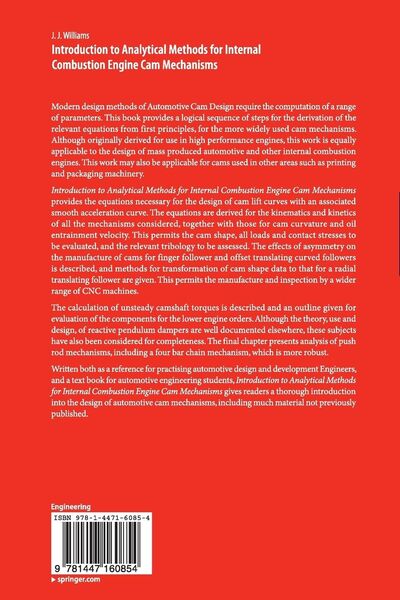
Modern design methods of Automotive Cam Design require the computation of a range of parameters. This book provides a logical sequence of steps for the derivation of the relevant equations from first principles, for the more widely used cam mechanisms. Although originally derived for use in high performance engines, this work is equally applicable to the design of mass produced automotive and other internal combustion engines. This work may also be applicable for cams used in other areas such as printing and packaging machinery.

 
Introduction to Analytical Methods for Internal Combustion Engine Cam
Mechanisms
provides the equations necessary for the design of cam lift curves with an associated smooth acceleration curve. The equations are derived for the kinematics and kinetics of all the mechanisms considered, together with those for cam curvature and oil entrainment velocity. This permits the cam shape, all loads and contact stresses to be evaluated, and the relevant tribology to be assessed. The effects of asymmetry on the manufacture of cams for finger follower and offset translating curved followers is described, and methods for transformation of cam shape data to that for a radial translating follower are given. This permits the manufacture and inspection by a wider range of CNC machines.

The calculation of unsteady camshaft torques is described and an outline given for evaluation of the components for the lower engine orders. Although the theory, use and design, of reactive pendulum dampers are well documented elsewhere, these subjects have also been considered for completeness. The final chapter presents analysis of push rod mechanisms, including a four bar chain mechanism, which is more robust

Written both as a reference for practising automotive design and development Engineers, and a text book for automotive engineering students,
Introduction toAnalytical Methods for Internal Combustion Engine Cam
Mechanisms
gives readers a thorough introduction into the design of automotive cam mechanisms, including much material not previously published.

Produktdetails

Einband

Taschenbuch

Erscheinungsdatum

09.11.2014

Abbildungen

XVIII, 198 p.

Verlag Springer London

Produktdetails

Einband

Taschenbuch

Erscheinungsdatum

09.11.2014

Abbildungen

XVIII, 198 p.

Verlag Springer London
Seitenzahl

198

Maße (L/B/H)

23,5/15,5/1,2 cm

Gewicht

335 g

Auflage

2013

Sprache

Englisch

ISBN

978-1-4471-6085-4

Herstelleradresse

Springer-Verlag KG
Sachsenplatz 4-6
1201 Wien
AT

Email: ProductSafety@springernature.com

Noch keine Bewertungen vorhanden

Verfassen Sie die erste Bewertung zu diesem Artikel

Helfen Sie anderen Kundinnen und Kunden durch Ihre Meinung.

Kundinnen und Kunden meinen

Bewertungen (0)

  • Produktbild: Introduction to Analytical Methods for Internal Combustion Engine Cam Mechanisms
  • Produktbild: Introduction to Analytical Methods for Internal Combustion Engine Cam Mechanisms
  • Elementary Cam Lift Curve.- Low Jerk Cam Lift Curve.- Flat Translating Follower.- Curved Translating Radial Follower.- Offset Curved Translating Follower.- Curved Finger Follower.- Asymmetric Cam Mechanisms.- Camshaft Torques.- Theory and Design of Pendulum Dampers.- Push Rod Mechanisms.