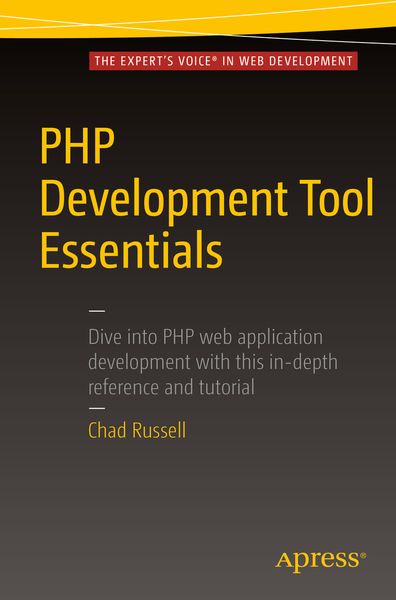
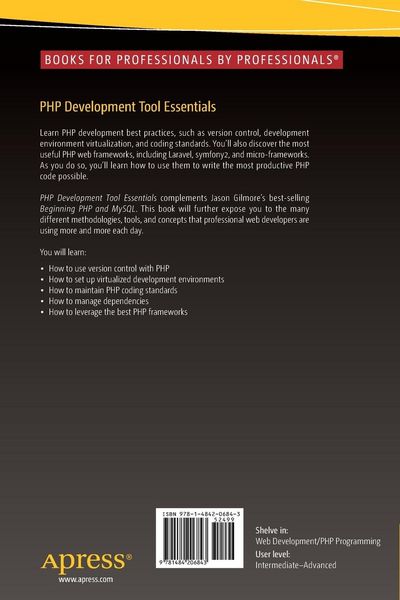
• Produktbild: PHP Development Tool Essentials
  • Produktbild: PHP Development Tool Essentials

PHP Development Tool Essentials

22,99 €

inkl. gesetzl. MwSt., Versandkostenfrei

Lieferung nach Hause

Beschreibung

Produktdetails

Einband

Taschenbuch

Erscheinungsdatum

16.07.2016

Verlag

Apress

Seitenzahl

114

Maße (L/B/H)

23,5/15,5/0,8 cm

Gewicht

207 g

Auflage

1st edition

Sprache

Englisch

ISBN

978-1-4842-0684-3

Beschreibung

Produktdetails

Einband

Taschenbuch

Erscheinungsdatum

16.07.2016

Verlag

Apress

Seitenzahl

114

Maße (L/B/H)

23,5/15,5/0,8 cm

Gewicht

207 g

Auflage

1st edition

Sprache

Englisch

ISBN

978-1-4842-0684-3

Herstelleradresse

Springer-Verlag GmbH
Tiergartenstr. 17
69121 Heidelberg
DE

Email: GPSR Kontakt

Noch keine Bewertungen vorhanden

Verfassen Sie die erste Bewertung zu diesem Artikel

Helfen Sie anderen Kundinnen und Kunden durch Ihre Meinung.

Kundinnen und Kunden meinen

Bewertungen (0)

  • Produktbild: PHP Development Tool Essentials
  • Produktbild: PHP Development Tool Essentials
  • Part I - Development Practices, Standards and Methodologies
    Chapter 1 - Version Control
    Section 1.1 - Overview of version control
    Section 1.2 - Using Git
    Section 1.3 - Branching
    Section 1.4 - Version control in the cloud: Bitbucket and GitHub
    Section 1.5 – Git Tools

    Chapter 2 - Virtualizing Development Environments
    Section 2.1 - Why virtualize development environments
    Section 2.2 - Introduction to Vagrant
    Section 2.3 - Setting up our first environment
    Section 2.4 - Advanced Configurations Using Puppet, Chef and Bash
    Section 2.5 - Configuration tools

    Chapter 3 - Coding Standards
    Section 3.1 - Coding standards and why we use them
    Section 3.2 - A look at PHP-FIG
    Section 3.3 - Coding standards checking with PHP Code Sniffer
    Section 3.3 - Code documentation using phpDocumentor

    Chapter 4 - Design Patterns
    Section 4.1 - Design Patterns overview
    Section 4.2 - Singleton Pattern
    Section 4.3 - Factory Pattern
    Section 4.4 - Abstract Pattern
    Section 4.5 - Strategy Pattern
    Section 4.6 - Dependency Injection Pattern

    Chapter 5 - Dependency Management
    Section 5.1 - Composer and Packagist
    Section 5.2 - PEAR and Pyrus

    Chapter 6 - SPL and Advanced PHP Features
    Section 6.1 - What is the SPL
    Section 6.2 - Exploring SPL functions
    Section 6.3 - Practical uses of the SPL
    Section 6.4 - Namespaces
    Section 6.5 - Traits
    Section 6.6 - Anonymous Functions (Closures)
    Section 6.7 - Variadic Functions

    Part II - Developing Web Applications
    Chapter 7 - PHP and Web Server Configurations

    Section 7.1 - Overview of PHP/Web Server Choices
    Section 7.2 - ModPHP, suPHP, FastCGI and PHP-FPM - What's right for you?
    Section 7.3 - Apache2 & Nginx working in harmony

    Chapter 8 - Frameworks
    Section 8.1 - Why you should be using a framework
    Section 8.2 - Zend Framework 2
    Section 8.3 - Symfony 2
    Section 8.4 - Laravel
    Section 8.5 - Micro-frameworks

    Chapter 9 - Testing & Debugging
    Section 9.1 - Why test?
    Section 9.2 - Test Driven Development
    Section 9.3 - Unit testing with PHPUnit
    Section 9.4 - PHPDBG
    Section 9.5 - Debugging tools (Xdebug and PHP Mess Detector)

    Chapter 10 - Exception Handling and Logging
    Section 10.1 - PHP's Exception handling
    Section 10.2 - Custom exception handlers
    Section 10.3 - Logging techniques

    Chapter 11 - Continuous Integration (CI)
    Section 11.1 - What is CI and why use it?
    Section 11.2 - Different CI choices for PHP
    Section 11.3 - Setting up CI for your application

    Chapter 12 - Caching and Performance
    Section 12.1 - Caching approaches
    Section 12.2 - Opcode and User Caches
    Section 12.3 - Redis
    Section 12.4 - Memcached
    Section 12.5 - Varnish
    Section 12.6 - Web Server caching
    Section 12.7 - Offloading tasks with queues

    Chapter 13 - Building an API
    Section 13.1 - Why build an API?
    Section 13.2 - The RESTful Approach
    Section 13.3 - The RPC Approach
    Section 13.4 - Building a simple API using Apigility

    Chapter 14 - Networking
    Section 14.1 - PHP Networking Functions
    Section 14.2 - Web Service clients with Guzzle
    Section 14.3 - Sockets

    Chapter 15 - Templates
    Section 15.1 - The pure PHP approach
    Section 15.2 - Twig Templates
    Section 15.3 - Smarty Templates

    Chapter 16 - Security
    Section 16.1 - General security overview
    Section 16.2 - Cross-Site Scripting (XSS)
    Section 16.3 - Cross-Site Request Forgery (CSRF)
    Section 16.4 - SQL Injection and Prepared Statements
    Section 16.5 - Password Hashing
    Section 16.6 - PHP Data Filtering
    Section 16.7 - Building a two-factor authentication system

    Chapter 17 - PHP CLI
    Section 17.1 - Overview
    Section 17.2 - Command-Line Arguments
    Section 17.3 - Handling Input/Output
    Section 17.4 - Built-in Web Server

    Chapter 18 - PHP and MySQL In The Cloud
    Section 18.1 - Advantages of using cloud infrastructure
    Section 18.2 - Working with Amazon Web Services (AWS)
    Section 18.3 - Working with Google App Engine for PHP

    Chapter 19 - Working with JavaScript Frameworks
    Section 19.1 - What are JavaScript Frameworks
    Section 19.2 - AngularJS
    Section 19.3 - Backbone.js
    Section 19.4 - Ember

    Part III - MySQL

    Chapter 20 - Object Relational Mapping
    Section 20.1 - Introduction to ORMs
    Section 20.2 - Using Propel & Doctrine
    Section 20.3 - Reverse engineering existing databases
    Section 20.4 - Working with advanced queries

    Chapter 21 - Database Design
    Section 21.1 - Standardizing naming conventions
    Section 21.2 - Choosing the correct column types
    Section 21.3 - Normalization
    Section 21.4 - Keys and Indexes

    Chapter 22 - Queries and MySQL Optimization
    Section 22.1 - Writing better-performing queries
    Section 22.2 - Using the MySQL Slow log
    Section 22.3 - Profiling queries with Explain
    Section 22.4 - Tweaking configuration values
    Section 22.5 - Query and administration tools

    Chapter 23 - Advanced MySQL Configurations
    Section 23.1 - MySQL Replication
    Section 23.2 - MySQL Cluster
    Section 23.3 - MySQL Partitioning
    Section 23.4 - High-availability with MySQL Fabric
    Section 23.5 - High-availability with Galera Cluster

    Chapter 24 - Implementing advanced Search capabilities
    Section 24.1 - Introduction to Sphinx
    Section 24.2 - Installing and configuring Sphinx
    Section 24.3 - Building search indexes
    Section 24.4 - Using the PHP Sphinx client

    Part IV - Looking Ahead
    Chapter 25 - Looking Ahead
    Section 25.1 - What is HHVM?
    Section 25.2 - The Hack Language
    Section 25.3 - PHPNG
    Section 25.4 - MySQL