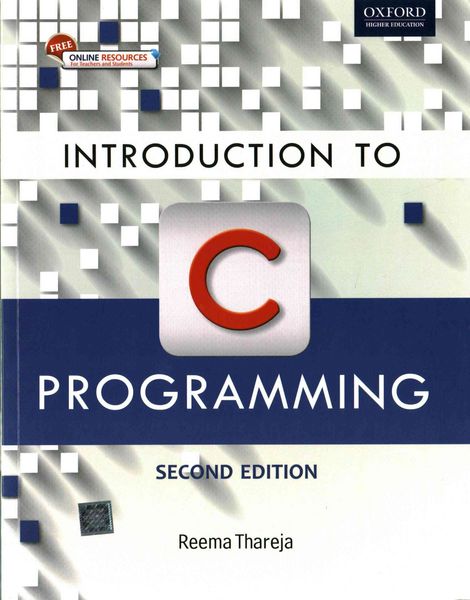
Produktbild: Introduction to C Programming

Introduction to C Programming 2nd edition

49,99 €

inkl. gesetzl. MwSt., Versandkostenfrei

Lieferung nach Hause

Beschreibung

Produktdetails

Einband

Taschenbuch

Erscheinungsdatum

01.11.2014

Verlag

Oxford University Press, USA

Seitenzahl

394

Maße (L/B/H)

21,6/27,4/1,8 cm

Gewicht

762 g

Auflage

2nd UK edition

Sprache

Englisch

ISBN

978-0-19-945205-7

Beschreibung

Produktdetails

Einband

Taschenbuch

Erscheinungsdatum

01.11.2014

Verlag

Oxford University Press, USA

Seitenzahl

394

Maße (L/B/H)

21,6/27,4/1,8 cm

Gewicht

762 g

Auflage

2nd UK edition

Sprache

Englisch

ISBN

978-0-19-945205-7

Herstelleradresse

Libri GmbH
Europaallee 1
36244 Bad Hersfeld
DE

Email: gpsr@libri.de

Noch keine Bewertungen vorhanden

Verfassen Sie die erste Bewertung zu diesem Artikel

Helfen Sie anderen Kundinnen und Kunden durch Ihre Meinung.

Kundinnen und Kunden meinen

Bewertungen (0)

  • Produktbild: Introduction to C Programming
    • 1: Introduction to Programming

    • 1.1 Introduction to Computer Software

    • 1.2 Classification of Computer Software

    • 1.3 Programming Languages

    • 1.4 Generation of Programming Languages

    • 1.5 Categorization of High Level Languages

    • 2: Introduction to C

    • 2.1 Introduction

    • 2.2 Structure of a C Program

    • 2.3 Writing the First C Program?

    • 2.4 Files Used in a C Program

    • 2.5 Compiling and Executing C Programs

    • 2.6 Using Comments

    • 2.7 Keywords

    • 2.8 Identifiers

    • 2.9 Basic Data Types in C

    • 2.10 Variables

    • 2.11 Constants

    • 2.12 Input/output Statement in C

    • 2.13 Operators in C

    • 2.14 Programming Examples

    • 2.15 Type Conversion and Typecasting

    • Annexure

    • 3: Decision Control and Looping Statements

    • 3.1 Introduction to Decision Control Statements

    • 3.2 Conditional Branching Statements

    • 3.3 Iterative Statements

    • 3.4 Nested Loops

    • 3.5 The Break and Continue Statement

    • 3.6 Goto Statement

    • 3.7 Building a Robust C Program

    • Annexure 2?

    • 4: Functions

    • 4.1 Introduction

    • 4.2 Using Functions

    • 4.3 Function Declaration/Function Prototype

    • 4.4 Function Definition

    • 4.5 Function Call

    • 4.6 Return Statement

    • 4.7 Passing Parameters to the Function

    • 4.8 Scope of Variables

    • 4.9 Storage Classes

    • 4.10 Recursive Functions

    • 4.11 Types of Recursion

    • 4.12 Tower of Hanoi

    • 4.13 Recursion versus Iteration

    • Annexure 3

    • 5: Arrays

    • 5.1 Introduction

    • 5.2 Declaration of Arrays

    • 5.3 Accessing Array Elements

    • 5.4 Storing Values in Arrays

    • 5.5 Length of an Array

    • 5.6 Array Operations

    • 5.7 One-Dimensional Arrays for Inter-Function Communication

    • 5.8 Two-Dimensional Arrays

    • 5.9 Operations on Two-dimensional(2D) Arrays

    • 5.10 Two-Dimensional Arrays for Inter-Function Communication

    • 5.11 Multidimensional Arrays

    • 5.12 Sparse Matrices

    • Annexure 4

    • 6: Strings

    • 6.1 Introduction

    • 6.2 Suppressing Input

    • 6.3 String Taxonomy

    • 6.4 String Operations

    • 6.5 Miscellaneous String and Character Functions

    • 6.6 Array of Strings?213

    • 7: Pointers

    • 7.1 Understanding the Computer's Memory

    • 7.2 Introduction to Pointers

    • 7.3 Declaring Pointer Variables

    • 7.4 Pointer Expressions and Pointer Arithmetic

    • 7.5 Null Pointers

    • 7.6 Generic Pointers

    • 7.7 Passing Arguments to Function Using Pointers

    • 7.8 Pointers and Arrays

    • 7.9 Passing an Array to a Function

    • 7.10 Difference between Array Name and Pointer

    • 7.11 Pointers and Strings

    • 7.12 Array of Pointers

    • 7.13 Pointers and 2-D Arrays

    • 7.14 Pointers and 3-D Array

    • 7.15 Function Pointers

    • 7.16 Array of Function Pointers

    • 7.17 Pointers to Pointers

    • 7.18 Memory Allocation in C Programs

    • 7.19 Memory Usage

    • 7.20 Dynamic Memory Allocation

    • 7.21 Drawback of Pointers

    • Annexure 5

    • 8: Structure, Union, and Enumerated Data Types

    • 8.1 Introduction

    • 8.2 Nested Structures

    • 8.3 Arrays of Structures

    • 8.4 Structures and Functions

    • 8.5 Self-referential Structures

    • 8.6 Union?

    • 8.7 Arrays of Union Variables

    • 8.8 Unions Inside Structures

    • 8.9 Enumerated Data Types

    • Annexure 6

    • 9: Files

    • 9.1 Introduction to Files

    • 9.2 Using Files in C

    • 9.3 Read Data from Files

    • 9.4 Writing Data to Files

    • 9.5 Detecting the End-of-File

    • 9.6 Error Handling During File Operations

    • 9.7 Accepting Command Line Arguments

    • 9.8 Functions for Selecting a Record Randomly

    • 9.9 remove ()?

    • 9.10 Renaming the File

    • 9.11 Creating a Temporary File

    • 10: Preprocessor Directives

    • 10.1 Introduction

    • 10.2 Types of Preprocessor Directives

    • 10.3 #define

    • 10.4 #include

    • 10.5 #undef

    • 10.6 #line

    • 10.7 Pragma Directives

    • 10.8 Conditional Directives

    • 10.9 The Defined Operator

    • 10.10 #error Directive

    • 10.11 Predefined Macro Names

    • Annexure

    • 11: Linked Lists

    • 11.1 Introduction

    • 11.2 Linked Lists versus Arrays

    • 11.3 Memory Allocation and Deallocation for a Linked List

    • 11.4 Different Types of Linked Lists

    • 11.5 Singly Linked List

    • 11.6 Circular Linked List

    • 11.7 Doubly Linked List?

    • 11.8 Circular Doubly Linked List

    • 11.9 Header Linked List