
• Produktbild: Modeling Infectious Disease Parameters Based on Serological and Social Contact Data
  • Produktbild: Modeling Infectious Disease Parameters Based on Serological and Social Contact Data
Band 63

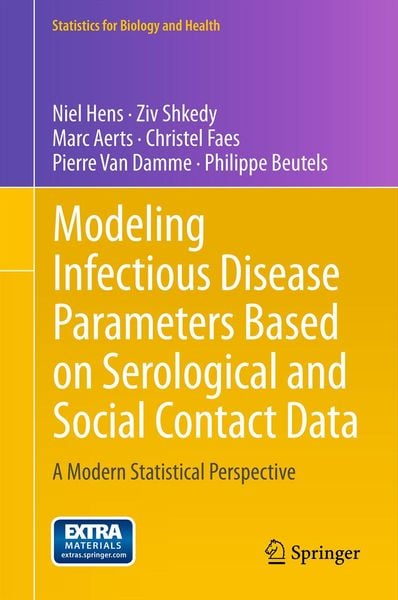
Modeling Infectious Disease Parameters Based on Serological and Social Contact Data A Modern Statistical Perspective

81,99 €

inkl. gesetzl. MwSt., Versandkostenfrei


Beschreibung

Produktdetails

Einband

Taschenbuch

Erscheinungsdatum

15.10.2014

Abbildungen

XVI, 300 p.

Verlag

Springer Us

Seitenzahl

300

Maße (L/B/H)

23,5/15,5/1,8 cm

Gewicht

482 g

Sprache

Englisch

ISBN

978-1-4899-8796-9

Beschreibung

Produktdetails

Einband

Taschenbuch

Erscheinungsdatum

15.10.2014

Abbildungen

XVI, 300 p.

Verlag

Springer Us

Seitenzahl

300

Maße (L/B/H)

23,5/15,5/1,8 cm

Gewicht

482 g

Sprache

Englisch

ISBN

978-1-4899-8796-9

Herstelleradresse

Springer-Verlag KG
Sachsenplatz 4-6
1201 Wien
AT

Email: ProductSafety@springernature.com

Noch keine Bewertungen vorhanden

Verfassen Sie die erste Bewertung zu diesem Artikel

Helfen Sie anderen Kundinnen und Kunden durch Ihre Meinung.

Kundinnen und Kunden meinen

Bewertungen (0)

  • Produktbild: Modeling Infectious Disease Parameters Based on Serological and Social Contact Data
  • Produktbild: Modeling Infectious Disease Parameters Based on Serological and Social Contact Data

  • Mathematical models for infectious diesease.- The static model.- The dynamic model.- The stochastic model.- Implementation of models in MATLAB.- Data sources for modelling infectious diseases.- Estimation from serological data.- Parametric models for teh prevalence and the force of infection.- Non-parametric approaches to model the prevalence and force of infection.- Semi-parametric approaches to model the prevalence and force of infection.- A Bayesian approach.- Modelling the prevalence and the force of infection direction from antibody levels.- Modelling multivariate serological data.- Estimation from other data sources.- Estimating mixing patterns and
    Ro
    in a heterogenous population.- Modelling in a homogeneous population.- Modelling in a heterogeneous population.- Modelling AIDS outbreak data.- Modelling hepatitis C among injection drug users.- Modelling dengue.- Modelling bovine herpes virus in cattle.