• Produktbild: Elementary Number Theory with Programming
  • Produktbild: Elementary Number Theory with Programming

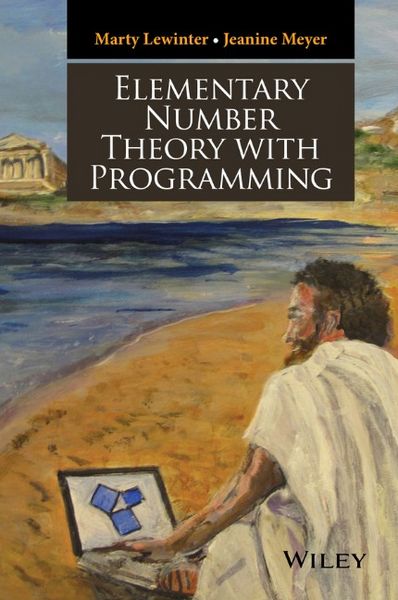
Elementary Number Theory with Programming

108,99 €

inkl. gesetzl. MwSt., Versandkostenfrei


Beschreibung

Produktdetails

Einband

Gebundene Ausgabe

Erscheinungsdatum

01.06.2015

Verlag

John Wiley & Sons

Seitenzahl

230

Maße (L/B/H)

24/16,1/1,7 cm

Gewicht

516 g

Auflage

1. Auflage

Sprache

Englisch

ISBN

978-1-119-06276-9

Beschreibung

Produktdetails

Einband

Gebundene Ausgabe

Erscheinungsdatum

01.06.2015

Verlag

John Wiley & Sons

Seitenzahl

230

Maße (L/B/H)

24/16,1/1,7 cm

Gewicht

516 g

Auflage

1. Auflage

Sprache

Englisch

ISBN

978-1-119-06276-9

Herstelleradresse

Libri GmbH
Europaallee 1
36244 Bad Hersfeld
DE

Email: gpsr@libri.de

Noch keine Bewertungen vorhanden

Verfassen Sie die erste Bewertung zu diesem Artikel

Helfen Sie anderen Kundinnen und Kunden durch Ihre Meinung.

Kundinnen und Kunden meinen

Bewertungen (0)

Die Leseprobe wird geladen.
  • Produktbild: Elementary Number Theory with Programming
  • Produktbild: Elementary Number Theory with Programming
  • Preface xi

    Words xiii

    Notation in Mathematical Writing and in Programming xv

    1 Special Numbers: Triangular, Oblong, Perfect, Deficient, and Abundant 1
    The programs include one for factoring numbers and one to test a conjecture up to a fixed limit.

    Triangular Numbers 1

    Oblong Numbers and Squares 3

    Deficient, Abundant, and Perfect Numbers 4

    Exercises 7

    2 Fibonacci Sequence, Primes, and the Pell Equation 13
    The programs include examples that count steps to compare two different approaches.

    Prime Numbers and Proof by Contradiction 13

    Proof by Construction 17

    Sums of Two Squares 18

    Building a Proof on Prior Assertions 18

    Sigma Notation 19

    Some Sums 19

    Finding Arithmetic Functions 20

    Fibonacci Numbers 22

    An Infinite Product 26

    The Pell Equation 26

    Goldbach's Conjecture 30

    Exercises 31

    3 Pascal's Triangle 44
    The programs include examples that generate factorial using iteration and using recursion and thus demonstrate and compare important techniques in programming.

    Factorials 44

    The Combinatorial Numbers n Choose k 46

    Pascal's Triangle 48

    Binomial Coefficients 50

    Exercises 50

    4 Divisors and Prime Decomposition 56
    The programs include one that uses the algorithm to produce the GCD of a pair of numbers and a program to produce the prime decomposition of a number.

    Divisors 56

    Greatest Common Divisor 58

    Diophantine Equations 65

    Least Common Multiple 67

    Prime Decomposition 68

    Semiprime Numbers 70

    When is a Number an mth Power? 71

    Twin Primes 73

    Fermat Primes 73

    Odd Primes Are Differences of Squares 74

    When is n a Linear Combination of a and b? 75

    Prime Decomposition of n! 76

    No Nonconstant Polynomial with Integer Coefficients Assumes Only Prime Values 77

    Exercises 78

    5 Modular Arithmetic 85
    One program checks if a mod equation is true, and another determines the solvability of a mod equation and then solves an equation that is solvable by a brute-force approach.

    Congruence Classes Mod k 85

    Laws of Modular Arithmetic 87

    Modular Equations 90

    Fermat's Little Theorem 91

    Fermat's Little Theorem 92

    Multiplicative Inverses 92

    Wilson's Theorem 93

    Wilson's Theorem 95

    Wilson's Theorem (2nd Version) 95

    Squares and Quadratic Residues 96

    Lagrange's Theorem 98

    Lagrange's Theorem 99

    Reduced Pythagorean Triples 100

    Chinese Remainder Theorem 102

    Chinese Remainder Theorem 103

    Exercises 104

    6 Number Theoretic Functions 111
    The programs include two distinct approaches to calculating the tau function.

    The Tau Function 111

    The Sigma Function 114

    Multiplicative Functions 115

    Perfect Numbers Revisited 115

    Mersenne Primes 116

    F(n) = ¿f(d) Where d is a Divisor of n 117

    The Möbius Function 119

    The Riemann Zeta Function 121

    Exercises 124

    7 The Euler Phi Function 134
    The programs demonstrate two approaches to calculating the phi function.

    The Phi Function 134

    Euler's Generalization of Fermat's Little Theorem 138

    Phi of a Product of m and n When gcd(m,n) > 1 139

    The Order of a (mod n) 139

    Primitive Roots 140

    The Index of m (mod p) Relative to a 141

    To Be or Not to Be a Quadratic Residue 145

    The Legendre Symbol 146

    Quadratic Reciprocity 147

    Law of Quadratic Reciprocity 148

    When Does x2 = a (mod n) Have a Solution? 148

    Exercises 150

    8 Sums and Partitions 158
    The exposition explains the central role of binary representation in computing and the programs produce the binary partition using a built-in function.

    An nth Power is the Sum of Two Squares 158

    Solutions to the Diophantine Equation a2 + b2 + c2 = d2 159

    Row Sums of a Triangular Array of Consecutive Odd Numbers 160

    Partitions 160

    When is a Number the Sum of Two Squares? 167

    Sums of Four or Fewer Squares 170

    Exercises 175

    9 Cryptography 182
    The programs include different ways to generate counts of letters and also Fermat factoring.

    Introduction and History 182

    Public-Key Cryptography 187

    Factoring Large Numbers 188

    The Knapsack Problem 191

    Superincreasing Sequences 192

    Exercises 194

    Answers or Hints to Selected Exercises 203

    Index 207