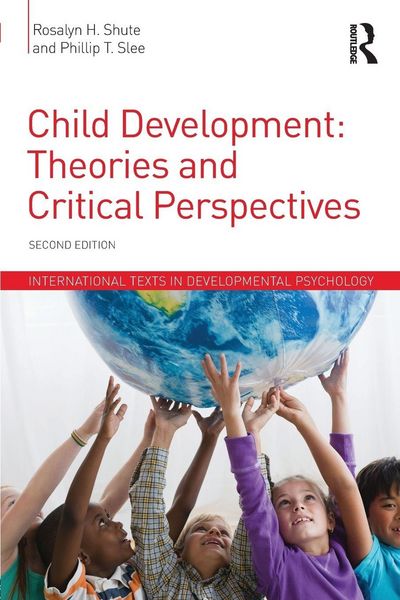
Child Development Theories and Critical Perspectives
-
- Hardcover
- Taschenbuch ausgewählt
- eBook
-
Sprache:Englisch
-
Verlag:Taylor & Francis
63,99 €
UVP
90,10 €
inkl. gesetzl. MwSt.,
Lieferung nach Hause
Beschreibung
Produktdetails
Einband
Taschenbuch
Erscheinungsdatum
20.05.2015
Abbildungen
schwarz-weiss Illustrationen, Zeichnungen, schwarz-weiss, Tabellen, schwarz-weiss
Verlag
Taylor & FrancisSeitenzahl
310
Maße (L/B/H)
23,4/15,6/1,7 cm
Gewicht
479 g
Auflage
2. Auflage
Sprache
Englisch
ISBN
978-1-84872-452-5
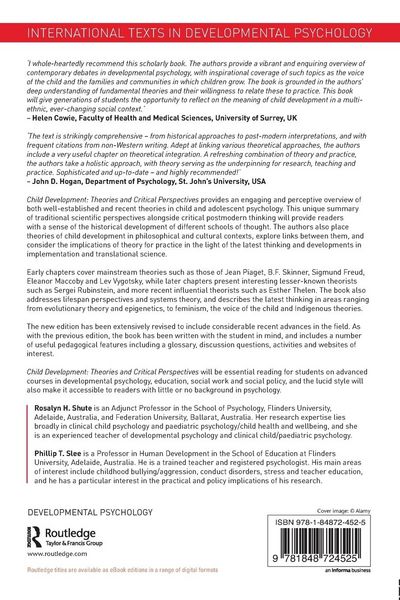
Child Development: Theories and Critical Perspectives provides an engaging and perceptive overview of both well-established and recent theories in child and adolescent psychology. This unique summary of traditional scientific perspectives alongside critical post-modern thinking will provide readers with a sense of the historical development of different schools of thought. The authors also place theories of child development in philosophical and cultural contexts, explore links between them, and consider the implications of theory for practice in the light of the latest thinking and developments in implementation and translational science.
Early chapters cover mainstream theories such as those of Piaget, Skinner, Freud, Maccoby and Vygotsky, whilst later chapters present interesting lesser-known theorists such as Sergei Rubinstein, and more recent influential theorists such as Esther Thelen. The book also addresses lifespan perspectives and systems theory, and describes the latest thinking in areas ranging from evolutionary theory and epigenetics, to feminism, the voice of the child and Indigenous theories.
The new edition of Child Development has been extensively revised to include considerable recent advances in the field. As with the previous edition, the book has been written with the student in mind, and includes a number of useful pedagogical features including further reading, discussion questions, activities, and websites of interest.
Child Development: Theories and Critical Perspectives will be essential reading for students on advanced courses in developmental psychology, education, social work and social policy, and the lucid style will also make it accessible to readers with little or no background in psychology.
Kundinnen und Kunden meinen
Verfassen Sie die erste Bewertung zu diesem Artikel
Helfen Sie anderen Kund*innen durch Ihre Meinung
Kurze Frage zu unserer Seite
Vielen Dank für dein Feedback
Wir nutzen dein Feedback, um unsere Produktseiten zu verbessern. Bitte habe Verständnis, dass wir dir keine Rückmeldung geben können. Falls du Kontakt mit uns aufnehmen möchtest, kannst du dich aber gerne an unseren Kund*innenservice wenden.
zum Kundenservice