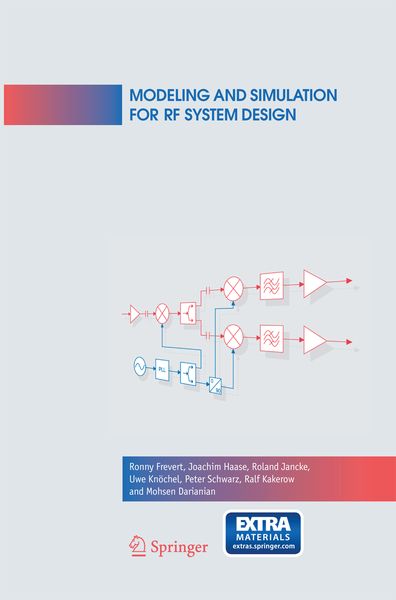
Modeling and Simulation for RF System Design
-
- Hardcover
- Taschenbuch ausgewählt
-
Sprache:Englisch
139,99 €
UVP
160,49 €
inkl. gesetzl. MwSt.,
Beschreibung
Produktdetails
Einband
Taschenbuch
Erscheinungsdatum
16.09.2014
Abbildungen
XI, 291 p.
Verlag
Springer UsSeitenzahl
291
Maße (L/B/H)
23,5/15,5/1,7 cm
Gewicht
464 g
Auflage
2005
Sprache
Englisch
ISBN
978-1-4614-9832-2
Modern telecommunication systems are highly complex from an algorithmic point of view. The complexity continues to increase due to advanced modulation schemes, multiple protocols and standards, as well as additional functionality such as personal organizers or navigation aids.
To have short and reliable design cycles, efficient verification methods and tools are necessary. Modeling and simulation need to accompany the design steps from the specification to the overall system verification in order to bridge the gaps between system specification, system simulation, and circuit level simulation. Very high carrier frequencies together with long observation periods result in extremely large computation times and requires, therefore, specialized modeling methods and simulation tools on all design levels.
The focus of
Modeling and Simulation for RF System Design
lies on RF specific modeling and simulation methods and the consideration of system and circuit level descriptions. It contains application-oriented training material for RF designers which combines the presentation of a mixed-signal design flow, an introduction into the powerful standardized hardware description languages VHDL-AMS and Verilog-A, and the application of commercially available simulators.
Modeling and Simulation for RF System Design
is addressed to graduate students and industrial professionals who are engaged in communication system design and want to gain insight into the system structure by own simulation experiences.
The authors are experts in design, modeling and simulation of communication systems engaged at the Nokia Research Center (Bochum, Germany) and the Fraunhofer Institute for Integrated Circuits, Branch Lab Design Automation (Dresden, Germany).
Noch keine Bewertungen vorhanden
Verfassen Sie die erste Bewertung zu diesem Artikel
Helfen Sie anderen Kundinnen und Kunden durch Ihre Meinung.
Kurze Frage zu unserer Seite
Vielen Dank für dein Feedback
Wir nutzen dein Feedback, um unsere Produktseiten zu verbessern. Bitte habe Verständnis, dass wir dir keine Rückmeldung geben können. Falls du Kontakt mit uns aufnehmen möchtest, kannst du dich aber gerne an unseren Kund*innenservice wenden.
zum Kundenservice