
Managing Elevated Risk Global Liquidity, Capital Flows, and Macroprudential Policy—An Asian Perspective
-
- Hardcover ausgewählt
- Taschenbuch
-
Sprache:Englisch
48,99 €
inkl. gesetzl. MwSt.,
Lieferung nach Hause
Beschreibung
Produktdetails
Einband
Gebundene Ausgabe
Erscheinungsdatum
15.01.2015
Abbildungen
VIII, 69 illus., schwarz-weiss Illustrationen
Herausgeber
Iwan J. Azis + weitereVerlag
Springer SingaporeSeitenzahl
124
Maße (L/B/H)
24,1/16/1,3 cm
Gewicht
371 g
Auflage
1. Auflage
Sprache
Englisch
ISBN
978-981-287-283-8
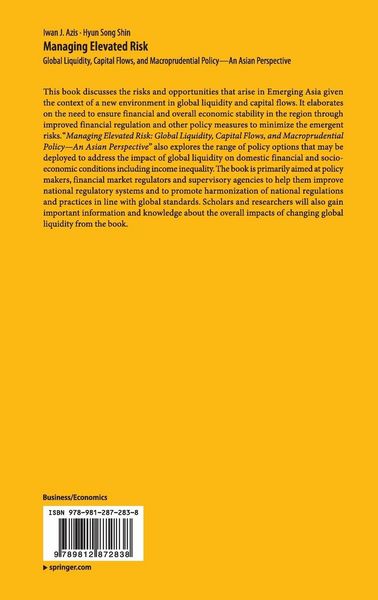
This book discusses the risks and opportunities that arise in Emerging Asia given the context of a new environment in global liquidity and capital flows. It elaborates on the need to ensure financial and overall economic stability in the region through improved financial regulation and other policy measures to minimize the emergent risks. " Managing Elevated Risk: Global Liquidity, Capital Flows, and Macroprudential Policy—An Asian Perspective " also explores the range of policy options that may be deployed to address the impact of global liquidity on domestic financial and socio-economic conditions including income inequality. The book is primarily aimed at policy makers, financial market regulators and supervisory agencies to help them improve national regulatory systems and to promote harmonization of national regulations and practices in line with global standards. Scholars and researchers will also gain important information and knowledge about the overall impacts of changing global liquidity from the book.
Noch keine Bewertungen vorhanden
Verfassen Sie die erste Bewertung zu diesem Artikel
Helfen Sie anderen Kundinnen und Kunden durch Ihre Meinung.
Kurze Frage zu unserer Seite
Vielen Dank für dein Feedback
Wir nutzen dein Feedback, um unsere Produktseiten zu verbessern. Bitte habe Verständnis, dass wir dir keine Rückmeldung geben können. Falls du Kontakt mit uns aufnehmen möchtest, kannst du dich aber gerne an unseren Kund*innenservice wenden.
zum Kundenservice