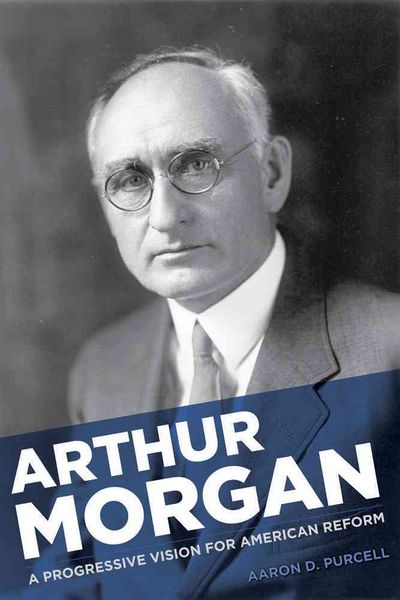
Arthur Morgan A Progressive Vision for American Reform
53,99 €
inkl. gesetzl. MwSt.,
Lieferung nach Hause
Beschreibung
Produktdetails
Einband
Gebundene Ausgabe
Erscheinungsdatum
28.11.2014
Verlag
University Of Tennessee PressSeitenzahl
367
Maße (L/B/H)
23,6/16,4/3,1 cm
Gewicht
712 g
Sprache
Englisch
ISBN
978-1-62190-058-0
On May 19, 1933, President Franklin D. Roosevelt announced the appointment of Arthur Morgan (1878–1975), a water-control engineer and college president from Ohio, as the chairman of the newly created Tennessee Valley Authority (TVA). With the eyes of the nation focused on the reform and recovery promised by the New Deal, Morgan remained in the national spotlight for much of the 1930s, as his visionary plans for the TVA drew both support and criticism. In this thoughtful biography, Aaron D. Purcell reassesses Morgan’s long life and career and provides the first detailed account of his post-TVA activities and fascination with utopian writer Edward Bellamy. As Purcell demonstrates, Morgan embraced an alternative type of Progressive Era reform throughout his life, one that was rooted in nineteenth-century socialism, an overlooked, but important, strain in American political thought.
Purcell pinpoints Morgan’s reading of Edward Bellamy’s Looking Backward while a teenager as a watershed moment in the development of his vision for building modern American society. He recounts Morgan’s early successes as an engineer, budding Progressive leader, and educational reformer; his presidency of Antioch College; and his revolutionary but contentious tenure at the TVA. After his dismissal from the TVA, Morgan wrote extensively, eventually publishing over a dozen books, including a biography of Edward Bellamy, and countless articles. He also raised money to support an experimental community in Kerala, India, sharing Mahatma Gandhi’s belief in small, self-sustaining communities cooperatively supported by persons of strong moral character. At the same time, however, Morgan retained many of his late-nineteenth-century beliefs, including eugenics, as part of his societal vision. His authoritarian administrative style and moral rigidity limited his ability to attract large numbers to his community-based vision.
As Purcell demonstrates, Morgan remained an active reformer well into the second half of the twentieth century, carrying forward a vision for American reform decades after his Progressive Era contemporaries had faded into obscurity. By presenting Morgan’s life and career within the context of the larger social and cultural events of his day, this revealing biographical study offers new insight into the achievements and motivations of an important but historically neglected American reformer.
Noch keine Bewertungen vorhanden
Verfassen Sie die erste Bewertung zu diesem Artikel
Helfen Sie anderen Kundinnen und Kunden durch Ihre Meinung.
Kurze Frage zu unserer Seite
Vielen Dank für dein Feedback
Wir nutzen dein Feedback, um unsere Produktseiten zu verbessern. Bitte habe Verständnis, dass wir dir keine Rückmeldung geben können. Falls du Kontakt mit uns aufnehmen möchtest, kannst du dich aber gerne an unseren Kund*innenservice wenden.
zum Kundenservice