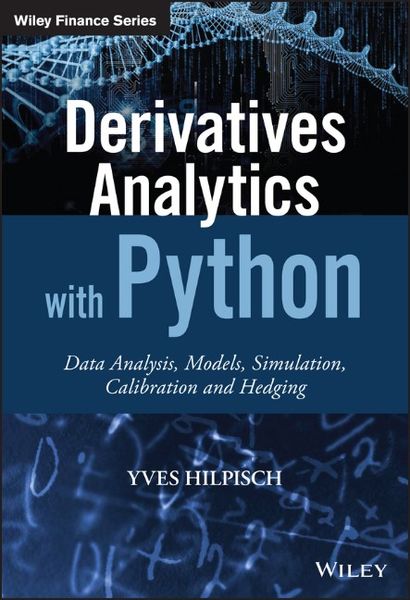
Derivatives Analytics with Python Data Analysis, Models, Simulation, Calibration and Hedging
116,99 €
inkl. gesetzl. MwSt.,
Beschreibung
Produktdetails
Einband
Gebundene Ausgabe
Erscheinungsdatum
10.07.2015
Verlag
John Wiley & SonsSeitenzahl
384
Maße (L/B/H)
25/17,5/2,5 cm
Gewicht
829 g
Auflage
1. Auflage
Sprache
Englisch
ISBN
978-1-119-03799-6
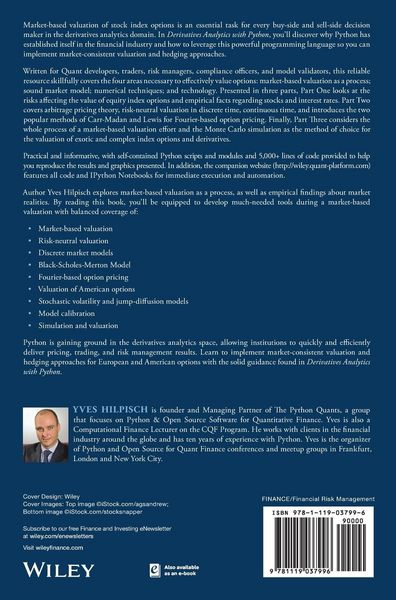
Derivatives Analytics with Python shows you how to implement market-consistent valuation and hedging approaches using advanced financial models, efficient numerical techniques, and the powerful capabilities of the Python programming language. This unique guide offers detailed explanations of all theory, methods, and processes, giving you the background and tools necessary to value stock index options from a sound foundation. You'll find and use self-contained Python scripts and modules and learn how to apply Python to advanced data and derivatives analytics as you benefit from the 5,000+ lines of code that are provided to help you reproduce the results and graphics presented. Coverage includes market data analysis, risk-neutral valuation, Monte Carlo simulation, model calibration, valuation, and dynamic hedging, with models that exhibit stochastic volatility, jump components, stochastic short rates, and more. The companion website features all code and IPython Notebooks for immediate execution and automation.
Python is gaining ground in the derivatives analytics space, allowing institutions to quickly and efficiently deliver portfolio, trading, and risk management results. This book is the finance professional's guide to exploiting Python's capabilities for efficient and performing derivatives analytics.
* Reproduce major stylized facts of equity and options markets yourself
* Apply Fourier transform techniques and advanced Monte Carlo pricing
* Calibrate advanced option pricing models to market data
* Integrate advanced models and numeric methods to dynamically hedge options
Recent developments in the Python ecosystem enable analysts to implement analytics tasks as performing as with C or C++, but using only about one-tenth of the code or even less. Derivatives Analytics with Python -- Data Analysis, Models, Simulation, Calibration and Hedging shows you what you need to know to supercharge your derivatives and risk analytics efforts.
Noch keine Bewertungen vorhanden
Verfassen Sie die erste Bewertung zu diesem Artikel
Helfen Sie anderen Kundinnen und Kunden durch Ihre Meinung.
Kurze Frage zu unserer Seite
Vielen Dank für dein Feedback
Wir nutzen dein Feedback, um unsere Produktseiten zu verbessern. Bitte habe Verständnis, dass wir dir keine Rückmeldung geben können. Falls du Kontakt mit uns aufnehmen möchtest, kannst du dich aber gerne an unseren Kund*innenservice wenden.
zum Kundenservice