
KI-Beratung Beta

Gutscheinbedingungen

**Gültig vom 05.10.2026 bis 07.10.2026 | Gültig für nicht preisgebundene fremdsprachige Bücher | Einzelne Artikel können ausgeschlossen sein | Online auf www.bücher.de einlösbar | Click & Collect nur mit Online-Zahlung (Paypal/Kreditkarte) vorab | Nicht kombinierbar mit anderen Gutscheinen oder Preisaktionen | Nur einmal pro Einkauf einlösbar | Gutschein wird auf max. 500€ Bestellwert angerechnet | Keine Barauszahlung | Nicht gültig für Versandkosten und Services

  • Produktbild: Excitotoxins
  • Produktbild: Excitotoxins
Band 39

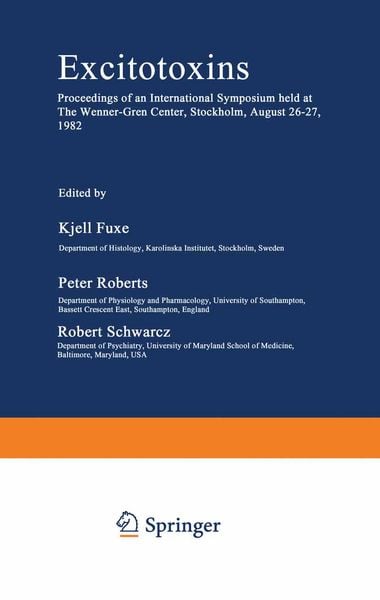
Excitotoxins Proceedings of an International Symposium held at The Wenner-Gren Center, Stockholm, August 26–27, 1982

97,99 €

inkl. gesetzl. MwSt., Versandkostenfrei


Beschreibung

Produktdetails

Einband

Taschenbuch

Erscheinungsdatum

08.10.2012

Abbildungen

XII, 363 p. 83 illus., 5 illus. in color.

Herausgeber

Kjell Fuxe

Verlag

Springer Us

Seitenzahl

363

Maße (L/B/H)

24,4/17/2,1 cm

Gewicht

655 g

Auflage

1983

Sprache

Englisch

ISBN

978-1-4757-0386-3

Beschreibung

Produktdetails

Einband

Taschenbuch

Erscheinungsdatum

08.10.2012

Abbildungen

XII, 363 p. 83 illus., 5 illus. in color.

Herausgeber

Kjell Fuxe

Verlag

Springer Us

Seitenzahl

363

Maße (L/B/H)

24,4/17/2,1 cm

Gewicht

655 g

Auflage

1983

Sprache

Englisch

ISBN

978-1-4757-0386-3

Herstelleradresse

Springer-Verlag GmbH
Tiergartenstr. 17
69121 Heidelberg
DE

Email: ProductSafety@springernature.com

Noch keine Bewertungen vorhanden

Verfassen Sie die erste Bewertung zu diesem Artikel

Helfen Sie anderen Kundinnen und Kunden durch Ihre Meinung.

Kundinnen und Kunden meinen

Bewertungen (0)

  • Produktbild: Excitotoxins
  • Produktbild: Excitotoxins
  • Session I Excitotoxic Amino Acids: Localization, Chemistry, Physiology, Pharmacology and Biochemistry.- Identification of excitatory amino acid pathways in the mammalian nervous system.- Electrophysiological actions of kainate and other excitatory amino acids, and the structure of their receptors.- Two types of excitatory amino acid responses in the cat caudate nucleus.- Recent advances in the pharmacology of excitatory amino acids in the mammalian central nervous system.- Alteration by kainate of energy stores and neuronal-glial metabolism of glutamate in vitro.- Receptors for excitotoxins.- Overview Lecture.- Excitotoxins: An overview.- Session II Mechanisms of Excitotoxicity.- Neuronal degeneration after intracerebral injections of excitotoxins. A histological analysis of kainic acid, ibotenic acid and quinolinic acid lesions in the rat.- Kainic acid: Insight into its receptor-mediated neurotoxic mechanisms.- The neurodegenerative properties of intracerebral quinolinic acid and its structural analog cis-2,3- piperidine dicarboxylic acid.- Studies on excitatory amino acid receptors and their interactions and regulation of pre- and postsynaptic dopaminergic mechanism in the rat telencephalon.- Electrophysiological and pharmacological studies on kainic acid-induced neuronal activation.- An analysis of bioelectrical phenomena evoked by microiontophoretically applied excitotoxic amino-acids in the feline spinal cord.- The role of seizures in kainic acid induced brain damage.- Excitatory amino acid transmitters in cerebellum and optic tectum.- Mechanisms of excitotoxins examined in organotypic cultures of rat central nervous system.- Session III Excitotoxins as Tools in Neuroscience.- Ibotenate as a tool in neurobiology. Studies on dopaminergic and cholecystokinin immunoreactive neurons after ibotenate induced lesions.- Characterization of striatal ibotenate lesions and of 6-hydroxydopamine induced nigral lesions by morphometric and densitometric approaches.- Effects of ibotenate acid stereotactically injected into striatum or hippocampus on local blood flow and glucose utilization in rats.- Synaptic rearrangements in the kainic acid model of ammon’s horn sclerosis.- On the problem of distant lesions in behavioural studies utilizing kainic acid.- Kainic acid injections into the rat neostriatum: Effects on learning and exploration.- Effects of neurotoxic excitatory amino acids on neuroendocrine regulation.- Session IV Clinical Aspects.- Adverse reactions in humans thought to be related to ingestion of elevated levels of free monosodium glutamate (MSG) (Chinese Restaurant Syndrome and Other Reactions).- Temporal lobe epilepsy, excitotoxins and the mechanism of selective neuronal loss.- Huntington’s disease: anti-neurotoxic therapeutic strategies.- Excitotoxicity in ageing and dementia.