KI-Beratung Beta

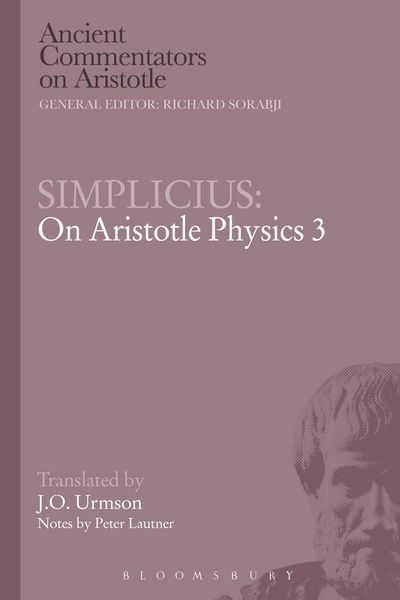
Produktbild: Simplicius: On Aristotle Physics 3

Simplicius: On Aristotle Physics 3

44,49 €

inkl. gesetzl. MwSt.

Beschreibung

Aristotle's Physics Book 3 covers two subjects: the definition of change and the finitude of the universe. Change enters into the very definition of nature as an internal source of change. Change receives two definitions in chapters 1 and 2, as involving the actualisation of the potential or of the changeable....

Beschreibung

Aristotle's Physics Book 3 covers two subjects: the definition of change and the finitude of the universe. Change enters into the very definition of nature as an internal source of change. Change receives two definitions in chapters 1 and 2, as involving the actualisation of the potential or of the changeable. Alexander of Aphrodisias is reported as thinking that the second version is designed to show that Book 3, like Book 5, means to disqualify change in relations from being genuine change. Aristotle's successor Theophrastus, we are told, and Simplicius himself, prefer to admit relational change. Chapter 3 introduces a general causal principle that the activity of the agent causing change is in the patient undergoing change, and that the causing and undergoing are to be counted as only one activity, however different in definition. Simplicius points out that this paves the way for Aristotle's God who moves the heavens, while admitting no motion in himself. It is also the basis of Aristotle's doctrine, central to Neoplatonism, that intellect is one with the objects it contemplates.In defending Aristotle's claim that the universe is spatially finite, Simplicius has to meet Archytas' question, "What happens at the edge?". He replies that, given Aristotle's definition of place, there is nothing, rather than an empty place, beyond the furthest stars, and one cannot stretch one's hand into nothing, nor be prevented by nothing. But why is Aristotle's beginningless universe not temporally infinite? Simplicius answers that the past years no longer exist, so one never has an infinite collection.

Produktdetails

Format

PDF

Kopierschutz

Ja

Family Sharing

Nein

Text-to-Speech

Nein

Produktdetails

Format

PDF

Format

eBooks im PDF-Format haben eine festgelegte Seitengröße und eignen sich daher nur bedingt zum Lesen auf einem tolino eReader oder Smartphone. Für den vollen Lesegenuss empfehlen wir Ihnen bei PDF-eBooks die Verwendung eines Tablets oder Computers.

Kopierschutz

Ja

Kopierschutz

Zum Lesen dieses eBooks auf eReadern außerhalb der tolino Familie sowie am PC benötigen Sie eine Adobe ID. Weitere Hinweise zum Lesen von kopiergeschützten eBooks finden Sie unter Hilfe/Downloads.

Family Sharing

Nein

Family Sharing

Mit Family Sharing können Sie eBooks innerhalb Ihrer Familie (max. sechs Mitglieder im gleichen Haushalt) teilen. Sie entscheiden selbst, welches Buch Sie mit welchem Familienmitglied teilen möchten. Auch das parallele Lesen durch verschiedene Familienmitglieder ist durch Family Sharing möglich. Um eBooks zu teilen oder geteilt zu bekommen, muss jedes Familienmitglied ein Konto bei Thalia oder einem anderen tolino-Buchhändler haben. Weitere Informationen finden Sie unter Hilfe/Family-Sharing.

Text-to-Speech

Nein

Text-to-Speech

Bedeutet Ihnen Stimme mehr als Text? Mit der Funktion Text-to-Speech können Sie sich im tolino webReader und in der aktuellen Thalia – Lesen & Hören App das eBook vorlesen lassen. Weitere Informationen finden Sie unter Hilfe/Text-to-Speech.

Erscheinungsdatum

10.04.2014

Verlag Bloomsbury eBooks UK
Seitenzahl

240 (Printausgabe)

Auflage

1. Auflage

Übersetzt von

J. O. Urmson

Sprache

Englisch

EAN

9781780939001

Barrierefreiheit
  • keine Information zur Barrierefreiheit bekannt

Noch keine Bewertungen vorhanden

Verfassen Sie die erste Bewertung zu diesem Artikel

Helfen Sie anderen Kundinnen und Kunden durch Ihre Meinung.

Kundinnen und Kunden meinen

Bewertungen (0)

Weitere Artikel findest du in

Die Leseprobe wird geladen.
  • Produktbild: Simplicius: On Aristotle Physics 3