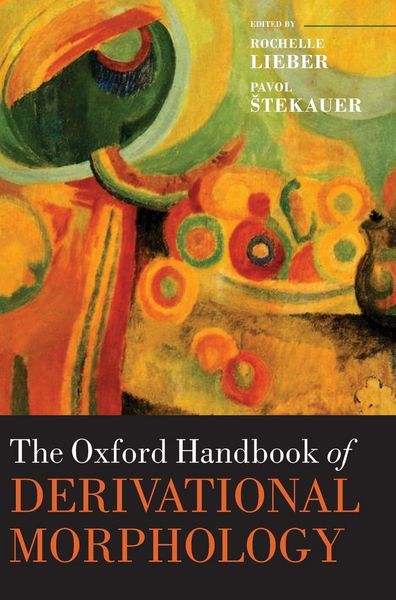
Produktbild: Oxford Handbook of Derivational Morphology

Oxford Handbook of Derivational Morphology

269,99 €

inkl. gesetzl. MwSt., Versandkostenfrei


Beschreibung

Produktdetails

Einband

Gebundene Ausgabe

Erscheinungsdatum

25.09.2014

Herausgeber

Lieber Rochelle + weitere

Verlag

Oxford University Press

Seitenzahl

956

Maße (L/B/H)

25/17,5/5,5 cm

Gewicht

1793 g

Sprache

Englisch

ISBN

978-0-19-964164-2

Beschreibung

Produktdetails

Einband

Gebundene Ausgabe

Erscheinungsdatum

25.09.2014

Herausgeber

Verlag

Oxford University Press

Seitenzahl

956

Maße (L/B/H)

25/17,5/5,5 cm

Gewicht

1793 g

Sprache

Englisch

ISBN

978-0-19-964164-2

Herstelleradresse

Libri GmbH
Europaallee 1
36244 Bad Hersfeld
DE

Email: gpsr@libri.de

Noch keine Bewertungen vorhanden

Verfassen Sie die erste Bewertung zu diesem Artikel

Helfen Sie anderen Kundinnen und Kunden durch Ihre Meinung.

Kundinnen und Kunden meinen

Bewertungen (0)

Die Leseprobe wird geladen.
  • Produktbild: Oxford Handbook of Derivational Morphology
    • Part I

    • 1: Rochelle Lieber and Pavol ¿tekauer: Introduction: The scope of the handbooks

    • 2: Pius ten Hacken: Delineating derivation and inflection

    • 3: Susan Olsen: Delineating derivation and compounding

    • 4: Rochelle Lieber: Theoretical approaches to derivation

    • 5: Mark Aronoff and Mark Lindsay: Productivity, blocking, and lexicalization

    • 6: Rochelle Lieber: Methodological issues in studying derivation

    • 7: Harald Baayen: Experimental and psycholinguistic approaches

    • 8: Laurie Bauer: Concatenative derivation

    • 9: Juliette Blevins: Infixation

    • 10: Salvador Valera: Conversion

    • 11: Sharon Inkelas: Non-concatenative derivation: Reduplication

    • 12: Stuart Davis and Natsuko Tsujimura: Non-concatenative derivation: Other processes

    • 13: Mary Paster: Allomorphy

    • 14: Artemis Alexiadou: Nominal derivation

    • 15: Andrew Koontz-Garboden: Verbal derivation

    • 16: Antonio Fábregas: Adjectival and adverbial derivation

    • 17: Livia Körtvélyessy: Evaluative derivation

    • 18: Gregory Stump: Derivation and function words

    • 19: Franz Rainer: Homophony versus polysemy in derivation

    • 20: Pavol ¿tekauer: Derivational paradigms

    • 21: Pauliina Saarinen and Jennifer Hay: Affix ordering in derivation

    • 22: Carola Trips: Derivation and historical change

    • 23: Livia Körtvélyessy and Pavol ¿tekauer: Derivation in a social context

    • 24: Eve Clark: Acquisition of derivational morphology

    • Part II

    • 25: Sailaja Pingali: Indo-European

    • 26: Ferenc Kiefer and Johanna Laakso: Uralic

    • 27: Irina Nikolaeva: Altaic

    • 28: Edward J. Vajda: Yeniseian

    • 29: Mark J. Alves: Mon-Khmer

    • 30: Robert Blust: Austronesian

    • 31: Denis Creissels: Niger-Congo

    • 32: Erin Shay: Afro-Asiatic

    • 33: Gerrit Dimmendaal: Nilo-Saharan

    • 34: Karen Steffen Chung, Nathan W. Hill, and Jackson T.-S. Sun: Sino-Tibetan

    • 35: Jane Simpson: Pama-Nyungan

    • 36: Keren Rice: Athabaskan

    • 37: Alana Johns: Eskimo-Aleut

    • 38: Gabriela Caballero: Uto-Aztecan

    • 39: Verónica Nercesian: Matacoan

    • 40: Bernd Heine: Areal tendencies in derivation

    • 41: Rochelle Lieber and Pavol ¿tekauer: Universals in derivation