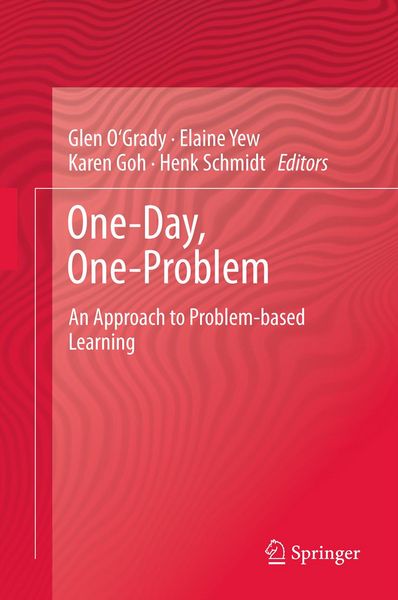
One-Day, One-Problem An Approach to Problem-based Learning
-
- Hardcover
- Taschenbuch ausgewählt
- eBook
-
Sprache:Englisch
92,99 €
UVP
106,99 €
inkl. gesetzl. MwSt.,
Beschreibung
Produktdetails
Einband
Taschenbuch
Erscheinungsdatum
09.05.2014
Abbildungen
VIII, 300 p.
Herausgeber
Glen O'Grady + weitereVerlag
Springer SingaporeSeitenzahl
300
Maße (L/B/H)
23,5/15,5/1,7 cm
Gewicht
470 g
Auflage
1. Auflage
Sprache
Englisch
ISBN
978-981-4560-94-8
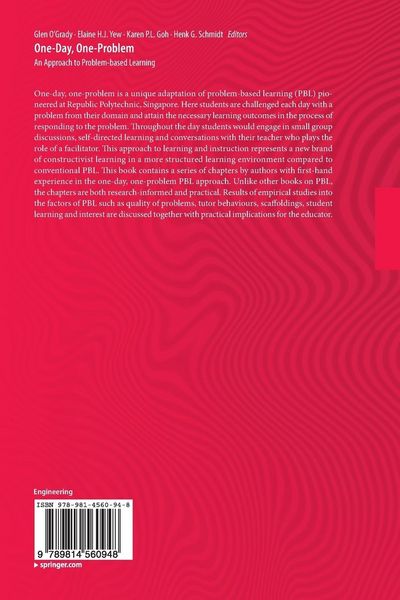
One-day, one-problem is a unique adaptation of problem-based learning (PBL) pioneered at Republic Polytechnic, Singapore. Here students are challenged each day with a problem from their domain and attain the necessary learning outcomes in the process of responding to the problem. Throughout the day students would engage in small group discussions, self-directed learning and conversations with their teacher who plays the role of a facilitator. This approach to learning and instruction represents a new brand of constructivist learning in a more structured learning environment compared to conventional PBL. This book contains a series of chapters by authors with first-hand experience in the One-day,one-problem PBL approach. Unlike other books on PBL, the chapters are both research-informed and practical. Results of empirical studies into the factors of PBL such as quality of problems, tutor behaviours, scaffoldings, student learning and interest are discussed together with practical implications for the educator.
The book begins with an overview of the one-day, one-problem process, providing a viewpoint from both the student and tutor. Republic Polytechnic’s pedagogical philosophy and epistemological belief of education are introduced with the intent to share how the polytechnic designed and implemented a system that supports the philosophical beliefs. Results and practical implications of empirical studies on the various factors that influence students’ learning in PBL are discussed. These include the quality of problems and the use of scaffoldings for students’ learning, tutors as facilitators, preparation of staff for PBL, student assessment, how students learn in the process of PBL and student interest.
Noch keine Bewertungen vorhanden
Verfassen Sie die erste Bewertung zu diesem Artikel
Helfen Sie anderen Kundinnen und Kunden durch Ihre Meinung.
Kurze Frage zu unserer Seite
Vielen Dank für dein Feedback
Wir nutzen dein Feedback, um unsere Produktseiten zu verbessern. Bitte habe Verständnis, dass wir dir keine Rückmeldung geben können. Falls du Kontakt mit uns aufnehmen möchtest, kannst du dich aber gerne an unseren Kund*innenservice wenden.
zum Kundenservice