Gutscheinbedingungen

**Gültig vom 15.06.2026 bis 17.06.2026 | Gültig für nicht preisgebundene fremdsprachige Bücher | Einzelne Artikel können ausgeschlossen sein | Maximaler rabattfähiger Warenkorbwert 500 € | Nicht kombinierbar mit weiteren Aktionen | Nur einmal pro Person einlösbar | Nur solange der Vorrat reicht

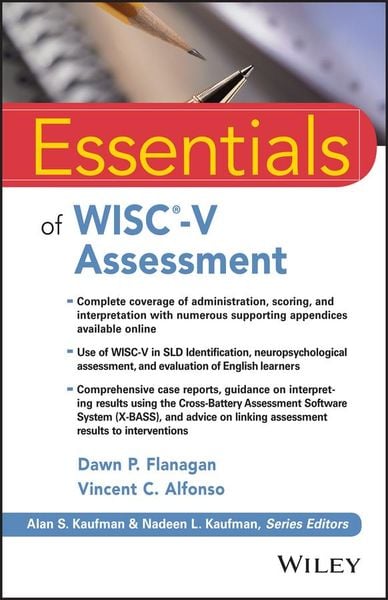
Produktbild: Essentials of WISC-V Assessment

Essentials of WISC-V Assessment

56,99 €

inkl. gesetzl. MwSt., Versandkostenfrei

Lieferung nach Hause

Beschreibung

Produktdetails

Einband

Taschenbuch

Erscheinungsdatum

07.04.2017

Verlag

John Wiley & Sons

Seitenzahl

656

Maße (L/B/H)

21,6/13,6/5 cm

Gewicht

751 g

Auflage

1. Auflage

Sprache

Englisch

ISBN

978-1-118-98087-3

Beschreibung

Produktdetails

Einband

Taschenbuch

Erscheinungsdatum

07.04.2017

Verlag

John Wiley & Sons

Seitenzahl

656

Maße (L/B/H)

21,6/13,6/5 cm

Gewicht

751 g

Auflage

1. Auflage

Sprache

Englisch

ISBN

978-1-118-98087-3

Herstelleradresse

Libri GmbH
Europaallee 1
36244 Bad Hersfeld
DE

Email: gpsr@libri.de

Kundinnen und Kunden meinen

0 Bewertungen

Informationen zu Bewertungen

Zur Abgabe einer Bewertung ist eine Anmeldung im Konto notwendig. Die Authentizität der Bewertungen wird von uns nicht überprüft. Wir behalten uns vor, Bewertungstexte, die unseren Richtlinien widersprechen, entsprechend zu kürzen oder zu löschen.

Die Bewertungen sind nach Format, Anzahl Sterne und Datum sortiert.

Verfassen Sie die erste Bewertung zu diesem Artikel

Helfen Sie anderen Kund*innen durch Ihre Meinung

Kundinnen und Kunden meinen

0 Bewertungen filtern

Die Leseprobe wird geladen.
  • Produktbild: Essentials of WISC-V Assessment
  • Acknowledgements
    Series Preface
    Foreword
    Susie Engi Raiford, PhD; Pearson Clinical Assessment; San Antonio, Texas
    Chapter 1: Overview of the WISC-V
    W. Joel Schneider, Ph.D.; Dawn P. Flanagan, Ph.D.; and Vincent C. Alfonso, Ph.D.
    From Prediction to Prevention
    From Explanation to Enduring Empathy
    General Trends in Intelligence Test Interpretation
    Why the History of the Wechsler Scales Matters
    Description of the WISC-V
    Test Yourself
    References
    Chapter Two: How to Administer the WISC-V
    Appropriate Testing Conditions
    Rapport with Examinee
    Testing Individuals with Special Needs
    Administration Considerations
    Rules for Starting and Discontinuing Subtests
    Recording Responses
    Timing
    Querying
    Subtest-By-Subtest Rules of Administration of the WISC-V Primary Subtests
    Subtest-by-Subtest Rules of Administration of the WISC-V Secondary & Complementary Subtests
    Frequently Asked Questions: Subtest Administration
    Test Yourself
    References
    Chapter 3: How to Score the WISC-V
    Types of Scores
    Step-by-Step: How the WISC-V is Scored
    Test Yourself
    References
    Chapter 4: How to Interpret The WISC-V
    Getting Started
    WISC-V Interpretation Step-by-Step
    Conclusion
    Test Yourself
    References
    Chapter 5: Strengths and Weaknesses of the WISC-V
    Test Yourself
    References
    Chapter 6: A Neuropsychological Approach to Interpretation of the WISC-V
    George McCloskey, Ph.D.; Jamie Slonim; Robert Whitaker, Psy.S. NCSP, ABSNP; Samantha Kaufman; Naoko Nagoshi, Ph.D.
    Introduction
    Levels of Interpretation
    Neuropsychological Interpretation of WISC-V Performance
    WISC-V Complementary Subtests
    Summary
    Test Yourself
    References
    Chapter 7: Use of the WISC-V in the Identification of Specific Learning Disabilities
    The Dual Discrepancy/Consistency Operational Definition of SLD
    Using X-BASS for SLD Identification: Three Steps to PSW Output
    PSW-A Data Summary
    PSW-A g-Value Data Summary
    Dual Discrepancy/Consistency Model: PSW Analyses for SLD
    Conclusions
    Test Yourself
    References
    Chapter 8: Illustrative Case Report
    Erin M. McDonough, Ph.D.
    Psycho-Educational Evaluation Report
    Chapter 9: Assessment of English Learners with the WISC-V
    Samuel O. Ortiz, Ph.D.; Kristan E. Melo, M.S.; Meghan A. Opperman, B.A.
    Introduction
    Fairness, Bias, and Traditional Assessment Approaches
    A Recommended Best Practice Approach
    Best Practices in the Evaluation of ELs with the WISC-V
    Case Study: Jose Maria
    Conclusion
    Test Yourself
    References
    Chapter 10: WISC-V and Q-interactive
    Carlea Dries, M.A., M.Ed., N.C.C.; Ron Dumont, Ed.D., NCSP; Kathleen D. Viezel, Ph.D., NCSP
    Introduction
    Digital Platform
    Hardware
    Software
    Setup
    Administration
    Training and Tech Support
    Output
    Security and Legal Issues
    Considerations for University Trainers
    Pricing
    Overall Impressions and Recommendations
    Test Yourself
    References
    Epilogue: Dorothea McCarthy Remembered
    Alan S. Kaufman, Ph.D.
    References
    Appendix A: A Brief Overview of the Cattell-Horn-Carroll (CHC) Theory
    Appendix B: Norms Tables for New Clinical Composites
    Appendix C: Case Reports
    Gail Cheramie, Ph.D.; Jamie Chaffin, Ed.D.; Robert Lichtenstein, Ph.D.
    Comprehensive Evaluation
    Psychoeducational Report
    Psychoeducational Assessment Report
    Appendix D: Form for Manifestations of Cognitive Weaknesses
    Appendix E: Definition of Terms and Clarification of Concepts Used in the DD/C Definition and X-BASS
    Appendix F: Task Characteristics of WISC-V Subtests
    Appendix G: Cognitive Constructs Assessed with the WISC-V Subtests
    Verbal Comprehension Domain Subtests
    Cognitive Constructs Assessed with the Fluid Reasoning and Visual Spatial Subtests
    Cognitive Capacities Assessed with the Working Memory Subtests and the Arithmetic and Immediate Symbol Translation Subtests
    Cognitive Constructs assessed with the Processing Speed Subtests
    Cognitive Constructs assessed with the Naming Speed Subtests
    Cognitive Constructs Assessed with the Symbol Translation Tasks
    Appendix H: Behavior Observations and Process-oriented Assessment at the Subtest, Item, and Cognitive Construct Levels
    Verbal Comprehension Subtests
    Fluid Reasoning and Visual Spatial Subtests
    Working Memory Domain and Arithmetic and Symbol Translation Subtests
    Processing Speed Subtests
    Naming Speed Subtests
    Appendix I: Cluster Analysis Interpretation
    Steps for Completing Subtest Cluster Analyses
    Verbal Comprehension Clinical Clusters and Cluster Contrasts
    Verbal Comprehension Clinical Cluster Contrasts
    Fluid Reasoning and Visual Spatial Clinical Clusters and Cluster Contrasts
    Fluid Reasoning/Visual Spatial Clinical Cluster Contrasts
    Working Memory Clinical Clusters and Clinical Cluster Contrasts
    Appendix J: Subtest and Process Score Comparison Worksheets
    Appendix K: CBRS Scores
    Appendix L: Cross-Battery Assessment Software System (X-BASS): Dual-Discrepancy/Consistency Model: PSW Results for Amanda Farris
    Appendix M: Factors That May Facilitate Learning and Aid in Bypassing or Minimizing the Effects of Deficits
    About the Authors
    Contributors