
KI-Beratung Beta

Gutscheinbedingungen

**Gültig vom 23.11. bis 30.11.2026 | Gültig für nicht preisgebundene fremdsprachige Bücher | Einzelne Artikel können ausgeschlossen sein | Online auf www.bücher.de einlösbar | Click & Collect nur mit Online-Zahlung (Paypal/Kreditkarte) vorab | Nicht kombinierbar mit anderen Gutscheinen oder Preisaktionen | Nur einmal pro Einkauf einlösbar | Gutschein wird auf max. 500€ Bestellwert angerechnet | Keine Barauszahlung | Nicht gültig für Versandkosten und Services

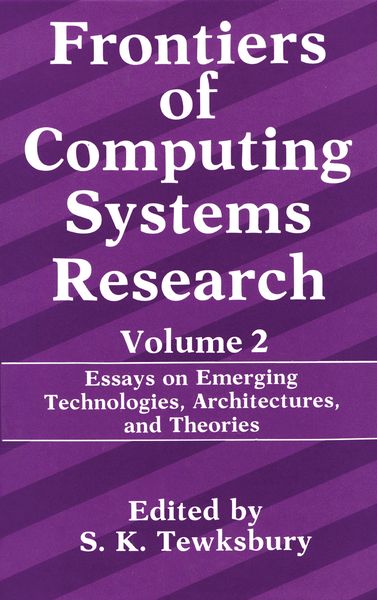
  • Produktbild: Frontiers of Computing Systems Research
  • Produktbild: Frontiers of Computing Systems Research
Band 2

Frontiers of Computing Systems Research Essays on Emerging Technologies, Architectures, and Theories

53,99 €

inkl. gesetzl. MwSt., Versandkostenfrei


Beschreibung

Intended for an interdisciplinary audience involved in computer systems research, this second volume presents technical information on emerging topics in the field.

Beschreibung

Intended for an interdisciplinary audience involved in computer systems research, this second volume presents technical information on emerging topics in the field.

Produktdetails

Einband

Taschenbuch

Erscheinungsdatum

25.11.2012

Abbildungen

X, 384 p. 51 illus.

Herausgeber Stuart K. Tewksbury

Produktdetails

Einband

Taschenbuch

Erscheinungsdatum

25.11.2012

Abbildungen

X, 384 p. 51 illus.

Herausgeber Stuart K. Tewksbury
Verlag Springer Us
Seitenzahl

384

Maße (L/B/H)

22,9/15,2/2,1 cm

Gewicht

561 g

Auflage

1991

Sprache

Englisch

ISBN

978-1-4615-7034-9

Herstelleradresse

Springer-Verlag GmbH
Tiergartenstr. 17
69121 Heidelberg
DE

Email: ProductSafety@springernature.com

Noch keine Bewertungen vorhanden

Verfassen Sie die erste Bewertung zu diesem Artikel

Helfen Sie anderen Kundinnen und Kunden durch Ihre Meinung.

Kundinnen und Kunden meinen

Bewertungen (0)

  • Produktbild: Frontiers of Computing Systems Research
  • Produktbild: Frontiers of Computing Systems Research
  • 1 Limits of Information Processing Systems.- 1.1 Introduction.- 1.2 Physical Nature of Systems.- 1.3 Devices.- 1.4 Information Storage.- 1.5 Communication.- 1.6 Heat Removal.- 1.7 Conclusion.- References.- 2 The Limitations of Interconnections in Providing Communication between an Array of Points.- 2.1 Introduction.- 2.2 Some Definitions.- 2.3 System Model.- 2.4 Optical Interconnections.- 2.5 Normally Conducting Interconnections.- 2.6 Repeatered Normally Conducting Interconnections.- 2.7 Superconducting Interconnections.- 2.8 Discussion.- 2.9 Towards Unifying Physical and Algorithmic Approaches.- 2.10 Summary and Conclusions.- A Appendix.- References.- 3 Optics in Multiple-Instruction, Multiple-Data Stream Computers.- 3.1 Introduction.- 3.2 Interconnection Networks for Massive Parallel Computers.- 3.3 An Electro-Optic Communication System.- 3.4 A Reconfigurable Optical Interconnection Protocol.- 3.5 Fabrication Processes Suitable to Realize an OELE.- 3.6 A New Class of Opto-Electronic Logic Elements.- 3.7 Future Research in the ‘DPP9X’ Computer Project.- A Appendix.- References.- 4 Clouds, Computers and Complexity.- 4.1 Interconnection Complexity.- 4.2 Clouds and Computers.- 4.3 Fractals and Entropy.- 4.4 Discussion.- 4.5 Conclusion.- References.- 5 Experimental Studies of Analog Neural Networks.- 5.1 Introduction.- 5.2 Adaptive Networks and Analog Electronic Hardware.- 5.3 Optically Controlled Adaptive Network.- 5.4 Network Performance.- 5.5 Signal Prediction.- 5.6 Simulation Results.- 5.7 Scaling Considerations.- 5.8 An Application of an Analog Neural Network.- 5.9 Future Prospects for Analog Neural Networks.- References.- 6 Complex Behavior in Networks with Distributed Routing.- 6.1 Introduction.- 6.2 Physical Model of Distributed Networks.- 6.3 DynamicBehavior.- 6.4 Phase Transition in Mesh Networks.- 6.5 Conclusions.- References.- 7 New Approaches in System-Level Diagnosis.- 7.1 Fault Diagnosis in Multi-Processor Systems.- 7.2 System-Level Diagnosis.- 7.3 Classification of Diagnosable Systems.- 7.4 Diagnosability Algorithms.- 7.5 Diagnosis Algorithms.- 7.6 Summary and Conclusions.- References.