KI-Beratung Beta

Gutscheinbedingungen

**Gültig vom 23.11. bis 30.11.2026 | Gültig für nicht preisgebundene fremdsprachige Bücher | Einzelne Artikel können ausgeschlossen sein | Online auf www.bücher.de einlösbar | Click & Collect nur mit Online-Zahlung (Paypal/Kreditkarte) vorab | Nicht kombinierbar mit anderen Gutscheinen oder Preisaktionen | Nur einmal pro Einkauf einlösbar | Gutschein wird auf max. 500€ Bestellwert angerechnet | Keine Barauszahlung | Nicht gültig für Versandkosten und Services

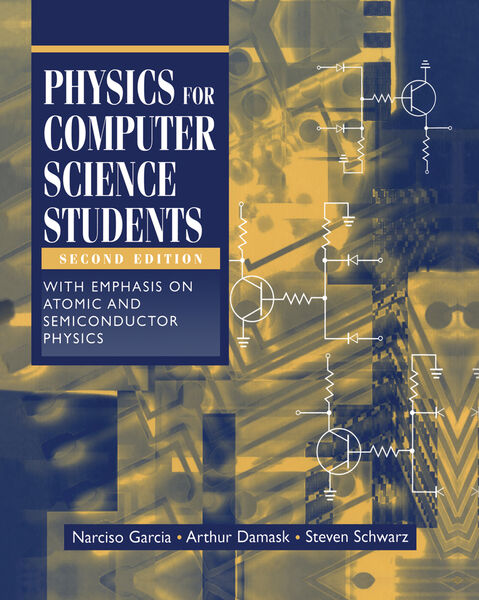
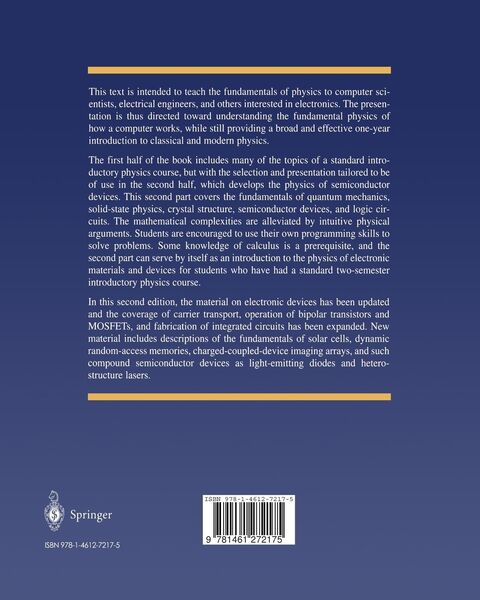
  • Produktbild: Physics for Computer Science Students
  • Produktbild: Physics for Computer Science Students

Physics for Computer Science Students With Emphasis on Atomic and Semiconductor Physics

53,99 €

inkl. gesetzl. MwSt., Versandkostenfrei


Beschreibung

presentation of the classical and quantum free electron theories and their successes and shortcomings (Chapter 23). In order to explain the large differences in the electrical properties of solids as well as the peculiar properties of semiconductors, the existence of allowed and forbidden energy bands...

Beschreibung

presentation of the classical and quantum free electron theories and their successes and shortcomings (Chapter 23). In order to explain the large differences in the electrical properties of solids as well as the peculiar properties of semiconductors, the existence of allowed and forbidden energy bands is investigated (Chapter 24). In this chapter, we introduce the concepts of the electron effective mass and of holes. Intrinsic and doped semiconductors, their electron and hole densities, and their electrical properties are discussed in Chapter 25. It is now a rather simple matter for the student to understand the behavior and the characteristics of semiconductor devices: diodes, bipolar transistors, field effect transistors, etc. Semiconductor devices are the subject of Chapter 26. The text concludes with two chapters unique to this physics textbook. In Chapter 27, we show how diodes and transistors can be used to construct the logic circuits (gates) that constitute the fundamental building blocks of the computer. Chapter 28 is a layman'S introduction to some of the techniques used in the fabrication of integrated circuits. The laboratory experiments for the first semester are standard in any physics department, and thus we do not feel that is is necessary to include them in this book.

Produktdetails

Einband

Taschenbuch

Erscheinungsdatum

23.10.2012

Abbildungen

XIX, 560 p.

Verlag Springer Us

Produktdetails

Einband

Taschenbuch

Erscheinungsdatum

23.10.2012

Abbildungen

XIX, 560 p.

Verlag Springer Us
Seitenzahl

560

Maße (L/B/H)

25,6/20,7/3,3 cm

Gewicht

1234 g

Auflage

Second Edition 1998

Sprache

Englisch

ISBN

978-1-4612-7217-5

Herstelleradresse

Libri GmbH
Europaallee 1
36244 Bad Hersfeld
DE

Email: gpsr@libri.de

Noch keine Bewertungen vorhanden

Verfassen Sie die erste Bewertung zu diesem Artikel

Helfen Sie anderen Kundinnen und Kunden durch Ihre Meinung.

Kundinnen und Kunden meinen

Bewertungen (0)

  • Produktbild: Physics for Computer Science Students
  • Produktbild: Physics for Computer Science Students
  • 1 Physical Quantities.- 2 Vectors.- 3 Uniformly Accelerated Motion.- 4 Newton’s Laws.- 5 Work, Energy, and Power.- 6 Momentum and Collisions.- 7 Rotational Motion.- 8 Rotational Dynamics.- 9 Kinetic Theory of Gases and the Concept of Temperature.- 10 Oscillatory Motion.- 11 Wave Motion.- 12 Interference of Waves.- 13 Electrostatics.- 14 The Electric Field and the Electric Potential.- 15 Electric Current.- 16 Magnetic Fields and Electromagnetic Waves.- 17 The Beginning of the Quantum Story.- 18 Atomic Models.- 19 Fundamental Principles of Quantum Mechanics.- 20 An Introduction to the Methods of Quantum Mechanics.- 21 Quantum Mechanics of Atoms.- 22 Crystal Structures and Bonding in Solids.- 23 Free Electron Theories of Solids.- 24 Band Theory of Solids.- 25 Semiconductors.- 26 Semiconductor Devices.- 27 Some Basic Logic Circuits of Computers.- 28 The Technology of Manufacturing Integrated Circuits.- Photo Credits.