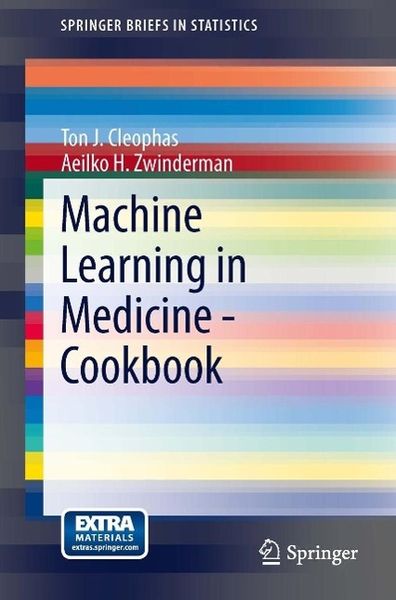
Machine Learning in Medicine - Cookbook
-
- Taschenbuch
- eBook ausgewählt
-
Form:Einzelkauf Download
-
Sprache:Englisch
53,49 €
inkl. gesetzl. MwSt.Beschreibung
Produktdetails
Format
Kopierschutz
Nein
Family Sharing
Nein
Text-to-Speech
Nein
Erscheinungsdatum
03.01.2014
Verlag
Springer Nature SwitzerlandSeitenzahl
137 (Printausgabe)
Dateigröße
2130 KB
Sprache
Englisch
EAN
9783319041810
The amount of data in medical databases doubles every 20 months, and physicians are at a loss to analyze them. Also, traditional methods of data analysis have difficulty to identify outliers and patterns in big data and data with multiple exposure / outcome variables and analysis-rules for surveys and questionnaires, currently common methods of data collection, are, essentially, missing.
Obviously, it is time that medical and health professionals mastered their reluctance to use machine learning and the current 100 page cookbook should be helpful to that aim. It covers in a condensed form the subjects reviewed in the 750 page three volume textbook by the same authors, entitled "Machine Learning in Medicine I-III" (ed. by Springer, Heidelberg, Germany, 2013) and was written as a hand-hold presentation and must-read publication. It was written not only to investigators and students in the fields, but also to jaded clinicians new to the methods and lacking time to read the entire textbooks.
General purposes and scientific questions of the methods are only briefly mentioned, but full attention is given to the technical details. The two authors, a statistician and current president of the International Association of Biostatistics and a clinician and past-president of the American College of Angiology, provide plenty of step-by-step analyses from their own research and data files for self-assessment are available at extras.springer.com.
From their experience the authors demonstrate that machine learning performs sometimes better than traditional statistics does. Machine learning may have little options for adjusting confounding and interaction, but you can add propensity scores and interaction variables to almost any machine learning method.
Noch keine Bewertungen vorhanden
Verfassen Sie die erste Bewertung zu diesem Artikel
Helfen Sie anderen Kundinnen und Kunden durch Ihre Meinung.
Kurze Frage zu unserer Seite
Vielen Dank für dein Feedback
Wir nutzen dein Feedback, um unsere Produktseiten zu verbessern. Bitte habe Verständnis, dass wir dir keine Rückmeldung geben können. Falls du Kontakt mit uns aufnehmen möchtest, kannst du dich aber gerne an unseren Kund*innenservice wenden.
zum Kundenservice