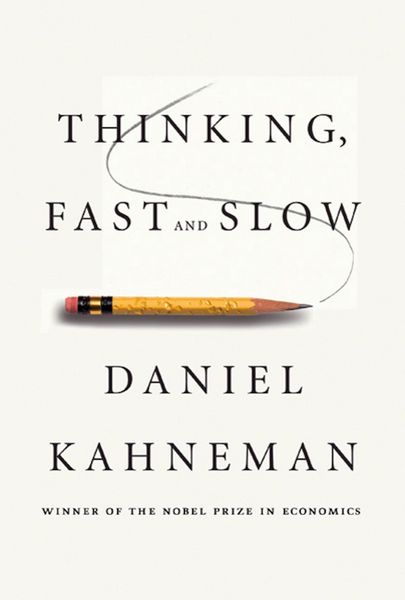
Produktbild: Thinking, Fast and Slow

Thinking, Fast and Slow

8

14,99 €

inkl. gesetzl. MwSt.

Beschreibung

Produktdetails

Verkaufsrang

20576

Format

ePUB

Kopierschutz

Ja

Family Sharing

Nein

Text-to-Speech

Ja

Erscheinungsdatum

25.10.2011

Verlag

Farrar, Straus and Giroux

Seitenzahl

512 (Printausgabe)

Dateigröße

3950 KB

Sprache

Englisch

EAN

9781429969352

Beschreibung

Produktdetails

Format

ePUB

eBooks im ePUB-Format erlauben eine dynamische Anpassung des Inhalts an die jeweilige Display-Größe des Lesegeräts. Das Format eignet sich daher besonders für das Lesen auf mobilen Geräten, wie z.B. Ihrem tolino, Tablets oder Smartphones.

Kopierschutz

Ja

Zum Lesen dieses eBooks auf Geräten der tolino Familie sowie auf sonstigen eReadern und am PC benötigen Sie eine Adobe ID. Weitere Hinweise zum Lesen von kopiergeschützten eBooks finden Sie unter Hilfe/Downloads.

Family Sharing

Nein

Mit Family Sharing können Sie eBooks innerhalb Ihrer Familie (max. sechs Mitglieder im gleichen Haushalt) teilen. Sie entscheiden selbst, welches Buch Sie mit welchem Familienmitglied teilen möchten. Auch das parallele Lesen durch verschiedene Familienmitglieder ist durch Family Sharing möglich. Um eBooks zu teilen oder geteilt zu bekommen, muss jedes Familienmitglied ein Konto bei Thalia oder einem anderen tolino-Buchhändler haben. Weitere Informationen finden Sie unter Hilfe/Family-Sharing.

Text-to-Speech

Ja

Bedeutet Ihnen Stimme mehr als Text? Mit der Funktion Text-to-Speech können Sie sich im tolino webReader und in der aktuellen Thalia – Lesen & Hören App das eBook vorlesen lassen. Weitere Informationen finden Sie unter Hilfe/Text-to-Speech.

Barrierefreiheit

  • keine Information zur Barrierefreiheit bekannt

Verkaufsrang

20576

Erscheinungsdatum

25.10.2011

Verlag

Farrar, Straus and Giroux

Seitenzahl

512 (Printausgabe)

Dateigröße

3950 KB

Sprache

Englisch

EAN

9781429969352

Kundinnen und Kunden meinen

8 Bewertungen

Informationen zu Bewertungen

Zur Abgabe einer Bewertung ist eine Anmeldung im Konto notwendig. Die Authentizität der Bewertungen wird von uns nicht überprüft. Wir behalten uns vor, Bewertungstexte, die unseren Richtlinien widersprechen, entsprechend zu kürzen oder zu löschen.

Die Bewertungen sind nach Format, Anzahl Sterne und Datum sortiert.

5 Sterne

4 Sterne

3 Sterne

2 Sterne

(0)

1 Sterne

(0)

Essential

Bewertung am 15.10.2025

Bewertungsnummer: 2626724

Bewertet: Buch (Gebundene Ausgabe)

Essential book to read for general knowledge and personal development. It will chance the way you think and decide. Even though I was not even interested in economics, the book have me the most interesting side of it and combines it with psychology. I think I will study Economical Psychology

Essential

Bewertung am 15.10.2025
Bewertungsnummer: 2626724
Bewertet: Buch (Gebundene Ausgabe)

Essential book to read for general knowledge and personal development. It will chance the way you think and decide. Even though I was not even interested in economics, the book have me the most interesting side of it and combines it with psychology. I think I will study Economical Psychology

A great read, which explains the risks and trivialities of how we humans think.

Bewertung aus Zofingen am 26.02.2024

Bewertungsnummer: 2140080

Bewertet: Buch (Gebundene Ausgabe)

The author, Daniel Kahneman, is a psychologist, whose scientific research was often in the field of economics. A great deal of his work was done in cooperation with his colleague and friend Amos Tversky, whom he describes with great care and fondness. In his book professor Kahneman explains how we humans have two modes of thinking, the fast intuitive, automated thinking (System 1) and the slow, rational, thoughtful, but lazy System 2. The book is especially about System 1 and the mistakes it tends to make, its biasses and its other positive and negative qualities. It covers a wide spectrum of interesting places, persons and situations, where one can see our biases at work. It is a revelation that even folks, who should know better, as professionals, tend to ‘make the same kind of mistakes’ as us mortals with our by nature given biases. As professor Kahneman in his ‘Conclusion’ of the book explicitly states: “we all would like to have a warning bell that rings loudly whenever we are about to make a serious error, but no such bell is available”. He hopes that by reading his book, the reader has somewhat of an aid to recognize ‘dangerous’ situations, where he/she has to become careful or rather be on his/her guard. I did not find the book an easy read though, I must confess, partly because of the writing style of the author, but also because of the many back referrals to subjects in former chapters of which the reader, being a lay man in the field, has already lost the details. But all that taken together, in case you want to know more about how we as humans, think, I strongly advise to work yourself through - Nobel Prize winner - Daniel Kahnemann's book 'Thinking fast and slow', a great read, which explains the risks and trivialities of how we humans think.

A great read, which explains the risks and trivialities of how we humans think.

Bewertung aus Zofingen am 26.02.2024
Bewertungsnummer: 2140080
Bewertet: Buch (Gebundene Ausgabe)

The author, Daniel Kahneman, is a psychologist, whose scientific research was often in the field of economics. A great deal of his work was done in cooperation with his colleague and friend Amos Tversky, whom he describes with great care and fondness. In his book professor Kahneman explains how we humans have two modes of thinking, the fast intuitive, automated thinking (System 1) and the slow, rational, thoughtful, but lazy System 2. The book is especially about System 1 and the mistakes it tends to make, its biasses and its other positive and negative qualities. It covers a wide spectrum of interesting places, persons and situations, where one can see our biases at work. It is a revelation that even folks, who should know better, as professionals, tend to ‘make the same kind of mistakes’ as us mortals with our by nature given biases. As professor Kahneman in his ‘Conclusion’ of the book explicitly states: “we all would like to have a warning bell that rings loudly whenever we are about to make a serious error, but no such bell is available”. He hopes that by reading his book, the reader has somewhat of an aid to recognize ‘dangerous’ situations, where he/she has to become careful or rather be on his/her guard. I did not find the book an easy read though, I must confess, partly because of the writing style of the author, but also because of the many back referrals to subjects in former chapters of which the reader, being a lay man in the field, has already lost the details. But all that taken together, in case you want to know more about how we as humans, think, I strongly advise to work yourself through - Nobel Prize winner - Daniel Kahnemann's book 'Thinking fast and slow', a great read, which explains the risks and trivialities of how we humans think.

Kundinnen und Kunden meinen

Thinking, Fast and Slow

von Daniel Kahneman

0 Bewertungen filtern

Weitere Artikel findest du in

Die Leseprobe wird geladen.
  • Produktbild: Thinking, Fast and Slow