Band 1
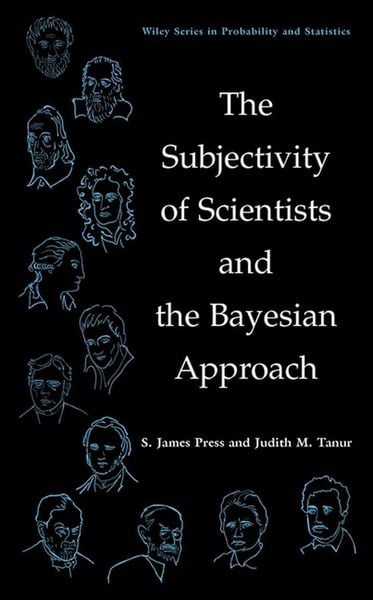
The Subjectivity of Scientists and the Bayesian Approach
Aus der Reihe
Wiley Series in Probability and Statistics
143,99 €
inkl. gesetzl. MwSt.Beschreibung
Produktdetails
Format
Kopierschutz
Ja
Family Sharing
Nein
Text-to-Speech
Nein
Erscheinungsdatum
20.01.2012
Verlag
John Wiley & SonsSeitenzahl
296 (Printausgabe)
Dateigröße
15241 KB
Auflage
1. Auflage
Sprache
Englisch
EAN
9781118150627
Comparing and contrasting the reality of subjectivity in the work
of history's great scientists and the modern Bayesian approach to
statistical analysis
Scientists and researchers are taught to analyze their data from an
objective point of view, allowing the data to speak for themselves
rather than assigning them meaning based on expectations or
opinions. But scientists have never behaved fully objectively.
Throughout history, some of our greatest scientific minds have
relied on intuition, hunches, and personal beliefs to make sense of
empirical data-and these subjective influences have often aided in
humanity's greatest scientific achievements. The authors argue that
subjectivity has not only played a significant role in the
advancement of science, but that science will advance more rapidly
if the modern methods of Bayesian statistical analysis replace some
of the classical twentieth-century methods that have traditionally
been taught.
To accomplish this goal, the authors examine the lives and work of
history's great scientists and show that even the most successful
have sometimes misrepresented findings or been influenced by their
own preconceived notions of religion, metaphysics, and the occult,
or the personal beliefs of their mentors. Contrary to popular
belief, our greatest scientific thinkers approached their data with
a combination of subjectivity and empiricism, and thus informally
achieved what is more formally accomplished by the modern Bayesian
approach to data analysis.
Yet we are still taught that science is purely objective. This
innovative book dispels that myth using historical accounts and
biographical sketches of more than a dozen great scientists,
including Aristotle, Galileo Galilei, Johannes Kepler, William
Harvey, Sir Isaac Newton, Antoine Levoisier, Alexander von
Humboldt, Michael Faraday, Charles Darwin, Louis Pasteur, Gregor
Mendel, Sigmund Freud, Marie Curie, Robert Millikan, Albert
Einstein, Sir Cyril Burt, and Margaret Mead. Also included is a
detailed treatment of the modern Bayesian approach to data
analysis. Up-to-date references to the Bayesian theoretical and
applied literature, as well as reference lists of the primary
sources of the principal works of all the scientists discussed,
round out this comprehensive treatment of the subject.
Readers will benefit from this cogent and enlightening view of the
history of subjectivity in science and the authors' alternative
vision of how the Bayesian approach should be used to further the
cause of science and learning well into the twenty-first century.
of history's great scientists and the modern Bayesian approach to
statistical analysis
Scientists and researchers are taught to analyze their data from an
objective point of view, allowing the data to speak for themselves
rather than assigning them meaning based on expectations or
opinions. But scientists have never behaved fully objectively.
Throughout history, some of our greatest scientific minds have
relied on intuition, hunches, and personal beliefs to make sense of
empirical data-and these subjective influences have often aided in
humanity's greatest scientific achievements. The authors argue that
subjectivity has not only played a significant role in the
advancement of science, but that science will advance more rapidly
if the modern methods of Bayesian statistical analysis replace some
of the classical twentieth-century methods that have traditionally
been taught.
To accomplish this goal, the authors examine the lives and work of
history's great scientists and show that even the most successful
have sometimes misrepresented findings or been influenced by their
own preconceived notions of religion, metaphysics, and the occult,
or the personal beliefs of their mentors. Contrary to popular
belief, our greatest scientific thinkers approached their data with
a combination of subjectivity and empiricism, and thus informally
achieved what is more formally accomplished by the modern Bayesian
approach to data analysis.
Yet we are still taught that science is purely objective. This
innovative book dispels that myth using historical accounts and
biographical sketches of more than a dozen great scientists,
including Aristotle, Galileo Galilei, Johannes Kepler, William
Harvey, Sir Isaac Newton, Antoine Levoisier, Alexander von
Humboldt, Michael Faraday, Charles Darwin, Louis Pasteur, Gregor
Mendel, Sigmund Freud, Marie Curie, Robert Millikan, Albert
Einstein, Sir Cyril Burt, and Margaret Mead. Also included is a
detailed treatment of the modern Bayesian approach to data
analysis. Up-to-date references to the Bayesian theoretical and
applied literature, as well as reference lists of the primary
sources of the principal works of all the scientists discussed,
round out this comprehensive treatment of the subject.
Readers will benefit from this cogent and enlightening view of the
history of subjectivity in science and the authors' alternative
vision of how the Bayesian approach should be used to further the
cause of science and learning well into the twenty-first century.
Noch keine Bewertungen vorhanden
Verfassen Sie die erste Bewertung zu diesem Artikel
Helfen Sie anderen Kundinnen und Kunden durch Ihre Meinung.
Kurze Frage zu unserer Seite
Vielen Dank für dein Feedback
Wir nutzen dein Feedback, um unsere Produktseiten zu verbessern. Bitte habe Verständnis, dass wir dir keine Rückmeldung geben können. Falls du Kontakt mit uns aufnehmen möchtest, kannst du dich aber gerne an unseren Kund*innenservice wenden.
zum Kundenservice