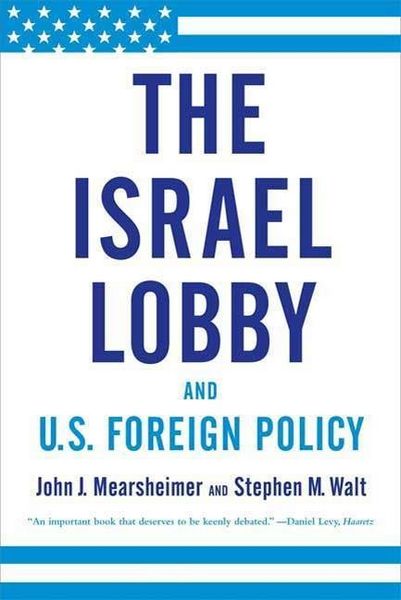
Produktbild: The Israel Lobby and U.S. Foreign Policy

The Israel Lobby and U.S. Foreign Policy

1

13,49 €

inkl. gesetzl. MwSt.

Beschreibung

Produktdetails

Format

ePUB

Kopierschutz

Ja

Family Sharing

Nein

Text-to-Speech

Ja

Erscheinungsdatum

04.09.2007

Verlag

Farrar, Straus and Giroux

Seitenzahl

496 (Printausgabe)

Dateigröße

2309 KB

Sprache

Englisch

EAN

9781429932820

Beschreibung

Produktdetails

Format

ePUB

eBooks im ePUB-Format erlauben eine dynamische Anpassung des Inhalts an die jeweilige Display-Größe des Lesegeräts. Das Format eignet sich daher besonders für das Lesen auf mobilen Geräten, wie z.B. Ihrem tolino, Tablets oder Smartphones.

Kopierschutz

Ja

Zum Lesen dieses eBooks auf Geräten der tolino Familie sowie auf sonstigen eReadern und am PC benötigen Sie eine Adobe ID. Weitere Hinweise zum Lesen von kopiergeschützten eBooks finden Sie unter Hilfe/Downloads.

Family Sharing

Nein

Mit Family Sharing können Sie eBooks innerhalb Ihrer Familie (max. sechs Mitglieder im gleichen Haushalt) teilen. Sie entscheiden selbst, welches Buch Sie mit welchem Familienmitglied teilen möchten. Auch das parallele Lesen durch verschiedene Familienmitglieder ist durch Family Sharing möglich. Um eBooks zu teilen oder geteilt zu bekommen, muss jedes Familienmitglied ein Konto bei Thalia oder einem anderen tolino-Buchhändler haben. Weitere Informationen finden Sie unter Hilfe/Family-Sharing.

Text-to-Speech

Ja

Bedeutet Ihnen Stimme mehr als Text? Mit der Funktion Text-to-Speech können Sie sich im tolino webReader und in der aktuellen Thalia – Lesen & Hören App das eBook vorlesen lassen. Weitere Informationen finden Sie unter Hilfe/Text-to-Speech.

Barrierefreiheit

  • keine Information zur Barrierefreiheit bekannt

Erscheinungsdatum

04.09.2007

Verlag

Farrar, Straus and Giroux

Seitenzahl

496 (Printausgabe)

Dateigröße

2309 KB

Sprache

Englisch

EAN

9781429932820

Kundinnen und Kunden meinen

1 Bewertungen

Informationen zu Bewertungen

Zur Abgabe einer Bewertung ist eine Anmeldung im Konto notwendig. Die Authentizität der Bewertungen wird von uns nicht überprüft. Wir behalten uns vor, Bewertungstexte, die unseren Richtlinien widersprechen, entsprechend zu kürzen oder zu löschen.

Die Bewertungen sind nach Format, Anzahl Sterne und Datum sortiert.

5 Sterne

(0)

4 Sterne

(1)

3 Sterne

(0)

2 Sterne

(0)

1 Sterne

(0)

This book looks at the…

Amin aus Potsdam am 10.01.2024

Bewertungsnummer: 2903338

Bewertet: Buch (Taschenbuch)

This book looks at the special relations between the US and Israel, including the US aid and arms transfer to Israel, putting that in context by comparing its dollar value as well as its no-strings-attached nature to the US relations to other nations. It then dives deeper into the rationale behind this exorbitant flow of tax-payer's money, considering the strategic alliance and the moral case of the US supporting Israel to the extent it does, and invalidates said justifications, arguing that Israel is becoming more of strategic liability to the US and the moral case is dwindling. In search of the true reason, the book introduces the Israel lobby. It defines the lobby as "the loose coalition of individuals and organizations that actively work to shape US foreign policy in a pro-Israel direction". It includes organizations such as American Public Affairs Committee (AIPAC), by far the most well-known, but also Anti-Defamation League (ADL), Conference of Presidents, and Zionist Organization of America (ZOA), to name a few; but also a host of individuals who shape public discourse by writing op-eds, putting pressure on university administrations and such. There's been a clear distinction made between the lobby, which is not an organized central effort, and the American Jewry on the one hand, and the American public opinion on the other, showing myriad examples in which the policies favored by the lobby differed from either. Then in painstaking detail, a host of examples are shown in which the lobby influenced American policy through, especially in the Middle East, especially the hawkish sentiments inside the beltline against Syria, Iraq, and Iran, in particular; and the war on Iraq very specifically. The book is very well-research and extensive, citing a variety of sources. While this adds to the scholarly credibility of the book, I found it somehow detracts from its readability. For each point made, there is example after example supporting it, with extensive notes to back up the presented examples. In that sense, it feels more of an expanded journal article than a book. I understand the draft version of the book was indeed a journal article, the authors decided to expand into a book, and tried to address criticism they received, by among others presenting a host of examples for each point they made. As a layperson reading the book, I found that rather unnecessary. Being factual, the book cites a lot of examples with details and being written in 2006, many examples were from before the time I started following the issue and hence did not direct context on them. I would have loved to be reading a newer version of the book, where it cites examples I remember from the time they were happening. Having said that, I would say the book has aged very well, in that the arguments presented are as relevant and valid today as they were at the time the book was first written. It is indeed very depressing to realize, reading this two decades later, that the US policy has not shifted from its course and the adverse effects the book is cautioning against continue happening and have in face come to a head as I write this. In short, I found the book top-notch scholarly work, well reasoned and abundantly documented and referenced in excruciating detail. It's a must-read for anyone interested in American politics, foreign policy, and international relations; Israel, or Palestine, despite being twenty years old now.

This book looks at the…

Amin aus Potsdam am 10.01.2024
Bewertungsnummer: 2903338
Bewertet: Buch (Taschenbuch)

This book looks at the special relations between the US and Israel, including the US aid and arms transfer to Israel, putting that in context by comparing its dollar value as well as its no-strings-attached nature to the US relations to other nations. It then dives deeper into the rationale behind this exorbitant flow of tax-payer's money, considering the strategic alliance and the moral case of the US supporting Israel to the extent it does, and invalidates said justifications, arguing that Israel is becoming more of strategic liability to the US and the moral case is dwindling. In search of the true reason, the book introduces the Israel lobby. It defines the lobby as "the loose coalition of individuals and organizations that actively work to shape US foreign policy in a pro-Israel direction". It includes organizations such as American Public Affairs Committee (AIPAC), by far the most well-known, but also Anti-Defamation League (ADL), Conference of Presidents, and Zionist Organization of America (ZOA), to name a few; but also a host of individuals who shape public discourse by writing op-eds, putting pressure on university administrations and such. There's been a clear distinction made between the lobby, which is not an organized central effort, and the American Jewry on the one hand, and the American public opinion on the other, showing myriad examples in which the policies favored by the lobby differed from either. Then in painstaking detail, a host of examples are shown in which the lobby influenced American policy through, especially in the Middle East, especially the hawkish sentiments inside the beltline against Syria, Iraq, and Iran, in particular; and the war on Iraq very specifically. The book is very well-research and extensive, citing a variety of sources. While this adds to the scholarly credibility of the book, I found it somehow detracts from its readability. For each point made, there is example after example supporting it, with extensive notes to back up the presented examples. In that sense, it feels more of an expanded journal article than a book. I understand the draft version of the book was indeed a journal article, the authors decided to expand into a book, and tried to address criticism they received, by among others presenting a host of examples for each point they made. As a layperson reading the book, I found that rather unnecessary. Being factual, the book cites a lot of examples with details and being written in 2006, many examples were from before the time I started following the issue and hence did not direct context on them. I would have loved to be reading a newer version of the book, where it cites examples I remember from the time they were happening. Having said that, I would say the book has aged very well, in that the arguments presented are as relevant and valid today as they were at the time the book was first written. It is indeed very depressing to realize, reading this two decades later, that the US policy has not shifted from its course and the adverse effects the book is cautioning against continue happening and have in face come to a head as I write this. In short, I found the book top-notch scholarly work, well reasoned and abundantly documented and referenced in excruciating detail. It's a must-read for anyone interested in American politics, foreign policy, and international relations; Israel, or Palestine, despite being twenty years old now.

Kundinnen und Kunden meinen

The Israel Lobby and U.S. Foreign Policy

von John J. Mearsheimer, Stephen M. Walt

0 Bewertungen filtern

Weitere Artikel findest du in

Die Leseprobe wird geladen.
  • Produktbild: The Israel Lobby and U.S. Foreign Policy