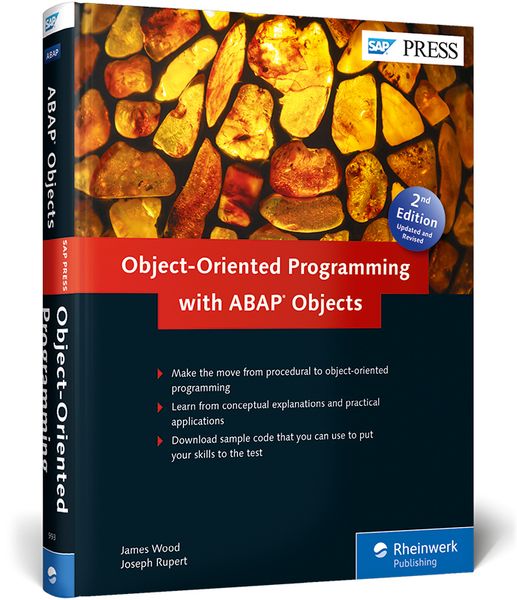
Produktbild: Object-Oriented Programming with ABAP Objects
- 11%

Object-Oriented Programming with ABAP Objects

Aus der Reihe SAP PRESS Englisch
11% sparen

61,99 € UVP 69,95 €

inkl. gesetzl. MwSt., Versandkostenfrei

Lieferung nach Hause

Beschreibung

Produktdetails

Einband

Gebundene Ausgabe

Erscheinungsdatum

28.10.2015

Verlag

Rheinwerk Publishing

Seitenzahl

470

Maße (L/B/H)

24/18,4/3,5 cm

Gewicht

1023 g

Auflage

2nd Enlarged edition

Sprache

Englisch

ISBN

978-1-59229-993-5

Beschreibung

Produktdetails

Einband

Gebundene Ausgabe

Erscheinungsdatum

28.10.2015

Verlag

Rheinwerk Publishing

Seitenzahl

470

Maße (L/B/H)

24/18,4/3,5 cm

Gewicht

1023 g

Auflage

2nd Enlarged edition

Sprache

Englisch

ISBN

978-1-59229-993-5

Herstelleradresse

Libri GmbH
Europaallee 1
36244 Bad Hersfeld
DE

Email: GPSR Kontakt

Noch keine Bewertungen vorhanden

Verfassen Sie die erste Bewertung zu diesem Artikel

Helfen Sie anderen Kundinnen und Kunden durch Ihre Meinung.

Kundinnen und Kunden meinen

Bewertungen (0)

  • Produktbild: Object-Oriented Programming with ABAP Objects


  • Introduction … 15

    PART I Introduction

    1 … Introduction to Object-Oriented Programming … 23

    1.1 … The Need for a Better Abstraction … 23

    1.2 … Classes and Objects … 26

    1.3 … Establishing Boundaries … 30

    1.4 … Reuse … 34

    1.5 … Object Management … 38

    1.6 … UML Tutorial: Class Diagram Basics … 38

    1.7 … Summary ... 45

    2 … Getting Started with Objects … 47

    2.1 … Defining Classes … 47

    2.2 … Working with Objects … 59

    2.3 … Building your First Object-Oriented Program ... 78

    2.4 … Working with Global Classes ... 84

    2.5 … Developing Classes Using the ABAP Development Tools in Eclipse ... 97

    2.6 … New Syntax Features in Release 7.40 ... 114

    2.7 … UML Tutorial: Object Diagrams ... 117

    2.8 … Summary ... 119

    3 … Encapsulation and Implementation Hiding … 121

    3.1 … Lessons Learned from Procedural Programming … 121

    3.2 … Data Abstraction with Classes … 131

    3.3 … Defining Component Visibilities … 133

    3.4 … Designing by Contract … 139

    3.5 … UML Tutorial: Sequence Diagrams … 140

    3.6 … Summary … 142

    4 … Object Initialization and Cleanup … 143

    4.1 … Understanding the Object Creation Process … 143

    4.2 … Working with Constructors … 148

    4.3 … Object-Creational Patterns ... 152

    4.4 … Garbage Collection … 157

    4.5 … Tuning Performance ... 159

    4.6 … UML Tutorial: State Machine Diagrams ... 161

    4.7 … Summary … 163

    5 … Inheritance and Composition … 165

    5.1 … Generalization and Specialization ... 166

    5.2 … Inheriting Components ... 175

    5.3 … The Abstract and Final Keywords ... 183

    5.4 … Inheritance vs. Composition … 191

    5.5 … Working with ABAP Refactoring Tools ... 194

    5.6 … UML Tutorial: Advanced Class Diagrams ... 198

    5.7 … Summary … 201

    6 … Polymorphism ... 203

    6.1 … Object Reference Assignments Revisited ... 204

    6.2 … Dynamic Method Call Binding ... 210

    6.3 … Interfaces ... 212

    6.4 … UML Tutorial: Advanced Class Diagrams Part II ... 229

    6.5 … Summary ... 232

    7 … Component-Based Design Concepts ... 233

    7.1 … Understanding the SAP Component Model … 233

    7.2 … The Package Concept ... 236

    7.3 .. Package Design Concepts ... 258

    7.4 … UML Tutorial: Package Diagrams ... 260

    7.5 … Summary … 262

    8 … Error Handling with Exception Classes … 263

    8.1 … Lessons Learned from Prior Approaches … 263

    8.2 … The Class-Based Exception Handling Concept ... 266

    8.3 … Creating Exception Classes ... 268

    8.4 … Dealing with Exceptions ... 275

    8.5 … Raising and Forwarding Exceptions ... 281

    8.6 … UML Tutorial: Activity Diagrams ... 294

    8.7 … Summary ... 297

    9 … Unit Tests with ABAP Unit ... 299

    9.1 … ABAP Unit Overview ... 300

    9.2 … Creating Unit Test Classes … 301

    9.3 … Assertions in ABAP Unit ... 307

    9.4 … Managing Dependencies ... 310

    9.5 … Case Study: Creating a Unit Test in ABAP Unit ... 313

    9.6 … Executing Unit Tests ... 316

    9.7 … Evaluating Unit Test Results ... 319

    9.8 … Moving Towards Test-Driven Development ... 321

    9.9 … Behavior-Driven Development ... 322

    9.10 … UML Tutorial: Use Case Diagrams ... 323

    9.11 … Summary ... 328

    PART II … Case Studies

    10 … ABAP Object Services ... 331

    10.1 … Introduction ... 331

    10.2 … Working with the Persistence Service ... 335

    10.3 … Querying Persistent Objects with the Query Service ... 357

    10.4 … Modeling Complex Entity Relationships ... 362

    10.5 … Transaction Handling with the Transaction Service ... 369

    10.6 … UML Tutorial: Communication Diagrams ... 375

    10.7 … Summary ... 377

    11 … Business Object Development with the BOPF ... 379

    11.1 … What is the BOPF? ... 379

    11.2 … Anatomy of a Business Object ... 382

    11.3 … Working with the BOPF Client API ... 397

    11.4 … Where to Go From Here ... 408

    11.5 … UML Tutorial: Advanced Sequence Diagrams ... 411

    11.6 … Summary ... 413

    12 … Working with the SAP List Viewer ... 415

    12.1 … What is the SAP List Viewer? ... 415

    12.2 … Introducing the ALV Object Model ... 418

    12.3 … Developing a Reporting Framework on top of ALV ... 421

    12.4 … UML Tutorial: Advanced Activity Diagrams ... 430

    12.5 … Summary … 432

    13 … Where to Go From Here … 433

    13.1 … Object-Oriented Analysis and Design … 433

    13.2 … Design Patterns … 434

    13.3 … Reading and Writing ABAP Objects Code … 435

    13.4 … Summary .... 436

    … Appendices …. 437

    A … Installing the Eclipse IDE ... 439

    A.1 … Installing the Java SDK ... 439

    A.2 … Installing Eclipse ... 440

    A.3 … Installing the ABAP Development Tools ... 442

    A.4 … Where to Go to Find Help ... 445

    B … Debugging Objects ... 447

    B.1 … Understanding Debugger Types ... 447

    B.2 … Debugging Objects Using the Classic Debugger ... 447

    B.3 … Debugging Objects Using the New Debugger ... 455

    C … Bibliography ... 459

    D … The Authors ... 461