
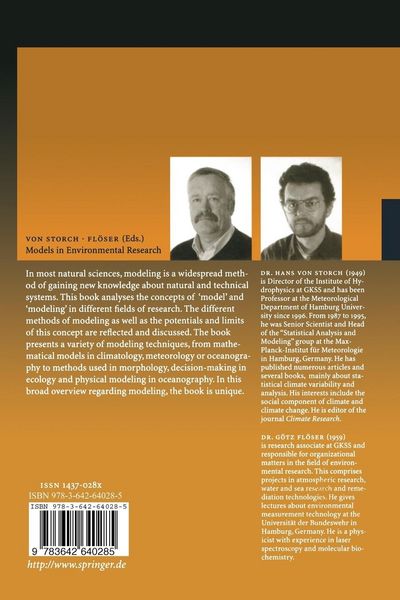
• Produktbild: Models in Environmental Research
  • Produktbild: Models in Environmental Research

Models in Environmental Research

49,99 €

inkl. gesetzl. MwSt., Versandkostenfrei


Beschreibung

Produktdetails

Einband

Taschenbuch

Erscheinungsdatum

20.11.2013

Abbildungen

XIII, 236 p. 103 illus. in color.

Herausgeber

Hans Storch

Verlag

Springer Berlin

Seitenzahl

236

Maße (L/B/H)

23,5/15,5/1,5 cm

Gewicht

394 g

Auflage

Softcover reprint of the original 1st edition 2001

Sprache

Englisch

ISBN

978-3-642-64028-5

Beschreibung

Portrait

Prof. Dr. Hans von Storch ist Direktor des Instituts für Küstenforschung, GKSS, Geesthacht und lehrt am Institut für Meteorologie der Universität Hamburg.

Produktdetails

Einband

Taschenbuch

Erscheinungsdatum

20.11.2013

Abbildungen

XIII, 236 p. 103 illus. in color.

Herausgeber

Hans Storch

Verlag

Springer Berlin

Seitenzahl

236

Maße (L/B/H)

23,5/15,5/1,5 cm

Gewicht

394 g

Auflage

Softcover reprint of the original 1st edition 2001

Sprache

Englisch

ISBN

978-3-642-64028-5

Herstelleradresse

Springer-Verlag KG
Sachsenplatz 4-6
1201 Wien
AT

Email: GPSR Kontakt

Noch keine Bewertungen vorhanden

Verfassen Sie die erste Bewertung zu diesem Artikel

Helfen Sie anderen Kundinnen und Kunden durch Ihre Meinung.

Kundinnen und Kunden meinen

Bewertungen (0)

  • Produktbild: Models in Environmental Research
  • Produktbild: Models in Environmental Research
  • 1 Models as Focusing Tools: Linking Nature and the Social World.- Abstract.- 1.1 Models as Focusing Tools: Linking Nature and the Social World.- 1.2 The Practice of Modeling.- 1.3 The Methodology of Modeling.- 1.4 Isomorphism.- 1.5 Quantification.- 1.6 Modeling Societal Sensitivity.- 1.7 Examples of Models.- 1.8 The Poverty of Economics.- 1.9 Hybrid Forms or the Linkage between Social and Physical Processes.- Appendix: Additional Comments of Modeling Climate and Societal Sensitivity.- 2 Models between Academia and Applications.- Abstract.- 2.1 Introduction.- 2.2 General Properties of Models.- 2.3 Purpose of Models.- 2.4 Conclusions.- Acknowledgments.- 3 Basic Concepts in Dynamical Modeling.- Abstract.- 3.1 Introduction.- 3.2 Classical Mechanics.- 3.3 Ideal Fluids.- 3.4 Thermodynamics.- 3.5 Dynamical Systems.- 3.6 Statistical Mechanics.- 3.7 Stochastic Processes.- 3.8 Discussion.- Acknowledgments.- 4 Process-oriented Models in Physical Oceanography.- Abstract.- 4.1 Introduction.- 4.2 Examples.- 4.3 Concluding Remarks.- Acknowledgments.- 5 Mathematical Models in Environmental Research.- 5.1 Introduction.- 5.2 Mathematical Models — an Overview.- 5.3 From Nature to Navier-Stokes’ Equations.- 5.4 From Differential Equations to a Numerical Representation.- 5.5 Summary.- Acknowledgments.- 6 Physical Modeling of Flow and Dispersion.- 6.1 Introduction.- 6.2 Properties of Wind-Tunnel Boundary Layers.- 6.3 Dimensional Analysis.- 6.4 Matching of Similarity Requirements.- 6.5 Experiments.- 6.6 Variation of Similarity Parameters.- 6.7 Parameterisation of Thermodynamic Processes.- 6.8 Small-Scale/Full-Scale Comparisons.- 6.9 Investigation of Obstacle Effects.- 6.10 Conclusions.- Acknowledgements.- 7 Conceptual Models for Ecology-Related Decisions.- Abstract.- 7.1 Introduction.-7.2 The Wadden Sea — a Sensitive Environment.- 7.3 The Environmental Sensitivity Index (ESI) for Wadden Sea Areas.- 7.4 Environmental (Ecological) Risk Assessment (ERA).- 7.5 Ecological Monitoring of the Benthos.- 7.6 Conclusions.- 8 Models in the Mechanics of Materials.- Abstract.- 8.1 Introduction.- 8.2 Modeling in the Mechanics of Materials.- 8.3 Examples.- 8.4 Conclusions.- 9 Mathematical Morphology.- Abstract.- 9.1 Introduction.- 9.2 An Introductive Example.- 9.3 The Morphological Tool Box.- 9.4 Quantification and Morphological Measurements.- 9.5 Random Models.- 10 Statistical Interpolation Models.- Abstract.- 10.1 Introduction.- 10.2 The Random Function Model.- 10.3 Multivariate Geostatistics.- 10.4 Non-Stationary Model.- 10.5 Conclusion.- 11 Statistics — an Indispensable Tool in Dynamical Modeling.- Abstract.- 11.1 Environmental Research.- 11.2 State Space Models.- 11.3 Statistics and Quasi-realistic Models.- 11.4 Reduced “Cognitive” Models.- Acknowledgments.- References.