KI-Beratung Beta

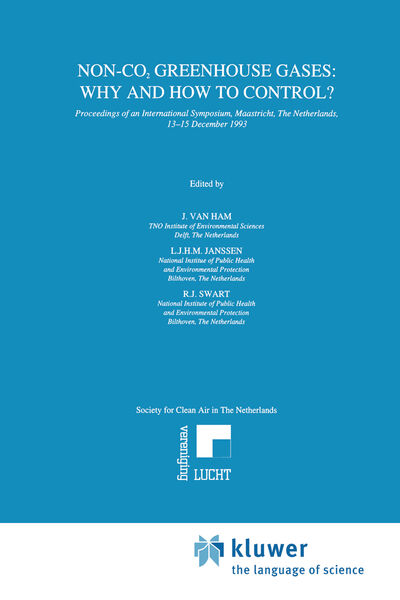
Produktbild: Non-CO2 Greenhouse Gases: Why and How to Control?

Non-CO2 Greenhouse Gases: Why and How to Control? Proceedings of an International Symposium, Maastricht, The Netherlands, 13–15 December 1993

185,99 €

inkl. gesetzl. MwSt., Versandkostenfrei


Beschreibung

The background This volume contains the proceedings of the first International symposium on "Non-C0 Greenhouse Gases: Why and How to 2 Control?" held in Maastricht, The Netherlands from 13-15 Decem ber 1993. Of the known greenhouse gases, political attention to date has been primarily focused on carbon...

Beschreibung

The background This volume contains the proceedings of the first International symposium on "Non-C0 Greenhouse Gases: Why and How to 2 Control?" held in Maastricht, The Netherlands from 13-15 Decem ber 1993. Of the known greenhouse gases, political attention to date has been primarily focused on carbon dioxide (C0 ) and the 2 CFCs - the latter because of their interaction with stratospheric ozone. The other greenhouse gases, notably methane (CH ), nitrous 4 oxide (N 0), HCFCs, HFCs and tropospheric ozone and its precur 2 sors nitrogen oxides (NO), carbon monoxide (CO) and volatile organic compounds (VOCs), may appear collectively to be of equal importance for global warming but have attracted less attention. Nevertheless, a comprehensive approach to climate change respon se, taking into account all sources and sinks of all greenhouse gases, is explicitly allowed in the Framework Convention on Clima te Change. The Netherlands' policy on climate already addresses all greenhouse gases. In order to stimulate the development of international climate policy on this subject, the Dutch Ministry of Housing, Physical Planning and Environment supported the initative of organizing an international symposium on the science and policy of the non-C0 greenhouse gases. An important rationale behind 2 this initative was recognizing that for the non-C0 greenhouse 2 gases, abatement options are available that do not only address other environmental problems but that also do not require the major structural changes in society that an effective CO policy 2 may.

Produktdetails

Einband

Taschenbuch

Erscheinungsdatum

05.11.2012

Abbildungen

XL, 562 p.

Herausgeber J. van Ham + weitere

Produktdetails

Einband

Taschenbuch

Erscheinungsdatum

05.11.2012

Abbildungen

XL, 562 p.

Herausgeber
Verlag Springer Netherland
Seitenzahl

562

Maße (L/B/H)

24/16/3,3 cm

Gewicht

957 g

Auflage

Softcover Reprint of the Original 1st 1994 edition

Sprache

Englisch

ISBN

978-94-010-4425-7

Herstelleradresse

Libri GmbH
Europaallee 1
36244 Bad Hersfeld
DE

Email: gpsr@libri.de

Noch keine Bewertungen vorhanden

Verfassen Sie die erste Bewertung zu diesem Artikel

Helfen Sie anderen Kundinnen und Kunden durch Ihre Meinung.

Kundinnen und Kunden meinen

Bewertungen (0)

Die Leseprobe wird geladen.
  • Produktbild: Non-CO2 Greenhouse Gases: Why and How to Control?
  • Foreword. Emission Inventories. Studies on Source Strengths and Sinks. Monitoring and Methodology. Modelling: Budgets and Lifetimes. Technological Options for Industrial Sources. Technical Options for Biotic Sources. Policy Options for Non-CO2 Greenhouse Gases. Authors Register. Keyword Register.