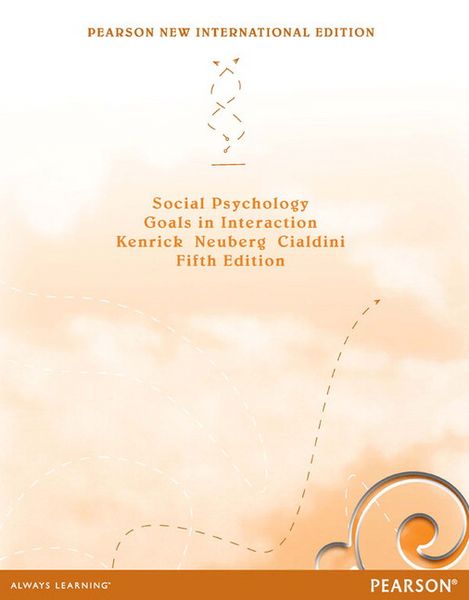
Social Psychology: Goals in Interaction
-
- Englisch ausgewählt
86,99 €
UVP
104,49 €
inkl. gesetzl. MwSt.,
Beschreibung
Produktdetails
Einband
Taschenbuch
Erscheinungsdatum
03.06.2024
Verlag
Pearson StudiumSeitenzahl
580
Maße (L/B/H)
27,6/21,6/3,2 cm
Gewicht
1140 g
Auflage
5
Sprache
Englisch
ISBN
978-1-292-02780-7
For an undergraduate introductory level course in social psychology.
Social Psychology: Goals in Interaction
reveals the motives behind social behavior—
why
people love, hate, lead, and follow, for example- and bridges the person and the social situation.
A unique integrated approach to social behavior:
What do terrorist bombings, testosterone, one-minute “hurry dates,” Facebook, and political smear campaigns have to do with one another?
Social Psychology textbooks typically provide a laundry list of interesting, but disconnected facts and theories. This standard approach grabs interest but falls short as a way to learn. Kenrick, Neuberg, and Cialdini instead provide an integrative approach, one that both builds upon traditional lessons learned by the field and pushes those lessons to the cutting-edge. By organizing each chapter around the two broad questions–“What are the goals that underlie the behavior in question?” and “What factors in the person and the situation connect to each goal?” –the book presents the discipline as a coherent framework for understanding human behavior. Expanding he integrative theme in this edition, KNC highlights social psychology as the
ultimate bridge discipline–
connectingthe different findings and theories of social psychology, exploring the field’s links to other areas of psychology (e.g., clinical, organizational, and neuroscience), and bridging to other important academic disciplines (e.g., anthropology, biology, economics, medicine, and law).
Opening mysteries:
Each chapter begins with a mystery, designed not only to grab student interest, but also to organize the ensuing discussion of scientific research:
Why did the beautiful and talented artist Frida Kahlo fall for the much older, and much less attractive, Diego Rivera, and then tolerate his numerous extramarital affairs? What psychological forces led the Dalai Lama, the most exalted personage in Tibet, to forge a lifelong friendship with a foreign vagabond openly scorned by Tibetan peasants? Why would a boy falsely confess to murdering his own mother?
The latest scholarship, engaging writing, engrossing real-world stories and the authors' strengths as renowned researchers and expert teachers, all come together to make the fifth edition of
Social Psychology: Goals in Interaction
an accessible and engaging read for students, while providing a modern and cohesive approach for their teachers.
Noch keine Bewertungen vorhanden
Verfassen Sie die erste Bewertung zu diesem Artikel
Helfen Sie anderen Kundinnen und Kunden durch Ihre Meinung.
Kurze Frage zu unserer Seite
Vielen Dank für dein Feedback
Wir nutzen dein Feedback, um unsere Produktseiten zu verbessern. Bitte habe Verständnis, dass wir dir keine Rückmeldung geben können. Falls du Kontakt mit uns aufnehmen möchtest, kannst du dich aber gerne an unseren Kund*innenservice wenden.
zum Kundenservice