Beschreibung
Produktdetails
Einband
Taschenbuch
Verlag
LAP LAMBERT Academic PublishingSeitenzahl
76
Maße (L/B/H)
22/15/0,4 cm
Gewicht
118 g
Sprache
Englisch
ISBN
978-3-659-47868-0
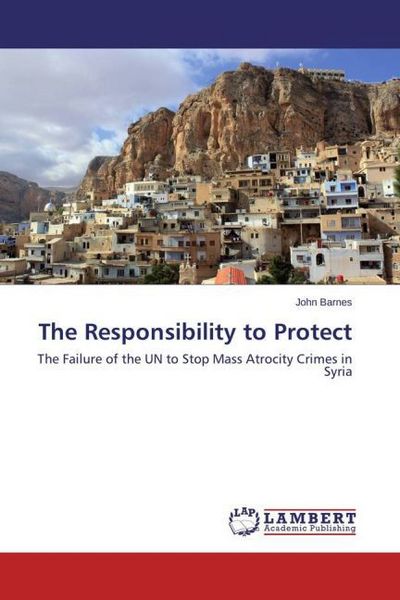
'Never again' has been an oft-repeated refrain ever since the Holocaust by world leaders faced with responding to state sponsored mass atrocity crimes. Unfortunately, 'Never again' has been necessarily transformed to 'alas, once again' too many times since 1945. The failure of the international community to halt the horrors it knew were being perpetrated in Rwanda and Srebrenica in 1994 and 1995 respectively testify that today, as in the time of Thucydides, the 'The strong do as they can, while the weak suffer what they must.' How can the international community in the 21st century square the circle of sovereignty and human rights, allowing for humanitarian intervention in locations where state sponsored violence leaves civilians unprotected? The 'Responsibility to Protect' (R2P) is a new UN norm which ostensibly does just that, framing the intervention debate in order to catalyse action. But does R2P have any effect on the essentially self-interested character of states? This book, using three case studies, is an attempt to give an answer. It finds that due to R2P's inherent problems, its failure to catalyse action in Syria is indicative of its limitations as a viable UN norm.
Noch keine Bewertungen vorhanden
Verfassen Sie die erste Bewertung zu diesem Artikel
Helfen Sie anderen Kundinnen und Kunden durch Ihre Meinung.
Kurze Frage zu unserer Seite
Vielen Dank für dein Feedback
Wir nutzen dein Feedback, um unsere Produktseiten zu verbessern. Bitte habe Verständnis, dass wir dir keine Rückmeldung geben können. Falls du Kontakt mit uns aufnehmen möchtest, kannst du dich aber gerne an unseren Kund*innenservice wenden.
zum Kundenservice