KI-Beratung Beta

  • Produktbild: Switch-Level Timing Simulation of MOS VLSI Circuits
  • Produktbild: Switch-Level Timing Simulation of MOS VLSI Circuits
Band 66 - 13%

Switch-Level Timing Simulation of MOS VLSI Circuits

13% sparen

92,99 € UVP 106,99 €

inkl. gesetzl. MwSt., Versandkostenfrei


Beschreibung

Produktdetails

Einband

Taschenbuch

Erscheinungsdatum

05.10.2011

Abbildungen

XII, 210 p.

Verlag

Springer Us

Seitenzahl

210

Maße (L/B/H)

23,5/15,5/1,3 cm

Gewicht

347 g

Auflage

1989 edition

Sprache

Englisch

ISBN

978-1-4612-8963-0

Beschreibung

Produktdetails

Einband

Taschenbuch

Erscheinungsdatum

05.10.2011

Abbildungen

XII, 210 p.

Verlag

Springer Us

Seitenzahl

210

Maße (L/B/H)

23,5/15,5/1,3 cm

Gewicht

347 g

Auflage

1989 edition

Sprache

Englisch

ISBN

978-1-4612-8963-0

Herstelleradresse

Libri GmbH
Europaallee 1
36244 Bad Hersfeld
DE

Email: gpsr@libri.de

Noch keine Bewertungen vorhanden

Verfassen Sie die erste Bewertung zu diesem Artikel

Helfen Sie anderen Kundinnen und Kunden durch Ihre Meinung.

Kundinnen und Kunden meinen

Bewertungen (0)

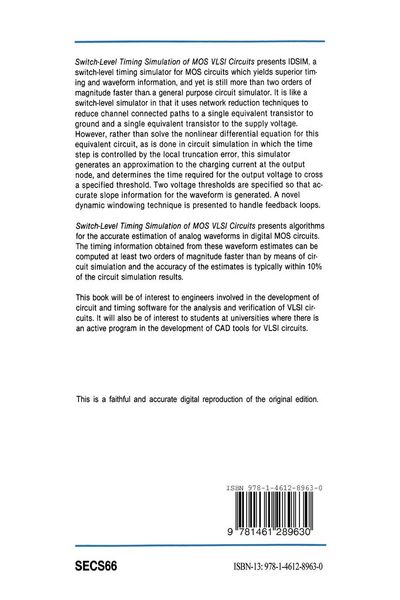
  • Produktbild: Switch-Level Timing Simulation of MOS VLSI Circuits
  • Produktbild: Switch-Level Timing Simulation of MOS VLSI Circuits
  • 1. Introduction.- 2. Overview of Simulation Techniques.- 2.1 Analog vs Digital Simulation.- 2.2 Gate-Level Simulation.- 2.3 Switch-Level Logic Simulation.- 2.4 Mixed-Mode or Hybrid Simulation.- 2.5 Switch-Level Timing Simulation.- 3. Mos Network Partitioning and Ordering.- 3.1 MOS Network Components and Models.- 3.2 Partitioning the MOS Network into Blocks.- 3.3* Partitioning into Driver and Pass Transistors.- 3.4 Ordering of Partitioned Blocks.- 3.5 Conclusions.- 4. Switch-Level Timing Simulation.- 4.1 Overview.- 4.2 Waveform Representation.- 4.3 Simulation Algorithm.- 4.4 Deriving Inverter Voltage Equations.- 4.5 Determining the dc Output Voltage.- 4.6 Mapping Complex Blocks to Primitives.- 4.7 Parasitics.- 4.8 Sample Subcircuit Processing.- 5. Simulating Strongly Connected Components.- 5.1 Waveform Relaxation vs Time-point Relaxation.- 5.2 Dynamic Windowing.- 6. Performance of Idsim2.- References.- About The Authors.