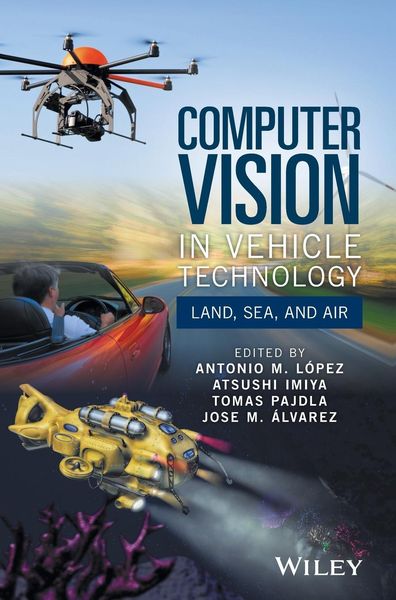
Computer Vision in Vehicle Technology Land, Sea, and Air
134,99 €
inkl. gesetzl. MwSt.,
Lieferung nach Hause
Beschreibung
Produktdetails
Einband
Gebundene Ausgabe
Erscheinungsdatum
17.04.2017
Herausgeber
Antonio M. López + weitereVerlag
John Wiley & Sons IncSeitenzahl
216
Maße (L/B/H)
25/17,5/1,6 cm
Gewicht
544 g
Auflage
1. Auflage
Sprache
Englisch
ISBN
978-1-118-86807-2
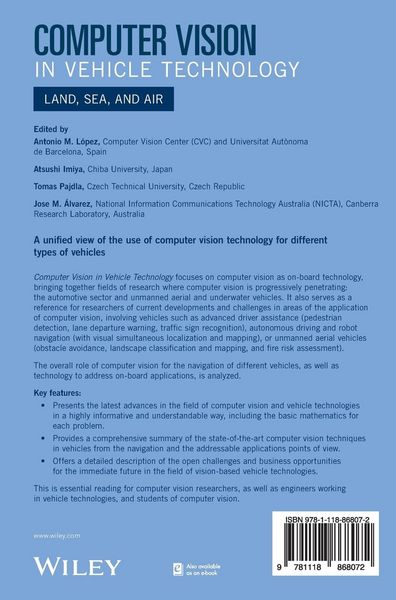
A unified view of the use of computer vision technology for different types of vehicles
Computer Vision in Vehicle Technology focuses on computer vision as on-board technology, bringing together fields of research where computer vision is progressively penetrating: the automotive sector, unmanned aerial and underwater vehicles. It also serves as a reference for researchers of current developments and challenges in areas of the application of computer vision, involving vehicles such as advanced driver assistance (pedestrian detection, lane departure warning, traffic sign recognition), autonomous driving and robot navigation (with visual simultaneous localization and mapping) or unmanned aerial vehicles (obstacle avoidance, landscape classification and mapping, fire risk assessment).
The overall role of computer vision for the navigation of different vehicles, as well as technology to address on-board applications, is analysed.
Key features:
* Presents the latest advances in the field of computer vision and vehicle technologies in a highly informative and understandable way, including the basic mathematics for each problem.
* Provides a comprehensive summary of the state of the art computer vision techniques in vehicles from the navigation and the addressable applications points of view.
* Offers a detailed description of the open challenges and business opportunities for the immediate future in the field of vision based vehicle technologies.
This is essential reading for computer vision researchers, as well as engineers working in vehicle technologies, and students of computer vision.
Computer Vision in Vehicle Technology focuses on computer vision as on-board technology, bringing together fields of research where computer vision is progressively penetrating: the automotive sector, unmanned aerial and underwater vehicles. It also serves as a reference for researchers of current developments and challenges in areas of the application of computer vision, involving vehicles such as advanced driver assistance (pedestrian detection, lane departure warning, traffic sign recognition), autonomous driving and robot navigation (with visual simultaneous localization and mapping) or unmanned aerial vehicles (obstacle avoidance, landscape classification and mapping, fire risk assessment).
The overall role of computer vision for the navigation of different vehicles, as well as technology to address on-board applications, is analysed.
Key features:
* Presents the latest advances in the field of computer vision and vehicle technologies in a highly informative and understandable way, including the basic mathematics for each problem.
* Provides a comprehensive summary of the state of the art computer vision techniques in vehicles from the navigation and the addressable applications points of view.
* Offers a detailed description of the open challenges and business opportunities for the immediate future in the field of vision based vehicle technologies.
This is essential reading for computer vision researchers, as well as engineers working in vehicle technologies, and students of computer vision.
Kundinnen und Kunden meinen
Verfassen Sie die erste Bewertung zu diesem Artikel
Helfen Sie anderen Kund*innen durch Ihre Meinung
Kurze Frage zu unserer Seite
Vielen Dank für dein Feedback
Wir nutzen dein Feedback, um unsere Produktseiten zu verbessern. Bitte habe Verständnis, dass wir dir keine Rückmeldung geben können. Falls du Kontakt mit uns aufnehmen möchtest, kannst du dich aber gerne an unseren Kund*innenservice wenden.
zum Kundenservice