
Gutscheinbedingungen

**Gültig vom 15.06.2026 bis 17.06.2026 | Gültig für nicht preisgebundene fremdsprachige Bücher | Einzelne Artikel können ausgeschlossen sein | Maximaler rabattfähiger Warenkorbwert 500 € | Nicht kombinierbar mit weiteren Aktionen | Nur einmal pro Person einlösbar | Nur solange der Vorrat reicht

  • Produktbild: Aerodynamic Theory
  • Produktbild: Aerodynamic Theory

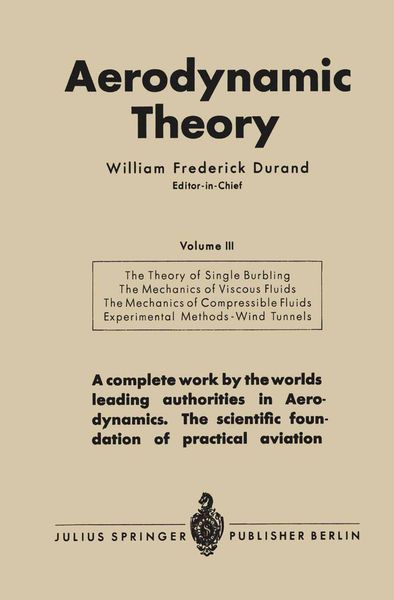
Aerodynamic Theory A General Review of Progress Under a Grant of the Guggenheim Fund for the Promotion of Aeronautics

54,99 €

inkl. gesetzl. MwSt., Versandkostenfrei

Lieferung nach Hause

Beschreibung

Produktdetails

Einband

Taschenbuch

Erscheinungsdatum

01.01.1935

Verlag

Springer Berlin

Seitenzahl

354

Maße (L/B/H)

23,5/15,5/2,1 cm

Gewicht

581 g

Auflage

1935

Sprache

Deutsch

ISBN

978-3-642-89629-3

Beschreibung

Produktdetails

Einband

Taschenbuch

Erscheinungsdatum

01.01.1935

Verlag

Springer Berlin

Seitenzahl

354

Maße (L/B/H)

23,5/15,5/2,1 cm

Gewicht

581 g

Auflage

1935

Sprache

Deutsch

ISBN

978-3-642-89629-3

Herstelleradresse

Springer-Verlag GmbH
Tiergartenstr. 17
69121 Heidelberg
DE

Email: ProductSafety@springernature.com

Kundinnen und Kunden meinen

0 Bewertungen

Informationen zu Bewertungen

Zur Abgabe einer Bewertung ist eine Anmeldung im Konto notwendig. Die Authentizität der Bewertungen wird von uns nicht überprüft. Wir behalten uns vor, Bewertungstexte, die unseren Richtlinien widersprechen, entsprechend zu kürzen oder zu löschen.

Die Bewertungen sind nach Format, Anzahl Sterne und Datum sortiert.

Verfassen Sie die erste Bewertung zu diesem Artikel

Helfen Sie anderen Kund*innen durch Ihre Meinung

Kundinnen und Kunden meinen

0 Bewertungen filtern

Weitere Artikel findest du in

  • Produktbild: Aerodynamic Theory
  • Produktbild: Aerodynamic Theory
  • Division F The Theory of Single Burbling.- Editor’s Preface.- 1. The Discontinuous Potential.- 2. Calculation of the Air Forces for Single Burbling.- 3. The Lift Force.- 4. The Form Drag.- 5. Determination of Moment and Center of Pressure.- 6. The General Case of Plane Motion.- 7. Influence of the Finite Span of the Wing.- Division G The Mechanics of Viscous Fluids.- Editor’s Preface.- 1. Viscosity.- 2. The Poiseuille Flow.- 3. General Theory of Stress.- 4. Equilibrium of Non-homogeneous States of Stress.- 5. Theory of Deformation.- 6. Stokes’ Theorem for Stresses.- 7. Reynolds’ Laws of Similitude.- 8. Dimensional Analysis Applied to the Problem.- 9. Properties of the Navier-Stokes’ Differential Equations.- 10. Some Examples of Exact Solutions.- 11. Theory of Very Slow Motions.- 12. Oseen’s Improvement of the Preceding Theory.- 13. Boundary Layers.- 14. The Flat Plate.- 15. Calculation of the Boundary Layer of the Steady Flow Around Cylinders. Separation of Flow from the Wall.- 16. Development of the Boundary Layer with Time.- 17. Theorem of Momentum and Kármán’s Approximate Theory.- 18. Prevention of the Separation Effect.- 19. The Facts about Turbulent Flow.- 20. Older Theories of Turbulence.- 21. Newer Theory. Mixing Length and Velocity Distribution.- 22. The Laws of Surface Friction from Experiments on Flows in Tubes. Resistance Formulas. Effect of Roughness.- 23. Turbulent Flow Along a Wall with Special Reference to the Frictional Resistance of Plates.- 24. Turbulent Friction Layers in Accelerated and Retarded Flows.- 25. Spread of Turbulence.- Appendix to 25.- 26. The Development of Turbulence.- 27. The Drag on Bodies Moving Through Fluids.- 28. The Drag in Non-Perfect Fluids.- 29. Experimental Methods for the Determination of Resistance.- Division H The Mechanics of Compressible Fluids.- Editor’s Preface.- I. The Propagation of Plane Disturbances.- 1. Introduction.- 2. Propagation of Small Plane Disturbances.- 3. Dynamic Similarity.- 4. Propagation of Large Disturbances and Shock Waves.- 5. Propagation of Discontinuities.- 6. Conditions Within a Shock Wave.- II. Steady Flow through Channels.- 1. Introduction.- 2. Bernoulli’s Equation.- 3. Flow Through a Channel of Varying Cross-Section.- 4. Velocity at Minimum Section.- 5. Design of High Speed Wind Tunnels.- III. Two-Dimensional Flow at Speeds Less than that of Sound.- 1. Differential Equation for Irrotational Motion.- 2. The Flow Past a Circular Cylinder.- 3. Prandtl and Glauert’s Approximation to the Lift of an Airfoil.- IV. Two-Dimensional Flow at Supersonic Speeds.- 1. The Motion Past Thin Airfoils.- 2. Oblique Shock Waves.- 3. Pressure in a Pitot-Tube or at the Nose of a Projectile.- 4. The Flow Past a Wedge and a Cone at Supersonic Speeds.- 5. The Two-Dimensional Flow Around a Corner.- 6. Two-Dimensional Flow Past a Curved Surface.- Division I Experimental Methods—Wind Tunnels.- Editor’s Preface.- 1.- I. Classification of Methods—Use of Natural Winds.- 1. Classification of Experimental Methods Used in Aerodynamic Research.- 2. Methods in which the Object is Stationary and the Fluid in Motion. (Methods Utilizing Natural Movements of the Air.).- References.- II. Methods Using an Artificial Air Flow—Classification of wind Tunnels, Description, Energy Losses.- 1. Methods Using Artificial Fluid Currents.- 2. Classification of Wind Tunnels.- 3. Coefficient of Utilization—Efficiency—Losses.- 4. Degree of Turbulence of Wind Tunnels.- 5. Wind Tunnels with the Experimental Section Downstream from the Fan.- 6. Wind Tunnels with the Experimental Section Upstream from the Fan.- 7. Wind Tunnels of the Eiffel Type.- 8. Evaluation of the Losses in a Tunnel with Experimental Section Upstream from the Fan.- 9. Wind Tunnels with Continuous Closed Circuit.- III. Influence of the Dimensions of the Air Stream.- 1. General Considerations.- 2. Wind Tunnels with Circular Section—Lifting Systems, Monoplane or Multicellular.- Note to Section 2.- 3. Wind Tunnel with Square or Rectangular Section-Constrained Air Stream.- 4. Tunnel with Rectangular Section with Two-Dimensional Flow.- 5. Body in Plane Flow of which the Wake is Composed of Alternate Vortices.- 6. Influence of Rigid Walls Limiting a Plane Constrained Flow on the Resistance of Cylinders with Sections Elongated in the Direction of the Flow.- 7. Influence of the Walls Limiting the Flow on the Drag of a Body of Revolution.- 2.- I. Scale Effect.- 1. Introductory.- 2. Fundamental Conceptions.- 3. Conditions for Flow Similarity.- 4. Scale Effect on Certain Bodies—Flat Plates.- II. The Variable Density Tunnel.- 1. General Description.- 2. Special Problems.- 3. Advantages of a Variable Density Wind Tunnel.- III Experimental Methods for the Investigation of Aerodynamic Phenomena at High Speeds.- 1. Introductory.- 2. Early Experiments.- 3. High Speed Tunnel of the U.S. National Advisory Committee for Aeronautics.- 4. Description of balance.- 5. Dynamic-Pressure and Velocity Determination.- 6. Presentation of Data.