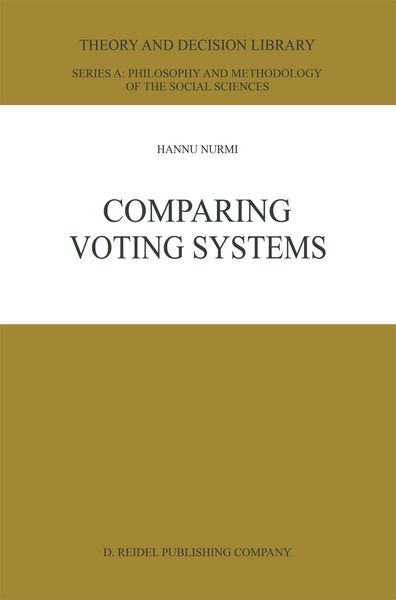
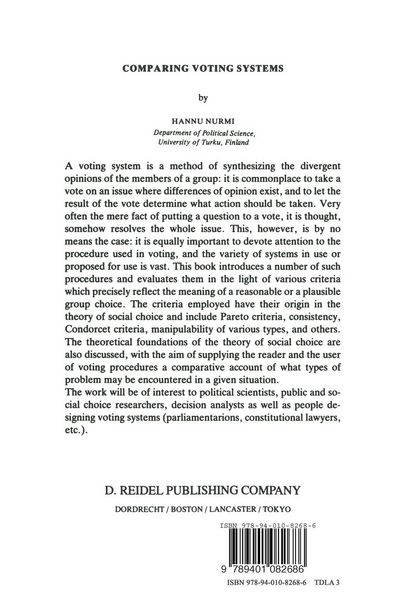
• Produktbild: Comparing Voting Systems
  • Produktbild: Comparing Voting Systems
Band 3 - 12%

Comparing Voting Systems

12% sparen

93,99 € UVP 106,99 €

inkl. gesetzl. MwSt., Versandkostenfrei

Lieferung nach Hause

Beschreibung

Produktdetails

Einband

Taschenbuch

Erscheinungsdatum

01.10.2011

Verlag

Springer Netherland

Seitenzahl

209

Maße (L/B/H)

23,5/15,5/1,3 cm

Auflage

Softcover reprint of the original 1st ed. 1987

Sprache

Englisch

ISBN

978-94-010-8268-6

Beschreibung

Produktdetails

Einband

Taschenbuch

Erscheinungsdatum

01.10.2011

Verlag

Springer Netherland

Seitenzahl

209

Maße (L/B/H)

23,5/15,5/1,3 cm

Auflage

Softcover reprint of the original 1st ed. 1987

Sprache

Englisch

ISBN

978-94-010-8268-6

Herstelleradresse

Springer-Verlag KG
Sachsenplatz 4-6
1201 Wien
AT

Email: GPSR Kontakt

Noch keine Bewertungen vorhanden

Verfassen Sie die erste Bewertung zu diesem Artikel

Helfen Sie anderen Kundinnen und Kunden durch Ihre Meinung.

Kundinnen und Kunden meinen

Bewertungen (0)

  • Produktbild: Comparing Voting Systems
  • Produktbild: Comparing Voting Systems
  • 1. Introduction.- 2. Preliminaries.- 3. Social Welfare Function, Social Choice Function and Voting Procedures.- 4. First Problem: Cyclic Majorities.- 4.1. The Condorcet paradox.- 4.2. How to conceal the problem: the amendment procedure.- 4.3. How common are the cycles.- 4.4. Solutions based on ordinal preferences.- 4.4.1. Schwartz’ procedure.- 4.4.2. Dodgson’s procedure.- 4.4.3. The maximin method.- 4.5. Solution based on scoring function: the Borda count.- 4.6. More general majority cycles.- 5. Second Problem: How to Satisfy the Condorcet Criteria.- 5.1. Condorcet criteria.- 5.2. Some complete successes.- 5.3. Some partial successes.- 5.4. Complete failures.- 5.5. Some probability considerations and the plausibility of the Condorcet criteria.- 5.6. The majority winning criterion.- 6. Third Problem: How the Avoid Perverse Response to Changes in Individual Opinions.- 6.1. Monotonicity and related concepts.- 6.2. Successes.- 6.3. Failures.- 6.4. The relevance of the monotonicity criteria.- 7. Fourth Problem: How to Honour Unanimous Preferences.- 7.1. Unanimity and Pareto conditions.- 7.2. Successes.- 7.3. A partial failure and a total failure.- 7.4 Relevance and compatibility with other criteria.- 8. Fifth Problem: How to Make Consistent Choices.- 8.1. Choice set invariance criteria.- 8.2. Performances with respect to consistency.- 8.3. Performances with respect to WARP and PI.- 8.4. The relevance of the criteria.- 9. Sixth Problem: How to Encourage the Sincere Revelation of Preferences.- 9.1. Manipulability.- 9.2. Performance with respect to manipulability.- 9.3. The difficulty of manipulation.- 9.4. Agenda-manipulability.- 9.5. Sincere truncation of preferences.- 10. Social Choice Methods Based on More detailed information about Individual Preferences.- 10.1. The von Neumann-Morgenstern utility and classes of interpersonal comparability.- 10.2. Old and new methods.- 10.3. An assessment.- 11. Asking for Less Than Individual Preference Orderings.- 11.1. Constructing a social preference order for a subset of alternatives.- 11.2. Results based on individual choice functions.- 12. Why Is There So Much Stability and How Can We Get More of It?.- 12.1. Explanations of stability.- 12.2. Improving the performance of the voting procedures.- 13. From Committees to Elections.- 13.1. Proportional and majoritarian systems.- 13.2. Criteria for proportional systems.- 13.3. Voting power.- 14. Conclusions.- Name Index.