Produktbild: Switching Machines

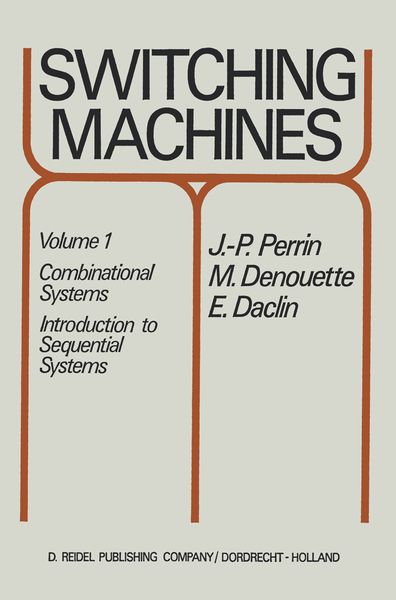
Switching Machines Volume 1: Combinational Systems Introduction to Sequential Systems

48,99 €

inkl. gesetzl. MwSt., Versandkostenfrei


Beschreibung

Produktdetails

Einband

Taschenbuch

Erscheinungsdatum

09.10.2011

Abbildungen

416 p.

Verlag

Springer Netherland

Seitenzahl

416

Maße (L/B/H)

23,5/15,5/2,3 cm

Gewicht

633 g

Auflage

Softcover reprint of the original 1st edition 1972

Sprache

Englisch

ISBN

978-94-010-2866-0

Beschreibung

Produktdetails

Einband

Taschenbuch

Erscheinungsdatum

09.10.2011

Abbildungen

416 p.

Verlag

Springer Netherland

Seitenzahl

416

Maße (L/B/H)

23,5/15,5/2,3 cm

Gewicht

633 g

Auflage

Softcover reprint of the original 1st edition 1972

Sprache

Englisch

ISBN

978-94-010-2866-0

Herstelleradresse

Springer-Verlag GmbH
Tiergartenstr. 17
69121 Heidelberg
DE

Email: ProductSafety@springernature.com

Noch keine Bewertungen vorhanden

Verfassen Sie die erste Bewertung zu diesem Artikel

Helfen Sie anderen Kundinnen und Kunden durch Ihre Meinung.

Kundinnen und Kunden meinen

Bewertungen (0)

  • Produktbild: Switching Machines
  • 1/Boolean Algebra.- 1.1. Introduction.- 1.2. Binary number systems—codes.- 1.3. Postulates and theorems of Boolean algebra.- 1.4. Boolean functions.- 1.5. Reduction of Boolean functions—Map representation.- 1.6. Reduction of Boolean functions (continued)—McCluskey-Quine method.- 1.7. Reduction of functions containing ‘don’t care’ terms.- 1.8. Factorization of Boolean functions.- 1.9. Conclusions.- Appendixes.- Exercises.- 2/Practical Realization of Logical Functions.- 2.1. Introduction.- 2.2. Elementary notions.- 2.3. The relay.- 2.4. Electronic circuits—Positive and negative logics.- 2.5. Diode circuits.- 2.6. Transistor circuits.- 2.7. Flip-flop and memory transistorized logics.- 2.8. Tunnel Diodes.- 2.9. Magnetic circuits.- 2.10. Cryotrons.- 2.11. Fluidic logic.- 2.12. Integrated circuits.- 2.13. Logical simulators.- Exercises.- 3/Combinational Systems.- 3.1. Introduction.- 3.2. Boolean algebra and technology.- 3.3. Combinational systems.- 3.4. Combinational dipoles.- 3.5. Study of combinational multipoles.- 3.6. Matrix analysis of combinational relay systems.- 3.7. Comparison between the general simplification method of Boolean functions and the matrix analysis method in relay systems.- Exercises.- 4/Introduction to Sequential Systems.- 4.1. Review of the general properties of transient phenomena in combinational Systems.- 4.2. Sequential systems—Analysis.- 4.2.5. Performance of a sequential system.- 4.3. Synthesis problems—Definitions of the internal state.- 4.4. Internal state—Technological state.- 4.5. Conclusion.- Appendix—Physical interpretation of the choice of internal variables.- Exercises.- 5/Representation and Classification of Sequential Systems.- 5.1. Introduction.- 5.2. Flow table of a sequential system.- 5.3. Asynchronous andsynchronous machines.- 5.4. Moore, Mealy, and Huffman machines.- 5.5. Complementary notions.- Exercises.- 6/Analysis of Sequential Systems Hazards in Sequential and Combinational Systems.- 6.1. Analysis of asynchronous sequential systems.- 6.2. Analysis of synchronous sequential systems.- 6.3. Hazards in combinational and sequential systems.- 6.4. Hazards in asynchronous sequential systems.- 6.5. Hazards in synchronous systems.- Exercises.