Gutscheinbedingungen

**Gültig vom 20.07.2026 bis 22.07.2026 | Gültig für nicht preisgebundene fremdsprachige Bücher | Einzelne Artikel können ausgeschlossen sein | Nicht kombinierbar mit anderen Gutscheinen oder Preisaktionen | Nur einmal pro Einkauf einlösbar | Gutschein wird auf max. 500€ Bestellwert angerechnet | Keine Barauszahlung | Nicht gültig für Versandkosten und Services

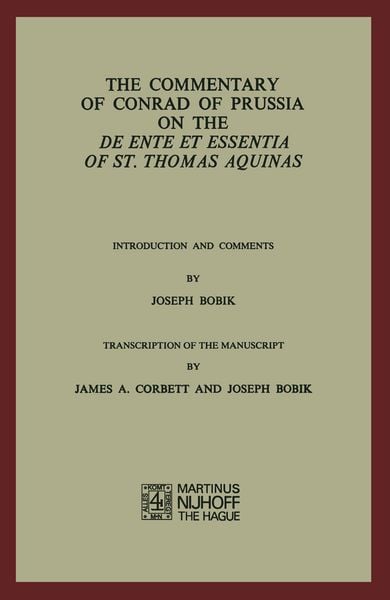
Produktbild: The Commentary of Conrad of Prussia on the De Ente et Essentia of St. Thomas Aquinas

The Commentary of Conrad of Prussia on the De Ente et Essentia of St. Thomas Aquinas Introduction and Comments by Joseph Bobik

48,99 €

inkl. gesetzl. MwSt., Versandkostenfrei

Lieferung nach Hause

Beschreibung

Produktdetails

Einband

Taschenbuch

Erscheinungsdatum

30.09.1974

Verlag

Springer Netherland

Seitenzahl

203

Maße (L/B/H)

23,5/15,5/1,2 cm

Gewicht

335 g

Auflage

Softcover reprint of the original 1st ed. 1974

Sprache

Englisch

ISBN

978-90-247-1939-6

Beschreibung

Produktdetails

Einband

Taschenbuch

Erscheinungsdatum

30.09.1974

Verlag

Springer Netherland

Seitenzahl

203

Maße (L/B/H)

23,5/15,5/1,2 cm

Gewicht

335 g

Auflage

Softcover reprint of the original 1st ed. 1974

Sprache

Englisch

ISBN

978-90-247-1939-6

Herstelleradresse

Springer-Verlag KG
Sachsenplatz 4-6
1201 Wien
AT

Email: GPSR Kontakt

Noch keine Bewertungen vorhanden

Verfassen Sie die erste Bewertung zu diesem Artikel

Helfen Sie anderen Kundinnen und Kunden durch Ihre Meinung.

Kundinnen und Kunden meinen

Bewertungen (0)

  • Produktbild: The Commentary of Conrad of Prussia on the De Ente et Essentia of St. Thomas Aquinas
  • I. Introduction.- 1. The man, Conrad of Prussia.- 2. The manuscript.- 3. Conrad’s division of the De Ente et Essentia.- 4. The transcription.- 5. Unlocated quotations.- 6. The date of composition of Conrad’s commentary.- 7. Good and bad, worthwhile nonetheless.- 8. Other commentaries on the De Ente et Essentia.- II. Conrad’s Commentary.- Prooemium Conradi de Prusya.- Lectio I.- Lectio II.- Lectio III.- Lectio IV.- Lectio V.- Lectio VI.- Lectio VII.- Lectio VIII.- Lectio IX.- Lectio X.- Lectio XI.- Lectio XII.- Lectio XIII.- Lectio XIV.- Lectio XV.- Lectio XVI.- III. Comments on Conred’s Commentary.- Conrad’s prooemium.- 1. The nature of philosophy.- a. Man’s need for philosophy rooted in the possible intellect.- b. Why phüosophy ought to be sought.- c. How philosophy has been defined and divided.- 2. How the De Ente et Essentia is related to other parts of philosophy.- 3. The four causes of the De Ente Essentia.- Conrad’s lectiones.- Opening comment.- Lectio I.- 1. A small mistake in the beginning is a big one in the end.- 2. What the intellect first conceives is being and essence.- 3. The three tasks of the De Ente et Essentia.- 4. From a knowledge of being to a knowledge of essence.- 5. The first task of the De Ente Essentia a linguistic one.- 6. Ipsum ens est communius quam essentia.- 7. Quiditas et essentia non different nisi secundum respectum diver sum.- 8. Additum notabile.- Lectio II.- 1. An aspect of the relation between essence and existence.- 2. God is a simple substance.- 3. Matter is cause of the unity of a composed substance.- 4. Ipse istud non confirmat rationibus.- Lectio III.- 1. Form and essence as causes of existence.- 2. The difficulty regarding matter and the possibility of definition.- 3. Materia signata nullo modo potest in specie reperiri.- Lectio IV.- 1. Parts (simples) and wholes (composites) and predication.- Lectio V.- 1. The genus is not of one and the same nature as it is found in each of its diverse species.- 2. The species includes designated matter indeterminately.- Lectio VI.- 1. The essence signified as a part can be neither a species nor a genus nor a specific difference.- 2. The nature or essence absolutely considered.- 3. Intellectus agens facit universalitatem in rebus.- Lectio VII.- 1. Averroes’ argument for one inteUect in all men.- Lectio VIII.- 1. Avicebron and matter-form composition.- 2. Every intelligent substance is completely immaterial.- 3. Simple because neither generable nor corruptible.- 4. Matter cannot exist without form, but form can exist without matter.- 5. Verum est de essentia que totum est.- Lectio IX.- 1. Probat quomodo ipse [substantie separate] componantur ex suo esse et essentia.- 2. Hoc ipse tanquam manifestum relinquit, et non facit mentionem.- Lectio X.- 1. Ergo probata est nécessitas illius dicti, scilicet quod Deus sit esse suum.- Lectio XI.- 1. God has no essence.- 2. God is not in a genus.- 3. God and the expression “universal existence”.- Lectio XII.- 1. Post separationem anime a corpore non erit talis individuatio in anima que acquisita est [a corpore.- 2. The multiple dependencies of the human soul on the body.- Lectio XIII.- 1. The form of a sensible substance is its simple difference.- 2. A possible objection.- 3. A possible misunderstanding.- Lectio XIV.- 1. Accidental forms are like substantial forms.- Lectio XV.- 1. Some corrections.- Lectio XVI.- 1. The concentrating and the scattering.- Concluding comment.