KI-Beratung Beta

  • Produktbild: PTCA An Investigational Tool and a Non-Operative Treatment of Acute Ischemia
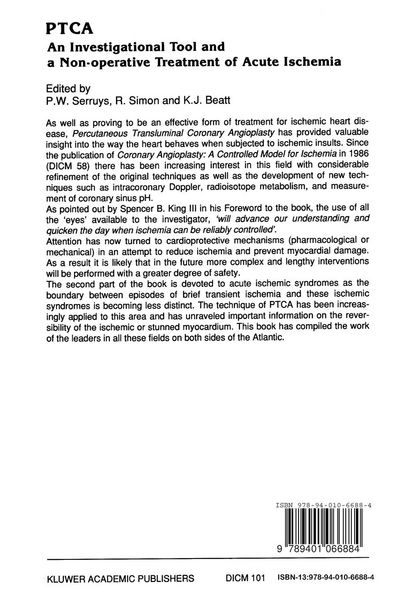
  • Produktbild: PTCA An Investigational Tool and a Non-Operative Treatment of Acute Ischemia
Band 101

PTCA An Investigational Tool and a Non-Operative Treatment of Acute Ischemia

48,99 €

inkl. gesetzl. MwSt., Versandkostenfrei


Beschreibung

Produktdetails

Einband

Taschenbuch

Erscheinungsdatum

20.09.2011

Abbildungen

400 p.

Herausgeber

P.W. Serruys + weitere

Verlag

Springer Netherland

Seitenzahl

400

Maße (L/B/H)

23,5/15,5/2,4 cm

Gewicht

657 g

Auflage

Softcover reprint of the original 1st ed. 1990

Sprache

Englisch

ISBN

978-94-010-6688-4

Beschreibung

Rezension

`
... durch die hervorragende Aufmachung and übersichtliche Gestaltung. Für jeden Kardiologen und Herzchirurgen ein unentbehrliches Werk, das den neuesten Stand dieser Behandlungsmethode aufzeigt.
'


Herz/Kreislauf
, 23/1, 1991


Produktdetails

Einband

Taschenbuch

Erscheinungsdatum

20.09.2011

Abbildungen

400 p.

Herausgeber

Verlag

Springer Netherland

Seitenzahl

400

Maße (L/B/H)

23,5/15,5/2,4 cm

Gewicht

657 g

Auflage

Softcover reprint of the original 1st ed. 1990

Sprache

Englisch

ISBN

978-94-010-6688-4

Herstelleradresse

Springer-Verlag KG
Sachsenplatz 4-6
1201 Wien
AT

Email: ProductSafety@springernature.com

Noch keine Bewertungen vorhanden

Verfassen Sie die erste Bewertung zu diesem Artikel

Helfen Sie anderen Kundinnen und Kunden durch Ihre Meinung.

Kundinnen und Kunden meinen

Bewertungen (0)

  • Produktbild: PTCA An Investigational Tool and a Non-Operative Treatment of Acute Ischemia
  • Produktbild: PTCA An Investigational Tool and a Non-Operative Treatment of Acute Ischemia
  • One: An Investigational Tool.- From in-vitro to in-vivo model.- 1. Myocardial ischemia: Early adjustment and reversibility.- 2. Early changes in wall thickness and epicardial wall motion during percutaneous transluminal coronary angioplasty in man: Similarities with in-vitro and in-vivo model.- 3. Early mechanical changes associated with coronary artery Occlusion.- Electrocardiographic changes.- 4. Coronary angiographic and hemodynamic determinants of ST-segment response to acute coronary occlusion.- 5. Dynamic appearance of collaterals during coronary occlusion and their impact on electrocardiographic changes and wall motion abnormalities.- Role of collaterals during PTCA.- 6. Collaterals and coronary wedge pressure.- Coronary flow and flow reserve.- 7. Intracoronary blood flow velocity, reactive hyperemia and coronary blood flow reserve during and following PTCA.- Myocardial metabolism.- 8. Loss of hydrogen and potassium ions after short periods of myocardial ischaemia in man.- 9. Myocardial release of hypoxanthine and lactate during coronary angioplasty: A quickly reversible phenomenon, but for how long?.- 10. Myocardial release of hypoxanthine and urate during angioplasty: Potential mechanism for free radical generation.- 11. Regional myocardial nitrogen-13-glutamate uptake following successful coronary angioplasty.- Myocardial function.- 12. Left atrial function in acute transient ischemia on the left ventricle.- 13. Left ventricular filling during acute ischemia.- 14. Left ventricular function during acute coronary artery balloon occlusion in humans.- 15. Use of intravenous DSA in the assessment of LV performance during PTCA.- 16. Two dimensional echocardiography during PTCA.- 17. Doppler echocardiographic assessment of left ventricular function during PTCA.- 18.Ejection filling and diastasis during transluminal occlusion in man: Consideration on global and regional left ventricular function.- Therapeutic effects.- 19. Myocardial ischemia during PTCA: Consequences and treatment strategies.- 20. Does Diltiazem protect the ischemic myocardium during PTCA?.- 21. Influence of anti-ischemic drug treatment on the ischemic response to acute coronary occlusion in man.- 22. Cardioprotective effects of coronary sinus retroperfusion during LAD angioplasty.- Two: Non-Operative Treatment of Acute Ischemia.- 23. Coronary angioplasty for unstable angina pectoris.- 24. Coronary angioplasty in patients with non-Q wave myocardial infarction.- 25. Thrombolytic therapy and PTCA in acute myocardial thrombosis.- 26. The United States thrombolysis and angioplasty trials for acute myocardial infarction.