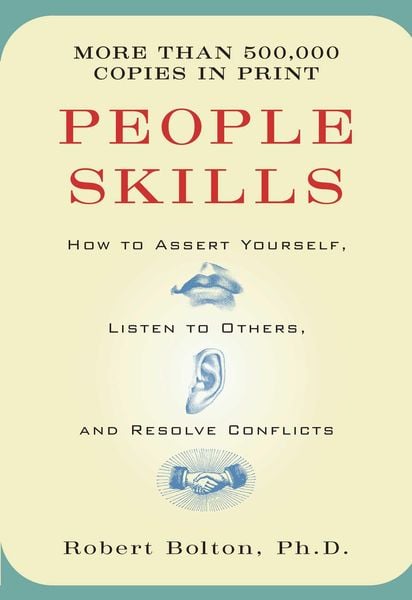
People Skills How to Assert Yourself, Listen to Others, and Resolve Conflicts
-
- Taschenbuch
- eBook ausgewählt
-
Form:Einzelkauf Download
-
Sprache:Englisch
14,83 €
inkl. gesetzl. MwSt.Beschreibung
Produktdetails
Format
ePUB
Kopierschutz
Ja
Family Sharing
Ja
Text-to-Speech
Ja
Erscheinungsdatum
24.11.2009
Verlag
Simon + Schuster LLCSeitenzahl
324 (Printausgabe)
Dateigröße
3298 KB
Sprache
Englisch
EAN
9781439188347
Improve your personal and professional relationships instantly with this timeless guide to communication, listening skills, body language, and conflict resolution.
Maybe a wall of silent resentment has shut you off from someone you love. Maybe you listen to an argument in which neither party seems to hear the other. Or maybe your mind drifts to other matters when people talk to you. People Skills is a communication skills handbook that can help you eliminate these and other communication problems. Author Robert Bolton describes the twelve most common communication barriers, showing how these "roadblocks" damage relationships by increasing defensiveness, aggressiveness, or dependency. He explains how to acquire the ability to listen, assert yourself, resolve conflicts, and work out problems with others. These are skills that will help you communicate calmly, even in stressful emotionally charged situations.
People Skills will show you:
-How to get your needs met using simple assertion techniques
-How body language often speaks louder than words
-How to use silence as a valuable communication tool
-How to de-escalate family disputes, lovers' quarrels, and other heated arguments
Both thought-provoking and practical, People Skills is filled with workable ideas that you can use to improve your communication in meaningful ways, every day.
Maybe a wall of silent resentment has shut you off from someone you love. Maybe you listen to an argument in which neither party seems to hear the other. Or maybe your mind drifts to other matters when people talk to you. People Skills is a communication skills handbook that can help you eliminate these and other communication problems. Author Robert Bolton describes the twelve most common communication barriers, showing how these "roadblocks" damage relationships by increasing defensiveness, aggressiveness, or dependency. He explains how to acquire the ability to listen, assert yourself, resolve conflicts, and work out problems with others. These are skills that will help you communicate calmly, even in stressful emotionally charged situations.
People Skills will show you:
-How to get your needs met using simple assertion techniques
-How body language often speaks louder than words
-How to use silence as a valuable communication tool
-How to de-escalate family disputes, lovers' quarrels, and other heated arguments
Both thought-provoking and practical, People Skills is filled with workable ideas that you can use to improve your communication in meaningful ways, every day.
Kundinnen und Kunden meinen
Verfassen Sie die erste Bewertung zu diesem Artikel
Helfen Sie anderen Kund*innen durch Ihre Meinung
Kurze Frage zu unserer Seite
Vielen Dank für dein Feedback
Wir nutzen dein Feedback, um unsere Produktseiten zu verbessern. Bitte habe Verständnis, dass wir dir keine Rückmeldung geben können. Falls du Kontakt mit uns aufnehmen möchtest, kannst du dich aber gerne an unseren Kund*innenservice wenden.
zum Kundenservice