Gutscheinbedingungen

**Gültig bis 10.06.2026 / Gültig für gebrauchte Bücher / Mindestbestellwert 20,00 € / Einzelne Artikel können ausgeschlossen sein / Online auf www.bücher.de.de / Nicht kombinierbar mit anderen Gutscheinen oder Preisaktionen / Nur einmal pro Einkauf einlösbar / Gutschein wird auf max. 500€ Bestellwert angerechnet / Keine Barauszahlung / Nicht gültig für Versandkosten und Services

  • Produktbild: Design Issues in CSCW
  • Produktbild: Design Issues in CSCW

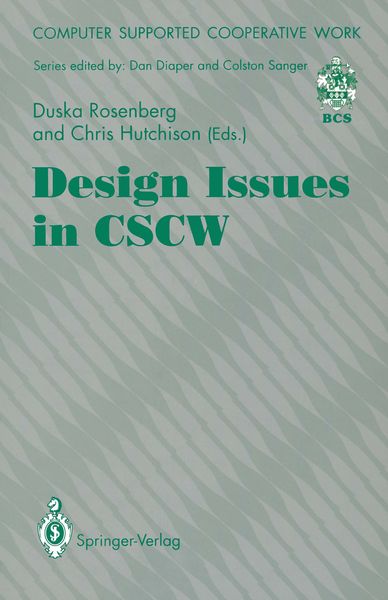
Design Issues in CSCW

48,99 €

inkl. gesetzl. MwSt., Versandkostenfrei

Lieferung nach Hause

Beschreibung

Produktdetails

Einband

Taschenbuch

Erscheinungsdatum

30.09.1994

Herausgeber

Duska Rosenberg + weitere

Verlag

Springer Berlin

Seitenzahl

321

Maße (L/B/H)

23,5/15,5/1,9 cm

Gewicht

506 g

Auflage

1st Edition.

Sprache

Englisch

ISBN

978-3-540-19810-9

Beschreibung

Produktdetails

Einband

Taschenbuch

Erscheinungsdatum

30.09.1994

Herausgeber

Verlag

Springer Berlin

Seitenzahl

321

Maße (L/B/H)

23,5/15,5/1,9 cm

Gewicht

506 g

Auflage

1st Edition.

Sprache

Englisch

ISBN

978-3-540-19810-9

Herstelleradresse

Springer Heidelberg
Tiergartenstr. 17
69121 Heidelberg
DE
[email protected]

Kundinnen und Kunden meinen

0 Bewertungen

Informationen zu Bewertungen

Zur Abgabe einer Bewertung ist eine Anmeldung im Konto notwendig. Die Authentizität der Bewertungen wird von uns nicht überprüft. Wir behalten uns vor, Bewertungstexte, die unseren Richtlinien widersprechen, entsprechend zu kürzen oder zu löschen.

Die Bewertungen sind nach Format, Anzahl Sterne und Datum sortiert.

Verfassen Sie die erste Bewertung zu diesem Artikel

Helfen Sie anderen Kund*innen durch Ihre Meinung

Kundinnen und Kunden meinen

0 Bewertungen filtern

  • Produktbild: Design Issues in CSCW
  • Produktbild: Design Issues in CSCW
  • 1 Introduction.- 2 Computer Supported Cooperative Work: A Framework.- 2.1 Introduction.- 2.2 Cooperative Work.- 2.2.1 Cooperation.- 2.2.2 Work.- 2.2.3 Communication through the Artefact.- 2.2.4 Understanding: Soft and Hard Artefacts.- 2.2.5 Deixis.- 2.3 Computer Support: Communication.- 2.3.1 Computer Mediated Communication.- 2.3.2 Anti-CMC.- 2.4 Computerized Artefacts of Work.- 2.5 Non-Computerized Artefacts.- 2.5.1 Prosthesis.- 2.5.2 Implications for Design.- 2.5.3 Success Story: Bar Codes.- 2.6 Summary.- 3 Capturing Interactions: Requirements for CSCW.- 3.1 Design Issues for CSCW.- 3.1.1 The Life-Cycle Framework.- 3.2 Ethnographic Study of Office Work.- 3.3 Case Study of a Technical Publications Unit.- 3.3.1 Organizational Description.- 3.3.2 Authors’ Views on their Work.- 3.3.3 Life History of a Job.- 3.3.4 Job Conditions.- 3.3.5 Interaction Episodes.- 3.4 The Analysis.- 3.4.1 Strategy.- 3.4.2 Classification of Activities.- 3.5 Conclusions.- 3.5.1 What the Authors Want.- 3.5.2 What the Analysis Found.- 3.5.3 In Conclusion.- 4 Situation Theory and the Design of Interactive Information Systems.- 4.1 Introduction.- 4.2 Information.- 4.3 On Mathematics, Metaphor and Design.- 4.4 Situation Theory: A Review.- 4.5 Normative Constraints and Cognition.- 4.6 Information, Situations and Design.- 4.7 Multimedia and Multi-User.- 4.8 The Role of Situation Theory.- 4.9 Conclusion.- 5 Patterns of Language in Organizations: Implications for CSCW.- 5.1 Introduction.- 5.1.1 Aims.- 5.1.2 The Sopwith Case Study.- 5.2 Four Models of Linguistic Support for Collaborative Work.- 5.2.1 Language and Information.- 5.2.2 Sociometric Analysis.- 5.2.3 Style Checkers: Form versus Content.- 5.2.4 Language and Reality: An Overview of Systemic Functional Linguistics.- 5.2.5 Language, Information and Organizations.- 5.3 Conclusions.- Appendix A.- A.1 The Message from Leyland.- A. 2 How the Sunday Times Rewrote It.- Appendix B.- B.1 Alcatraz on the Third Floor or Communications and Information Free of Time and Space (CIFTS!).- 6 Coordination Issues in Tools for CSCW.- 6.1 Introduction.- 6.2 Early Experiences with CSCW.- 6.3 Cognitive Issues in CSCW.- 6.4 Conversation Analysis.- 6.4.1 Turn Management in Conversations.- 6.4.2 An Example of Conversation Analysis.- 6.5 Coordination in CSCW.- 6.6 Studies of Turn Management in CSCW.- 6.7 Discussion.- 6.8 Concluding Remarks.- Appendix A.- A.1 Annotated Bibliography.- 7 Software Engineering Design: A Paradigm Case of Computer Supported Cooperative Working.- 7.1 Introduction.- 7.1.1 What is Design Theory?.- 7.1.2 Is Design a Natural Phenomenon?.- 7.1.3 A View of Design from Cognitive Science.- 7.2 Use of Abstract Representations.- 7.2.1 Implications for Design Methods and Tool Support.- 7.2.2 Philosophical Issues: Are they relevant?.- 7.2.3 The Role of Concepts in Structuring Knowledge.- 7.3 The Design Frameworks Approach.- 7.4 An Approach to Design-for-Reuse.- 7.4.1 Considerations Regarding the Use of Frameworks in Design.- 7.5 Conclusions.- 8 Where Are Designers? Styles of Design Practice, Objects of Design and Views of Users in CSCW.- 8.1 Design as Technique, as Social Function and as Politics.- 8.2 Three Interpretations of the Significance of “Users”.- 8.3 Users as Clients: The “Specify and Deliver” Style.- 8.4 Users as Codesigners: The “Reflect and Reinterpret” Style.- 8.5 Users as Actor-Constructors: The “Enable and Empower” Style.- 8.6 Where are Designers? The Geo-Economic “Location” Problem.- 8.7 Taking Design with Us.- 9 Coping with Complexity and Interference: Design Issues in Multimedia Conferencing Systems.- 9.1 Introduction.- 9.2 The CAR Multimedia Conferencing System.- 9.3 Design Principles.- 9.3.1 WYSIWIS.- 9.3.2 Seamlessness.- 9.4 Design and Usability Issues.- 9.4.1 Screen Clutter.- 9.4.2 Unexpected Events.- 9.4.3 Notification of Events.- 9.4.4 Floor Control.- 9.4.5 Pointers.- 9.5 Discussion: Design Principles for Multimedia Conferencing.- 9.6 Conclusions.- 10 The Role of Replication in the Development of Remote CSCW Systems.- 10.1 Designing for the Future.- 10.1.1 The System Designer as Creative Problem Solver.- 10.1.2 The Difficulty of Exchanging Creation for Facilitation.- 10.1.3 Single-User Product Innovation.- 10.2 Designing for the Present: Replication.- 10.3 An Experiment in Replication.- 10.3.1 The ROCOCO Station.- 10.3.2 User Interface.- 10.4 Evaluating the System.- 10.4.1 The LookingGlass.- 10.4.2 An Investigation of the LookingGlass in Use.- 10.5 Conclusion.- 11 Computer Supported Conflict Management in Design Teams.- 11.1 The Challenge: Supporting Collaboration in Design Groups.- 11.2 Contributions and Limitations of Existing Work.- 11.3 The Design Collaboration Support System.- 11.3.1 Describing Design Actions and Rationale.- 11.3.2 Detecting Conflicts.- 11.3.3 Resolving Conflicts.- 11.4 Evaluation and Future Work.- 12 ShareLib: A Toolkit for CSCW Applications Programming Using X Windows.- 12.1 Introduction.- 12.2 Existing Applications.- 12.3 Other Similar Work.- 12.4 What Programming Support Should Provide.- 12.4.1 Features of CSCW.- 12.4.2 Tailorability.- 12.5 Design of ShareLib: Architecture.- 12.5.1 A New Level of Abstraction.- 12.5.2 Features and Tailorability Provided by the CSCW Layer.- 12.6 Design of ShareLib: Implementation.- 12.6.1 The X Window System.- 12.6.2 ShareLib as a Layer above X Windows.- 12.7 Example Implementation: The Telepointer.- 12.7.1 Writing Xlib Applications.- 12.7.2 The Telepointer Type.- 12.7.3 Initializing the Telepointer.- 12.7.4 Processing Telepointer Events.- 12.7.5 Floor Control.- 12.7.6 Drawing the Telepointer Pixmap.- 12.8 Summary and Further Work.- 13 Adapting a Design History Editor for Concurrent Engineering.- 13.1 Introduction.- 13.1.1 Motivation.- 13.1.2 Starting Point.- 13.1.3 Outline of the DHE Work.- 13.2 Design History Editor.- 13.2.1 Inherent Difficulties with Current Approaches.- 13.2.2 Conventional Logbooks and Hypertext.- 13.2.3 The Impact of Prescription.- 13.3 User Requirements of the Design History Editor.- 13.3.1 Page Emulation.- 13.3.2 Representation of Finer Structure.- 13.3.3 The Lemma.- 13.4 Technology.- 13.4.1 The SMART Frame Server.- 13.4.2 The Blackboard Architecture.- 13.4.3 Managing Knowledge Assets.- 13.4.4 Khoros.- 13.5 Technology Transfer.- 13.6 Concluding Remarks.- 14 “Nouvelle Design”: A Pragmatic Approach to CSCW Systems Building.- 14.1 Introduction.- 14.2 Background.- 14.3 Conversation Analysis.- 14.4 User Centred Design.- 14.5 Requirements Capture ? Structured Observation.- 14.5.1 Basic System Functionality.- 14.5.2 Prototyping.- 14.5.3 Evaluation.- 14.5.4 Subject Selection.- 14.5.6 Types of Data.- 14.6 System Specification ? Analyse Observations.- 14.6.1 Aims of Analysis Phase.- 14.6.2 Data Analysis.- 14.7 Build and Release ? Review, Interpret, Modify.- 14.7.1 Aims of this Phase.- 14.8 Application of the Design Process.- 14.8.1 Programme.- 14.8.2 Evaluation.- 14.9 Summary and Conclusions.- References.- Name Index.